AI Spec Sheet Extraction: 85-90% Accuracy, Mobile
Robotic ImagingMarch 26, 2026
AI Spec Sheet Extraction from Equipment Photos
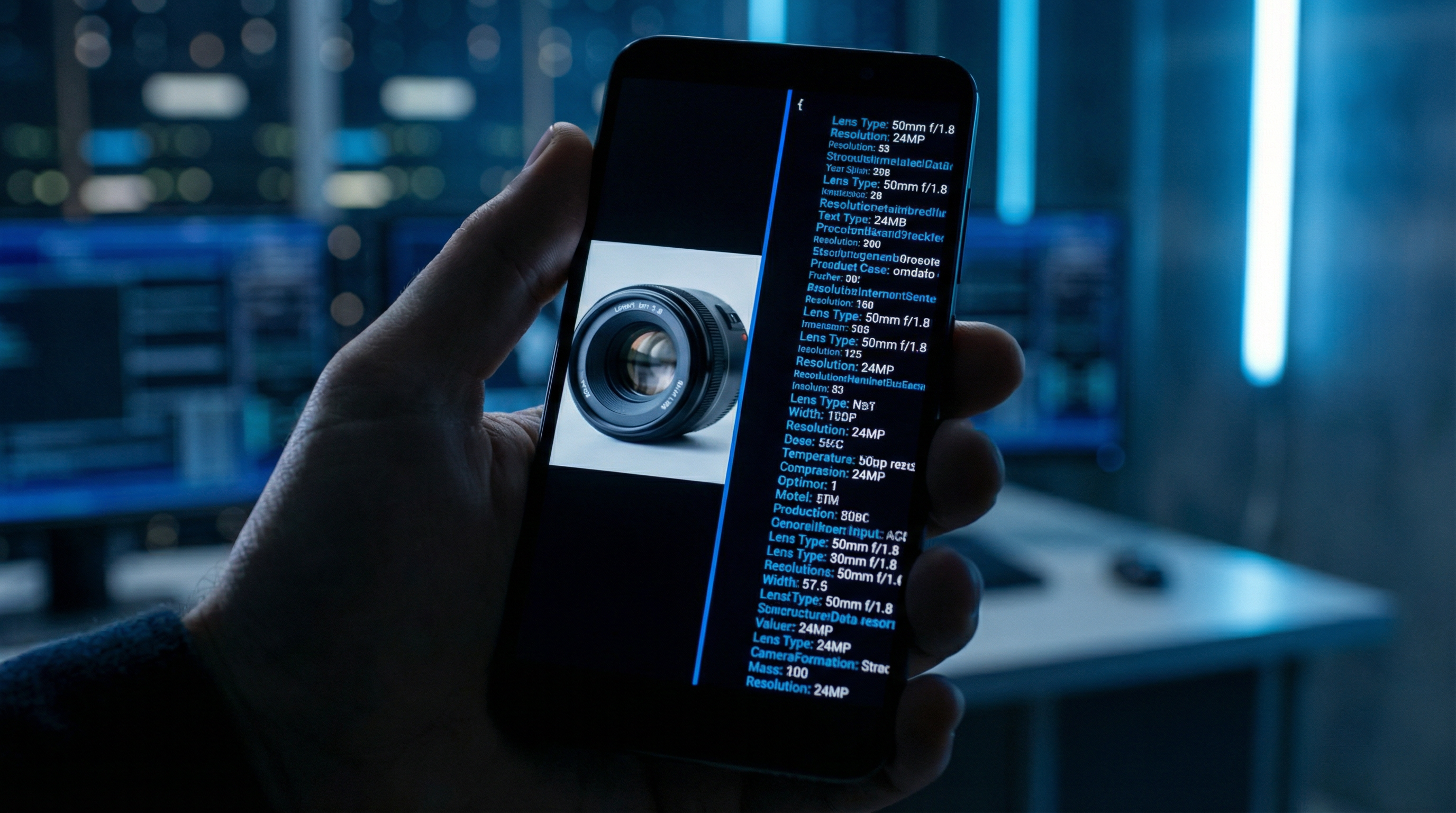
For IT Managers and Facility Directors managing multi-location retail portfolios, equipment data accuracy starts at the nameplate. Robotic Imaging's AI spec sheet extraction from equipment photos automates this process — using optical character recognition (OCR) and specification database matching to extract manufacturer, model number, serial number, and technical specifications from smartphone photos at 85-90% automated accuracy, eliminating the manual data entry bottleneck that makes portfolio-wide asset documentation operationally infeasible at scale.
The result: a 100-equipment portfolio documented in 10-15 minutes instead of 5-8 hours, with consistent data quality across every location regardless of which staff member holds the phone.
The Manual Data Entry Bottleneck at Scale
Every equipment nameplate contains the data that drives maintenance scheduling, parts procurement, warranty validation, and capital planning. The problem isn't that this data is unavailable — it's stamped directly onto every Hussmann refrigeration case, every Carrier RTU, every Square D electrical panel in your portfolio. The problem is getting it out accurately and consistently across hundreds of locations.
Manual transcription at scale fails on two dimensions. First, it's slow: a technician typing specifications from a nameplate takes 3-5 minutes per unit. Across a 100-location portfolio with 50 equipment items per site, that's a full-time documentation project — before accounting for errors, inconsistencies between staff members, and the compounding cost of wrong data downstream. Second, it's inconsistent: different staff abbreviate model numbers differently, skip fields they don't recognize, or transpose digits under time pressure.
Professional audit services solve the consistency problem but introduce a cost problem: $5K-15K per location for a specialist team to document assets systematically. For a 200-location chain, that's a $1M-3M audit program before any remediation work begins.
Robotic Imaging's platform addresses both problems simultaneously. AI spec sheet extraction from equipment photos converts smartphone photos into structured asset records automatically, at 85-90% accuracy, with a quality control mechanism that handles the exceptions without returning the workload to manual entry.
> Request an AI Extraction Demo — see how Robotic Imaging's spec extraction performs on your equipment types before committing to deployment.
How OCR Technology and Nameplate Recognition Work
Understanding the technical mechanism helps IT Managers evaluate the accuracy claims with appropriate confidence — and explains why this approach outperforms generic OCR tools that fail on equipment nameplates.
Equipment nameplate recognition combines three processing layers within Robotic Imaging's platform:
Layer 1: Image Pre-Processing The native iOS and Android apps apply real-time image analysis before capture — adjusting for lighting conditions, detecting motion blur, identifying nameplate boundaries within the frame. This pre-processing step is what separates purpose-built nameplate reading technology from generic document scanning: the model is trained specifically on the visual characteristics of metal nameplates, label deterioration patterns, and reflective surfaces common in refrigeration and HVAC equipment environments.
Layer 2: OCR Text Extraction Optical character recognition reads the pre-processed image, converting nameplate text into structured data fields. The OCR engine within Robotic Imaging's platform is trained on equipment-specific character sets — handling the embossed text, dot-matrix printing, and partial corrosion patterns that cause consumer OCR tools to fail. Manufacturer codes, model number formats, serial number structures, and specification notation conventions are all encoded into the extraction model.
Layer 3: Specification Database Matching Raw text extraction alone produces incomplete records — a model number means nothing without the associated specifications. Robotic Imaging's specification database matches extracted model numbers against manufacturer databases to auto-populate complete equipment records: full specification sheets, refrigerant types, tonnage ratings, voltage requirements, and part compatibility data that don't appear on the nameplate at all.
This three-layer architecture — OCR equipment data extraction plus database enrichment — is why the platform produces actionable asset records rather than raw nameplate transcriptions.
Extractable Specifications by Equipment Type
IT Managers evaluating platforms against a specific retail equipment portfolio need concrete confirmation: does the system actually capture the specifications that matter for service calls, maintenance scheduling, and capital planning? Robotic Imaging's AI spec sheet extraction from equipment photos covers the three primary equipment categories in retail environments.
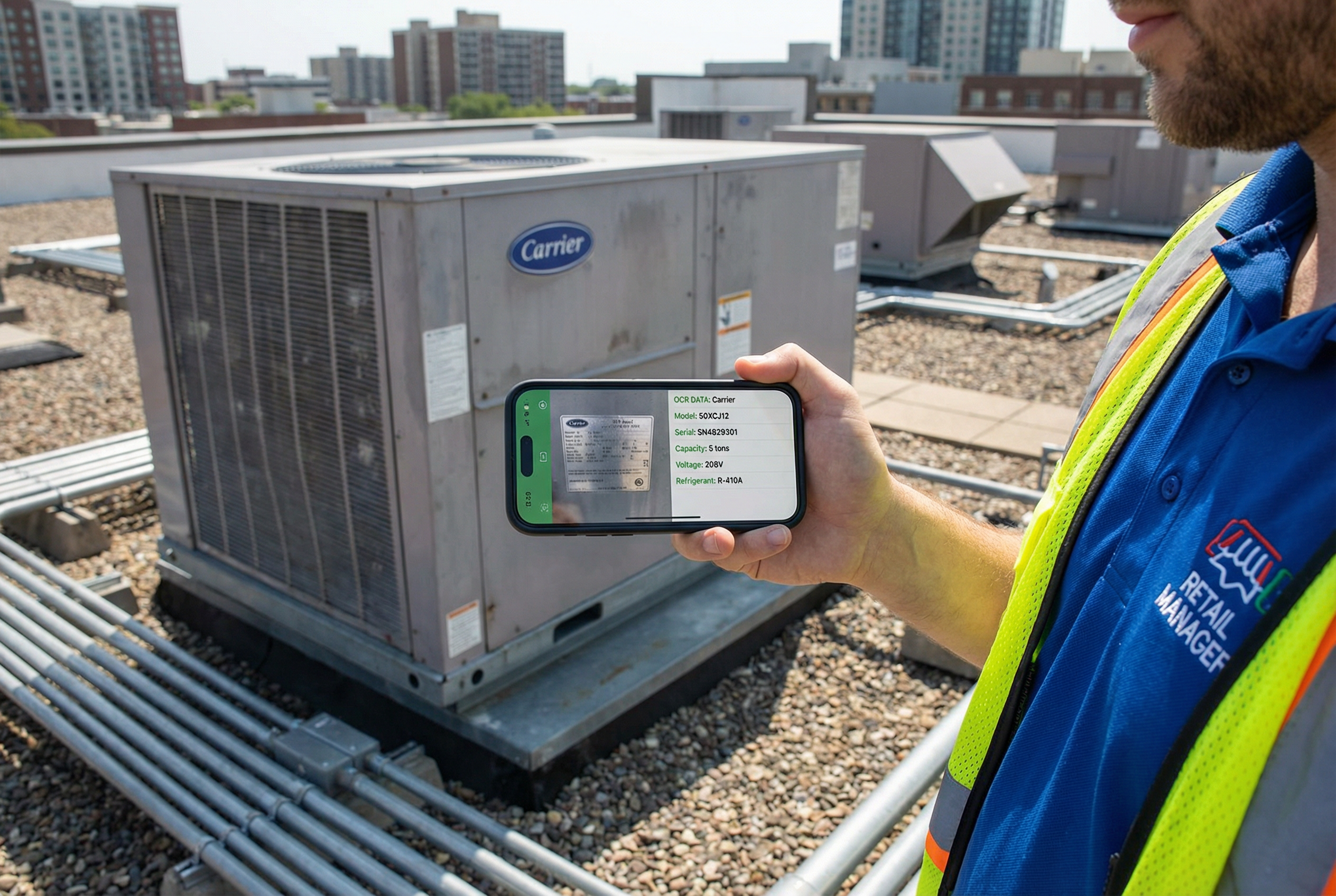
Refrigeration Equipment Hussmann, Tyler, Hill Phoenix, and Anthony cases — including walk-in cooler systems and reach-in display cases. Extracted specifications include: manufacturer, model number, serial number, refrigerant type (R-404A, R-448A, R-290), compressor tonnage, BTU rating, voltage and amperage requirements, and manufacture date. For multi-temperature cases, the system captures both circuit configurations from a single nameplate image.
HVAC Equipment Carrier, Trane, Lennox, and York rooftop units. Extracted specifications include: manufacturer, model number, serial number, cooling and heating capacity (tons and BTUs), voltage configuration (208/230/460V), refrigerant type, filter specifications, and unit weight for load planning. The automated spec recognition accounts for the weathered nameplate conditions common on rooftop equipment — partial corrosion and UV degradation patterns that cause standard OCR to fail are flagged rather than guessed.
Electrical Equipment Square D, Eaton, and Siemens panels and equipment. Extracted specifications include: manufacturer, model number, serial number, amperage rating, voltage configuration, phase type (single/three), NEMA enclosure rating, and circuit count. Electrical specification accuracy is critical for safety compliance documentation — Robotic Imaging's extraction model prioritizes amperage and voltage fields with highest-confidence thresholds.
The 7-Eleven deployment across 1,000+ sites demonstrates this equipment type diversity in production: convenience store locations include refrigeration cases, HVAC units, and electrical equipment across a single site, all documented within a single workflow using AI asset data extraction.
Accuracy Specifications and Confidence Scoring
The 85-90% automated extraction accuracy metric answers one question. The confidence scoring mechanism answers the more important one: what happens to the other 10-15%?
How Accuracy Is Measured Robotic Imaging's 85-90% automated extraction rate means that 85-90% of equipment photos submitted through the platform produce complete, verified asset records without human intervention. This metric is measured against complete specification records — not partial extractions — and improves as the AI model learns from deployment data. At 12 months of deployment, accuracy improves to 90%+ as the model incorporates equipment-specific patterns from each customer's portfolio.
How Confidence Scoring Works Every AI extraction produces a confidence score alongside the extracted data. When the model's confidence in one or more fields falls below the threshold — due to nameplate damage, unusual character formatting, lighting artifacts, or equipment types underrepresented in the training data — the extraction is automatically flagged rather than submitted as complete.
Flagged extractions enter a human review queue within the platform interface. Reviewers see the original photo alongside the extracted data and the specific fields triggering low confidence, allowing targeted correction rather than full re-entry. This workflow processes the 10-15% exception volume efficiently — typically 30-60 seconds per flagged record versus the 3-5 minutes required for full manual entry.
The confidence scoring mechanism is itself a trust signal: a system that knows when it's uncertain and escalates transparently is more reliable than one that submits all extractions with equal claimed confidence regardless of actual extraction quality.
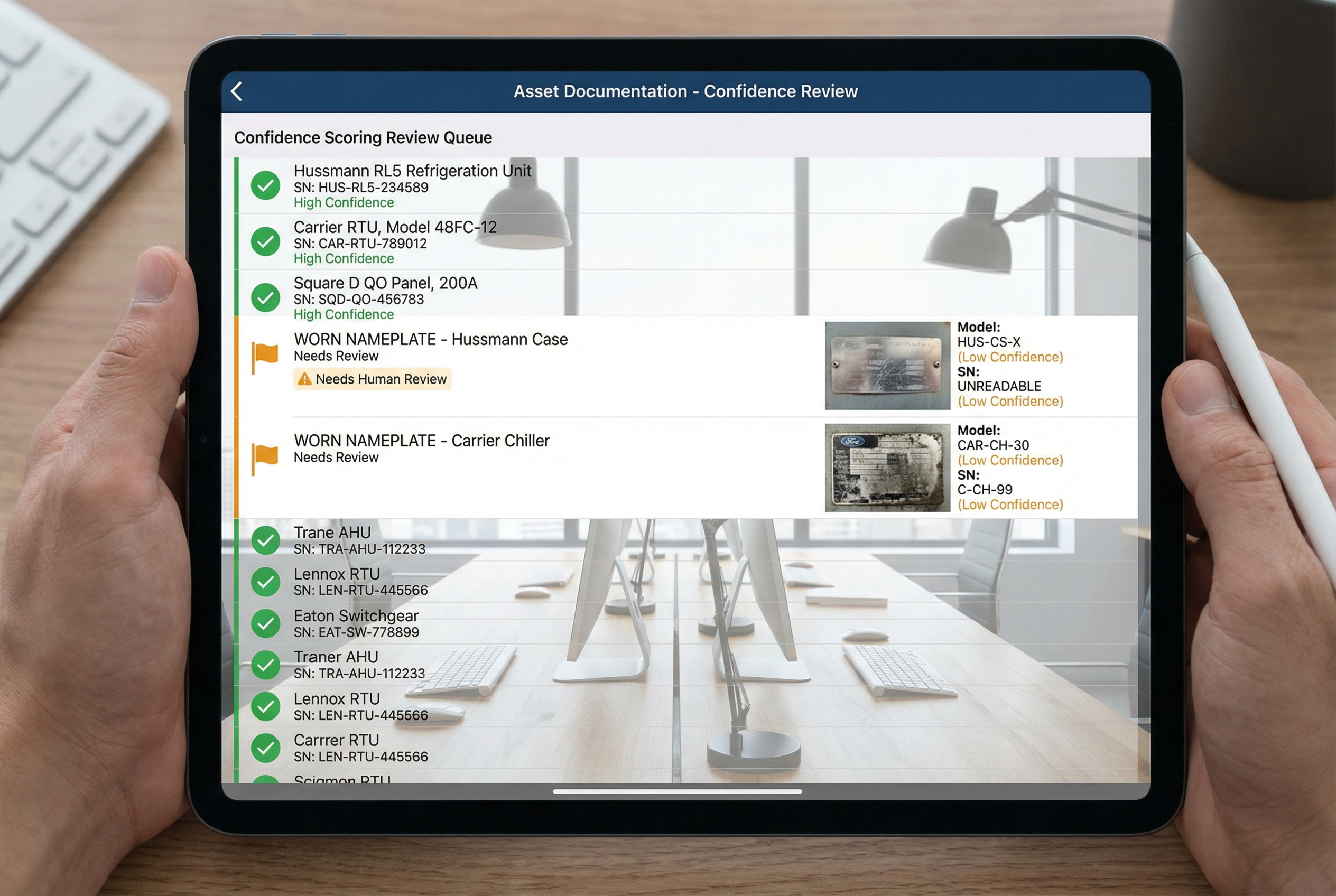
On Worn and Faded Nameplates This is the objection that surfaces in every technical evaluation: "Our equipment nameplates are worn, dirty, or partially legible — OCR won't work." The confidence scoring architecture directly resolves this concern. A worn nameplate doesn't produce a wrong record — it produces a flagged record. The system identifies which specific fields it couldn't read with confidence and queues only those for human review. The result is the same quality-controlled asset record, through a slightly longer path.
Photo Quality Requirements and Real-Time Guidance
"Garbage in, garbage out" is a legitimate concern when store-level staff — not trained technicians — are executing the documentation workflow. Robotic Imaging's platform addresses this through in-app guidance that operates before capture, not after.
The native iOS and Android apps provide real-time photo feedback during the capture process:
- Frame alignment: Visual overlay indicates when the nameplate fills the required percentage of frame
- Blur detection: Real-time motion blur alert prevents capture until the image stabilizes
- Lighting assessment: Automatic flash activation or exposure adjustment for low-light back-of-house environments
- Distance calibration: Proximity indicator ensures nameplate text resolution meets extraction requirements
This guidance system means the quality standard for nameplate recognition is enforced at capture — not discovered during post-processing when recapture requires another store visit. Staff don't need to understand OCR requirements; they follow the app prompts until the capture indicator confirms.
The practical implication for Facility Directors: documentation tasks can be assigned to store managers during regular facility walks without specialist training. The 7-Eleven deployment validated this at scale — 1,000+ locations with non-technical store staff executing the capture workflow.
For genuinely inaccessible nameplates — equipment in confined spaces, overhead installations, or heavily corroded units — the platform supports barcode and QR scanning as an alternative capture path, with manual entry as the fallback within the same workflow interface.
Specification Database Integration and Record Enrichment
The difference between raw OCR equipment data and a complete asset record is specification database depth. Robotic Imaging's platform integrates with manufacturer specification databases to auto-populate fields that don't appear on the nameplate.
When a model number extraction returns a high-confidence match, the platform queries its specification database and returns:
- Complete part compatibility lists for maintenance planning
- Filter specifications and replacement intervals
- Refrigerant charge quantities and circuit configurations
- Warranty period lookup by manufacture date and serial number
- Service manual cross-references
This enrichment layer converts a nameplate photo into a fully populated asset record — eliminating the follow-up research step where technicians look up specifications in manufacturer documentation after completing field capture.
For CMMS integration, extracted and enriched records export in standard formats compatible with major work order management systems. Robotic Imaging's platform supports structured data export that maps to asset fields in existing maintenance management environments, with API integration options for automated record synchronization. IT Managers evaluating integration fit should assess the platform against their specific CMMS data schema — the output structure is configurable to match existing asset record formats.
Manual Data Entry Elimination: The ROI Case
The ROI calculation for AI spec sheet extraction from equipment photos is straightforward at scale:
| Metric | Manual Entry | AI Extraction |
|---|---|---|
| Time per equipment unit | 3-5 minutes | 5-10 seconds |
| 100-unit portfolio | 5-8 hours | 10-15 minutes |
| Speed advantage | — | 30-60x faster |
| Error rate | Variable by staff | 85-90% first-pass accuracy |
| Exception handling | Full re-entry | Confidence-scored queue |
For a 200-location portfolio with 50 equipment items per site — 10,000 total units — manual entry at 4 minutes average equals 667 hours of documentation labor. AI extraction reduces that to 17-25 hours, with exception review adding roughly 25-35 additional hours for the 1,000-1,500 flagged records. Total: under 60 hours versus 667 hours. At fully-loaded labor rates, the difference exceeds the platform investment within the first documentation cycle.
Against professional audit services at $5K-15K per location, the math is more dramatic. A 200-location documentation program at $10K average costs $2M. AI-enabled self-service documentation at enterprise platform pricing recovers that gap within months, not years.
> See AI extraction in action. Schedule a focused demo with Robotic Imaging to evaluate extraction accuracy against your specific equipment portfolio before committing to deployment.
Conclusion: Accurate Asset Records at Portfolio Scale
AI spec sheet extraction from equipment photos solves the foundational problem in multi-location asset management: getting accurate, complete equipment data out of distributed facilities without the labor cost of manual entry or the budget requirements of professional audit programs.
Robotic Imaging's platform delivers 85-90% automated extraction accuracy through a three-layer architecture — OCR nameplate recognition, confidence-scored quality control, and specification database enrichment — validated across 1,000+ 7-Eleven locations spanning refrigeration, HVAC, and electrical equipment portfolios.
For IT Managers evaluating platforms against technical accuracy requirements, the confidence scoring mechanism is the key differentiator: a transparent quality control workflow that handles exceptions systematically rather than obscuring them behind aggregate accuracy claims.
For Facility Directors prioritizing operational feasibility, the real-time photo guidance system means store-level staff can execute documentation during regular facility walks — no specialist required, no additional site visits, no documentation backlog accumulating across your portfolio.
> Ready to evaluate AI extraction for your equipment portfolio? Request a platform demo or download the AI Accuracy Guide to see extraction performance data by equipment type.