Capital Forecasting: CFO Asset Management Platform
Robotic ImagingApril 14, 2026
CFO Mobile Asset Platform for Capital Planning and Budget Forecasting
For CFOs managing equipment capital budgets across hundreds of retail locations, the fundamental problem is not a lack of budget data — it is a lack of verified equipment data to anchor that budget to. Facilities teams submit multi-million dollar replacement requests built on informal surveys, institutional memory, and aging spreadsheets. The CFO approves or challenges those requests with no independent data source to reference. Robotic Imaging's CFO asset management platform addresses this gap directly, delivering mobile capital forecast dashboards built on AI-verified equipment data — giving finance executives the financial intelligence to allocate capital accurately, validate facilities requests, and present defensible 5-year forecasts from any device. Deployments at 7-Eleven across 1,000+ stores and Dollar General's 4,000-location program demonstrate that the platform operates at the scale enterprise retail capital planning demands.
The CFO Capital Planning Challenge in Multi-Location Retail
Equipment capital planning for a 100-to-500-store retail portfolio is a multi-million dollar annual commitment made with structurally incomplete information. The average retail CFO approves $8M or more in annual equipment capital with limited ability to independently verify what actually needs replacing, when, or why.
A CFO asset management platform built for this challenge provides something traditional CMMS, ERP, and FP&A systems do not: capital forecasting anchored to verified equipment age, condition, and replacement cost data. Here is what that distinction means in practice:
> A CFO mobile asset platform for capital planning provides multi-year equipment replacement forecasting with annual budget requirements accessible from tablets, ROI-based capital prioritization ranking investments by store performance and expected returns, budget scenario modeling for what-if analysis during planning meetings, facilities request validation using verified equipment age and condition data, and executive dashboards optimized for mobile review.
The critical constraint most CFOs encounter is not a forecasting methodology problem — their FP&A systems model scenarios well. It is a data foundation problem. Without verified equipment age and condition records, every capital forecast is an estimate compounding uncertainty across hundreds of locations. Robotic Imaging's platform solves this at the data layer first, then delivers the financial intelligence layer on top.
Request a CFO Platform Demo to see how capital forecasting works from verified equipment data.
Mobile Capital Forecast Dashboard

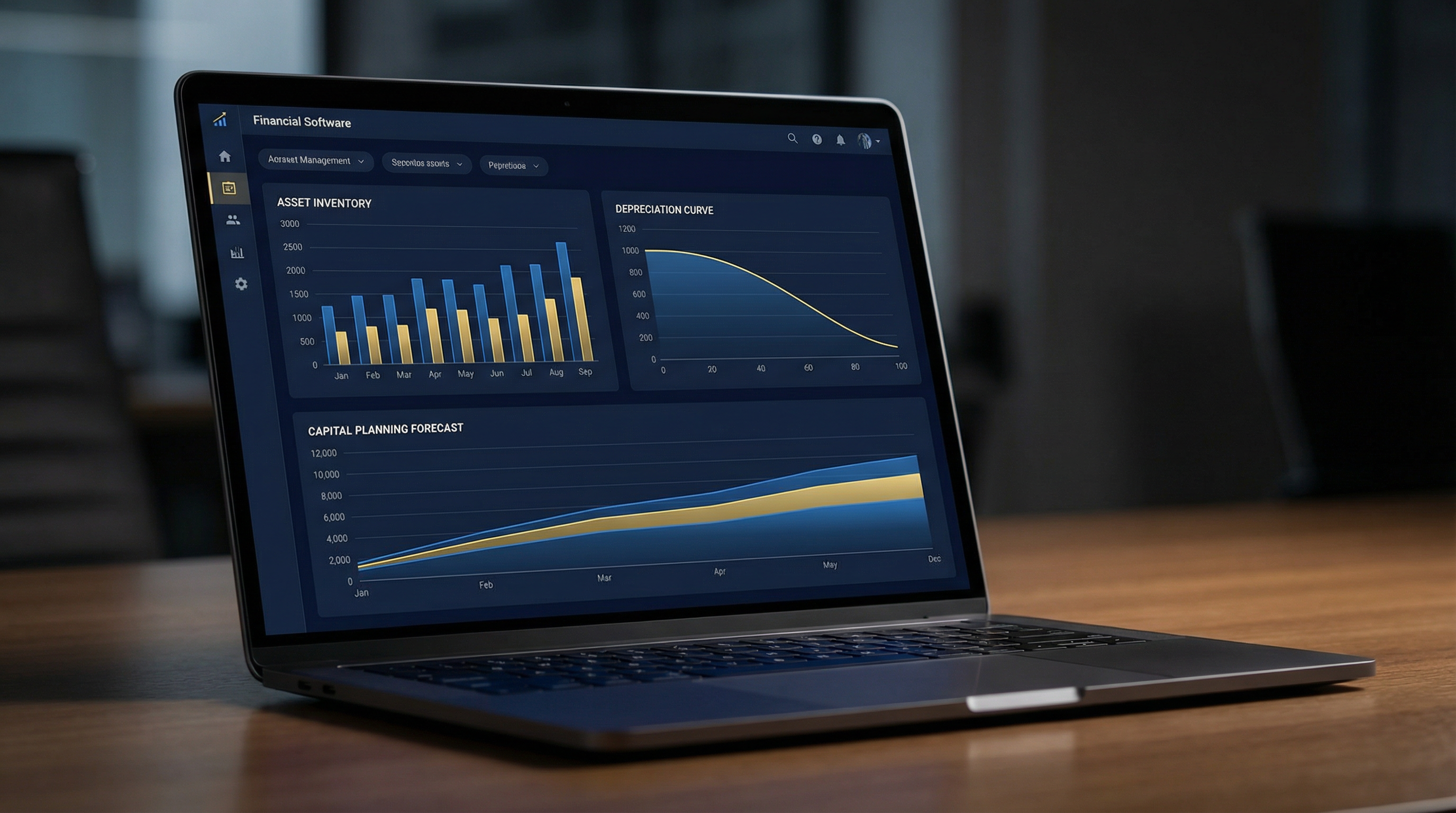
The capital forecast dashboard is where Robotic Imaging's platform makes the clearest departure from operational asset tools. This is not a maintenance schedule — it is a capital planning instrument designed for the finance executive reviewing portfolio-wide equipment investment requirements before a board meeting.
The 5-year capital forecast view aggregates replacement needs across every store in the portfolio, organized by equipment category, location cluster, and annual budget requirement. A 100-store portfolio example showing $40.1M in forecast capital requirements over five years breaks down by HVAC systems, refrigeration units, lighting infrastructure, and secondary equipment — each with annual budget demand visible at a glance. Regional distribution shows which geographic clusters carry the heaviest capital obligation in years two and three, allowing proactive reallocation before budget cycles close.
Confidence tiers are built directly into the forecast methodology. Equipment with complete AI-verified documentation — manufacturer, model, serial number, installation date extracted from on-site photos at 85-90% accuracy — carries high-confidence forecast status (80%+ confidence intervals). Equipment with partial records is flagged at medium confidence, prompting targeted documentation before the annual planning cycle finalizes. This tiering gives CFOs an honest view of forecast reliability, not a false precision built on assumed data.
The board meeting scenario this enables is specific: a CFO opens an iPad, navigates directly to the 5-year capital summary, drills into a regional breakdown showing three underperforming markets with concentrated HVAC replacement needs in year two, and presents that analysis in under 30 seconds. Native iOS and Android apps with sub-2-second load and 60fps scrolling make this scenario real rather than aspirational — enterprise platforms built on responsive web cannot match the performance on tablet hardware that a board meeting environment demands.
Budget forecasting equipment tracking integrates with the capital planning calendar. Monthly refresh cycles update forecast confidence as new store documentation is added, so the forecast a CFO presents in Q4 planning is current, not based on site surveys completed six months earlier.
Equipment Capital Prioritization and ROI Analysis
Capital allocation is a trade-off decision. Every dollar committed to HVAC replacement is a dollar not available for store remodels, technology investment, or inventory. Robotic Imaging's financial asset intelligence layer ranks equipment replacement opportunities by ROI, giving CFOs a prioritization framework that finance leadership can defend to the board.
ROI-based prioritization scores each replacement candidate on four dimensions: remaining useful life versus replacement cost, energy efficiency delta between current and replacement equipment, maintenance cost trajectory on aging assets, and store performance weighting — higher-revenue locations rank replacement urgency higher than equivalent equipment aging in lower-revenue stores. This integration of store financial data with equipment condition data is the analytical differentiation that separates CFO equipment planning from basic asset tracking.
The energy efficiency ROI calculation is particularly compelling for retail portfolios with older refrigeration and HVAC assets. An illustrative example: a 100-store portfolio replacing end-of-life commercial refrigeration units at stores exceeding 15 years of age generates approximately $680K in annual energy savings — a capital investment that pays operational returns within a definable period, not just deferred failure cost. This framing converts capital requests from sunk-cost replacement into positive-return investments with board-presentable ROI.
Maintenance cost reduction provides a parallel ROI stream. Equipment entering its final third of useful life typically generates 20-30% higher maintenance spend than mid-life assets. Robotic Imaging's platform surfaces this cost trajectory at the individual unit level, allowing CFOs to compare the cumulative maintenance spend projection against replacement cost and expected performance gain. The result is a replace-versus-maintain decision supported by actual financial data, not facilities team intuition.
The $600K+ net annual value verified for a 100-store portfolio reflects these combined streams: capital optimization through accurate replacement forecasting, energy efficiency gains from prioritized replacement of aging equipment, and maintenance cost reduction from proactive rather than reactive capital deployment. Payback on platform investment occurs in under two months on this scale — positioning the platform as a financial decision tool with measurable return, not an IT operational expense.
Budget Scenario Modeling on Mobile Tablets
Capital planning rarely produces a single approved budget. Boards challenge assumptions, economic conditions shift between Q3 planning and Q1 approval, and facilities teams revise scope after initial submission. CFOs need a mobile capital planning platform that supports scenario modeling during live planning discussions — not a static export that becomes outdated the moment the meeting starts.
Robotic Imaging's budget scenario modeling generates three parallel capital plans from the same underlying equipment dataset. A base scenario executes all high-confidence replacement needs within standard budget parameters. An accelerated scenario front-loads year-two and year-three replacements into year one, trading higher near-term capital for reduced long-term maintenance exposure. A constrained scenario identifies the minimum capital deployment that avoids critical failure risk across the portfolio, providing the floor for budget negotiation when capital is limited.
All three scenarios are accessible from the same tablet interface, with side-by-side comparison views that show annual budget requirement, total 5-year cost, and risk exposure by scenario. A CFO can switch between scenarios and drill into store-level implications during a planning meeting without requiring support from a facilities analyst or IT team.
Capital budget forecasting accuracy improves directly with data completeness. The platform's self-service documentation capability — field teams capturing equipment photos that AI processes at 85-90% accuracy for manufacturer, model, and serial data — means CFOs can direct targeted documentation campaigns at stores with medium-confidence forecasts before finalizing scenario assumptions. This closes the data gap that makes scenario modeling unreliable in traditional spreadsheet-based capital planning.
Facilities Capital Request Validation
The most direct CFO application of Robotic Imaging's platform is facilities request validation — the ability to independently verify whether a submitted capital budget reflects actual equipment conditions rather than facilities team estimates.
A validated production example: a retail facilities team submits an $8.5M capital request for equipment replacement across 60 stores. The CFO uses Robotic Imaging's platform to review AI-documented equipment records at each location — verifying installation dates, current condition flags, and manufacturer end-of-life data against the submitted replacement list. After validation, $7.2M of the $8.5M request is confirmed by equipment data, while $1.3M reflects equipment still within acceptable useful life ranges. The final approved capital budget reflects actual need, not departmental overestimation.
This $1.3M validation example illustrates the facility investment planning value that no FP&A system or ERP platform can replicate — because those systems contain no equipment age or condition data. They track what was purchased and when it was capitalized. They do not track current operational condition, maintenance cost trajectory, or remaining useful life. Robotic Imaging's platform provides the independent data source that makes CFO oversight of facilities requests analytically grounded rather than relationship-dependent.

Equipment age verification surfaces another validation dimension: warranty coverage and service contract status. Assets submitted for replacement that carry active extended warranties or service contracts appear as flagged items in the validation workflow, preventing capital expenditure on equipment with existing coverage entitlements. Across a large portfolio, this catch alone can offset meaningful portions of platform investment cost.
The CFO's role shifts from passive approval to active financial oversight. Rather than approving or challenging facilities requests based on relationship credibility, finance leadership validates capital commitments against an independent equipment data layer — the same discipline applied to vendor contracts and financial projections applied to physical asset decisions.
Capital Project Budget Tracking from Mobile Devices
Approved capital projects require ongoing financial oversight that CFO mobile asset management enables from any device. Equipment replacement projects across 100+ locations involve parallel procurement timelines, installation schedules, and budget consumption rates that diverge from plan within weeks of execution. Without real-time tracking, quarter-end capital variance analysis arrives too late to reallocate.
Robotic Imaging's platform provides real-time spending versus budget tracking at the portfolio, regional, and individual store level. A CFO reviewing Q2 capital execution on a tablet during an investor call can see aggregate project spend, percentage complete by region, and stores where installation costs have exceeded approved budgets — without requesting a report from facilities or finance staff.
Store-level drill-down from the capital tracking view shows individual project status: procurement complete, installation scheduled, installation complete, and post-installation documentation confirmed. This last step — post-installation AI documentation capture — closes the capital planning loop by updating the equipment record with the new asset's specifications, installation date, and warranty data. The replacement that completed this year enters next year's forecast as a new data point, improving forecast accuracy incrementally with each capital cycle.
Mobile approval workflow integration allows CFOs to review and approve budget amendment requests directly from the platform on iOS or Android, with full audit trail documentation. Change orders and scope expansions arrive as structured requests with equipment data attached — not email threads requiring manual reconciliation with spreadsheet budgets.
Executive Mobile Dashboard Design for CFO Review
The executive dashboard in Robotic Imaging's platform is designed for a single standard: a CFO should be able to assess portfolio capital health in under 60 seconds from a tablet without navigating menus built for facilities technicians.
Four KPIs anchor the executive view: Portfolio Health Score (weighted composite of equipment age distribution and condition flags across all locations), Aging Equipment Percentage (share of portfolio assets within 80%+ of rated useful life), 5-Year Capital Forecast (total replacement requirement with confidence tier breakdown), and Budget Utilization Status (current-year approved capital versus spent versus committed).
Touch-optimized navigation with 60fps scrolling and native iOS/Android performance means drill-down from portfolio summary to regional breakdown to individual store equipment list happens in three taps, loading in under 2 seconds per level. This is the performance difference between an executive mobile asset platform designed for CFO use and a responsive web dashboard adapted from a desktop application.
Board-ready presentation mode formats the KPI dashboard for direct screen sharing — no export required. A CFO presenting capital planning status to the board or audit committee opens the platform, enters presentation mode, and walks through forecast data on the room's display system with the same interface used for daily review.
The offline capability of the platform extends this board meeting reliability. With 1,000+ equipment records cached locally on the device, connectivity disruptions during presentations do not interrupt dashboard access. Capital forecasts and project tracking remain available at full functionality regardless of venue network conditions.
CFO Mobile Capital Platform — Decision and Next Steps
CFOs managing multi-location retail portfolios face a capital planning challenge that ERP systems, FP&A tools, and facilities management platforms do not resolve: the absence of verified equipment data at the individual asset level. Robotic Imaging's platform solves this at the foundation, extracting equipment specifications from smartphone photos at 85-90% accuracy, then delivering the capital forecasting, ROI prioritization, scenario modeling, and facilities validation tools that transform that data into board-ready financial intelligence.
The financial outcomes are specific and verified. $600K+ net annual value on a 100-store portfolio. $5K-$15K per-location professional audit fee elimination. $1.3M in validated facilities request reductions from a single planning cycle. Under two months to positive ROI on platform investment. 7-Eleven's 1,000+ store deployment and Dollar General's planned 4,000-location rollout confirm that the platform operates at the density and scale enterprise retail capital planning requires.
The distinction from incumbent platforms is architectural. IBM Maximo, Archibus, and ServiceNow are desktop-primary platforms where mobile is an add-on, not a design principle. Their capital planning modules require complete existing asset data to forecast from — the same data gap they do not solve. Robotic Imaging's platform builds the verified data foundation first, then delivers mobile-native capital intelligence on top of it.
Frequently Asked Questions
How do CFOs forecast equipment capital requirements across multiple locations? Robotic Imaging's platform aggregates AI-verified equipment age, condition, and replacement cost data across all portfolio locations into a multi-year capital forecast with annual budget breakdowns by equipment category, region, and store. Confidence tiers reflect data completeness at each location, giving CFOs an accurate view of forecast reliability before presenting to the board.
What is a capital planning asset management platform? A capital planning asset management platform combines verified equipment documentation with financial forecasting tools, enabling CFOs to generate multi-year replacement schedules, model budget scenarios, validate facilities requests, and track capital project execution — all from a mobile-first interface optimized for executive review rather than technician use.
How can CFOs validate facilities budget requests with data? Robotic Imaging's platform provides independent equipment records — AI-extracted from on-site photos — that CFOs can compare against submitted capital requests. Equipment age, condition flags, and remaining useful life data confirm or challenge replacement justifications, typically reducing facilities capital requests by 10-20% through data-driven validation.
What ROI does equipment capital planning software provide? On a 100-store retail portfolio, Robotic Imaging's platform delivers $600K+ net annual value through capital optimization, $5K-$15K per-location professional audit fee elimination, energy efficiency gains from prioritized aging equipment replacement, and reduced maintenance spend on assets proactively replaced before failure. Platform investment payback occurs in under two months at this portfolio scale.
Ready to bring verified capital intelligence to your next board meeting?
Request a CFO Platform Demo — See the 5-year capital forecast dashboard and facilities validation workflow on a portfolio matching your store count.
Schedule an Executive Financial Briefing — A focused 30-minute session on capital planning ROI, forecast methodology, and deployment timeline for your retail portfolio.
Download the CFO Capital Planning Guide — Framework for transitioning from facilities-estimated to data-verified equipment capital budgets across multi-location retail portfolios.
Written by
Robotic Imaging