CRE Portfolio Scan-to-BIM: LOD 300 at Scale
Robotic ImagingMarch 11, 2026
Corporate Real Estate Scan-to-BIM for Portfolios
For corporate real estate directors managing multi-property portfolios, capital planning built on assumptions rather than verified building conditions is a structural liability. Outdated floor plans, unverified MEP systems, and inconsistent documentation across holdings make accurate multi-year forecasting nearly impossible — and acquisition due diligence dependent on seller representations is a known risk exposure. Robotic Imaging provides corporate real estate scan to BIM documentation at portfolio scale, delivering LOD 300 BIM models across 10–50+ properties concurrently to support capital planning, acquisition due diligence, disposition preparation, and portfolio standardization.
Corporate real estate Scan-to-BIM for portfolios delivers LOD 300 BIM models across 10–50+ properties concurrently, providing as-built documentation for capital planning forecasts, acquisition due diligence verification, disposition preparation, and portfolio standardization. Robotic Imaging delivers per-property documentation in 10–14 business days with fixed pricing, corporate dashboard visibility, and master service agreement structure for enterprise portfolio programs.
Clients including JLL (Jones Lang LaSalle) rely on Robotic Imaging for enterprise-scale portfolio documentation. With 100+ million square feet documented and verified concurrent multi-property deployment capability, Robotic Imaging brings institutional-grade execution to corporate real estate programs.
Corporate Real Estate Portfolio Documentation Challenges
The gap between what corporate real estate teams know about their holdings and what those properties actually contain is the root cause of most capital planning errors, acquisition surprises, and disposition delays.
Traditional approaches to building documentation — manual measurement, legacy CAD files, and inspection reports — produce data that is inconsistent between properties, measured in inches rather than millimeters, and often years out of date by the time capital decisions are made. When a portfolio spans 20, 30, or 50 properties across multiple markets, those inconsistencies compound. A capital forecast built on floor area discrepancies of 5–8% across a portfolio of office buildings produces budget variances that materially affect multi-year capital appropriations.
Corporate real estate teams face four compounding documentation challenges:
1. Capital uncertainty: Building system conditions are unknown until failure or costly investigation 2. Acquisition risk: Pre-purchase documentation relies on seller disclosure rather than verified field data 3. Benchmarking impossibility: Properties documented using different methods, at different times, by different firms cannot be compared 4. Disposition friction: Buyer data rooms lack the professional, verified documentation that accelerates transactions
Corporate real estate scan to BIM addresses all four — and does so at the portfolio level, not property by property.
Ready to assess your portfolio's documentation gaps? Request a Portfolio Assessment to identify which properties create the highest capital planning risk.
Capital Planning and Building Asset Management
The most expensive capital planning errors in corporate real estate originate from the same source: decisions made without verified as-built data. When MEP systems are undocumented, deferred maintenance is invisible until it becomes emergency spend. When floor areas are based on lease abstracts rather than field measurements, renovation budgets are wrong before the first bid.
LOD 300 BIM models produced through Scan-to-BIM methodology give corporate asset managers the verified building system inventory that accurate multi-year capital forecasting requires.
What LOD 300 documentation captures for capital planning:
- Verified gross and net floor areas (replacing lease-abstract estimates with field-measured dimensions)
- As-built MEP system routing, equipment locations, and approximate age-condition indicators
- Structural grid and ceiling height verification across all spaces
- Core and shell conditions: elevator shafts, stairwells, loading docks, mechanical rooms
- Exterior envelope conditions visible during interior capture
The practical implication for capital budgeting: when a portfolio of commercial office properties is documented to LOD 300, capital teams can identify deferred MEP maintenance priorities that traditional inspection methods miss — enabling data-driven capital allocation rather than assumption-based budgeting. For a multi-property portfolio, the difference between assumption-based and verified capital planning can represent material variance in multi-year reserve requirements.
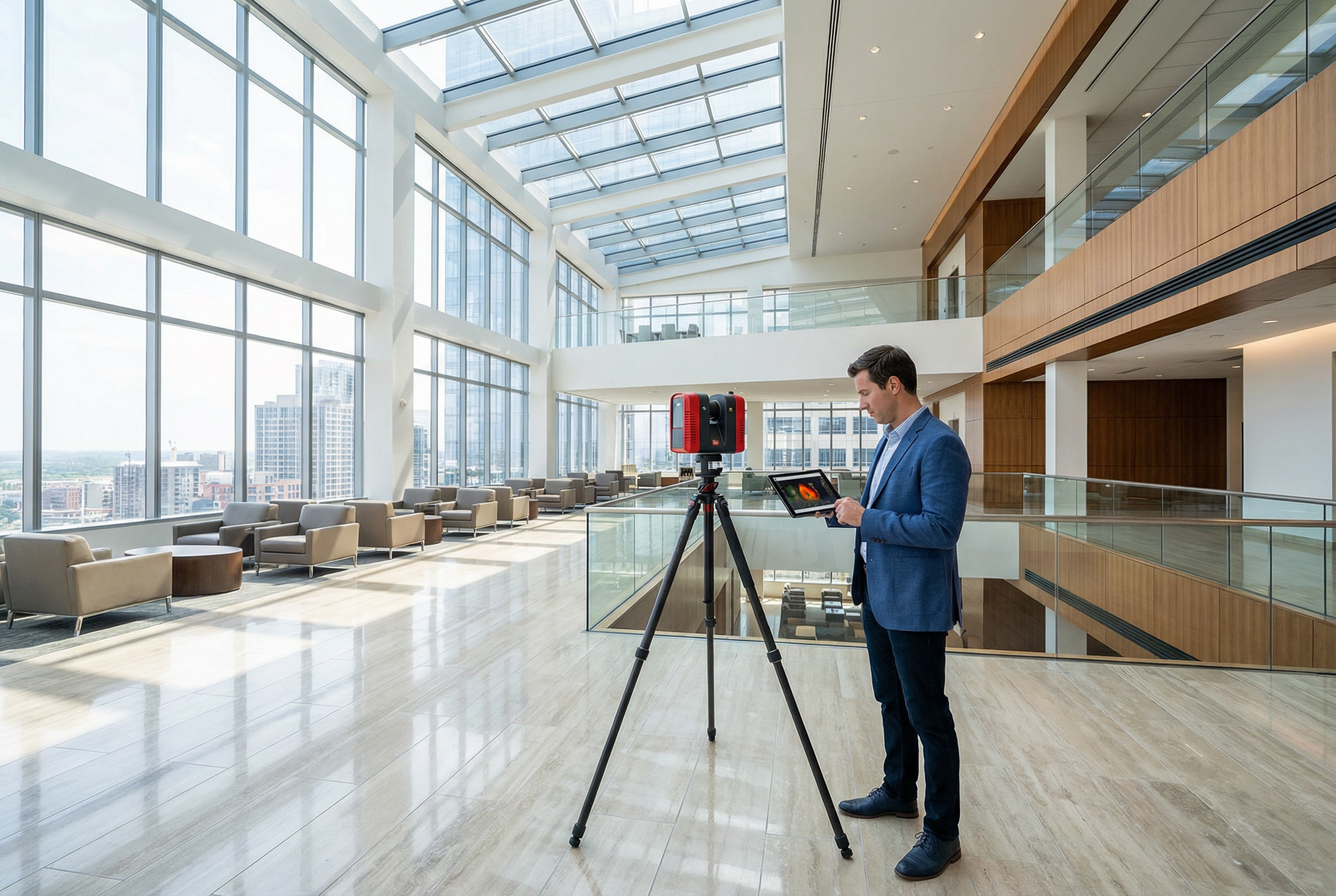
Robotic Imaging uses the LEICA RTC 360 laser scanner (2,000,000 points per second, ±1/16 inch accuracy) for commercial office documentation, producing point cloud data that supports ±2–4mm dimensional accuracy in delivered BIM models. That precision level is the foundation for capital planning reliability — not a scanner specification, but a budget protection mechanism.
LOD 300 is the appropriate level of development for corporate real estate capital planning. It captures sufficient MEP and architectural detail to inform system replacement forecasting without the additional modeling investment of LOD 400, which is reserved for fabrication-level detail in construction applications.
Acquisition Due Diligence and Pre-Purchase Verification
Pre-purchase building documentation is among the highest-ROI applications of corporate real estate scan to BIM. In acquisition due diligence, the buyer's exposure is asymmetric: undisclosed conditions discovered post-closing become the acquirer's problem.
Traditional due diligence relies on physical inspection reports, which are qualitative by nature, and seller-provided documentation, which reflects the seller's interest in closing. Neither approach produces the geometric precision or system-level detail that informs accurate post-acquisition capital planning or purchase price negotiation.
A pre-purchase Scan-to-BIM engagement changes the information balance. Pre-purchase scans of acquisition targets have identified undisclosed structural and MEP conditions that directly informed purchase price negotiations — conditions that a physical walkthrough would not have quantified with sufficient precision to support a specific dollar adjustment.
What acquisition scan documentation delivers:
- Independent, verified floor area measurements (eliminating rentable area disputes post-close)
- MEP system routing and equipment documentation (identifying system age, condition, and replacement exposure)
- Structural condition indicators visible through laser scan point cloud
- Baseline BIM model for immediate post-acquisition capital planning and space planning
Timeline fit for acquisition due diligence: Standard commercial real estate due diligence periods run 30–60 days. Robotic Imaging delivers per-property documentation in 10–14 business days — field capture in 2–3 days, processing in 3–5 days, BIM modeling in 7–10 days. That timeline fits standard due diligence windows with buffer for negotiation and closing preparation.
For portfolio acquisition scenarios — acquiring a multi-property portfolio as a single transaction — Robotic Imaging's concurrent deployment capability allows simultaneous documentation across all acquisition targets. Rather than sequentially processing each property, field teams deploy to multiple locations in parallel, compressing total due diligence documentation to the same 10–14 business day window regardless of property count.
Evaluating an acquisition target? Contact Robotic Imaging for pre-purchase scan availability and acquisition due diligence timeline confirmation.
Disposition Preparation and Property Marketing
On the disposition side of the transaction, seller documentation quality directly influences buyer confidence, due diligence timeline, and ultimately transaction value. Buyers who receive a professional data room with verified as-built BIM models and 360° virtual tour access move through due diligence faster and price the asset with less uncertainty discount.
Robotic Imaging captures 360° virtual tours using the MATTERPORT Pro3 during the same field mobilization as point cloud capture, enabling simultaneous delivery of:
- LOD 300 BIM model for technical due diligence
- Matterport 360° virtual tour for remote buyer property access
- Point cloud data in RCS, RCP, and E57 formats for buyer's engineering team
The operational efficiency matters: one field mobilization produces both the technical documentation and the marketing-quality virtual tour. For a corporate real estate seller managing a multi-property disposition, this eliminates duplicate vendor coordination and compresses the timeline from decision-to-market.
The asset documentation services delivered in a disposition package position the property differently in a buyer's due diligence process. A buyer receiving verified as-built documentation can underwrite capital requirements more accurately, which typically translates to either a tighter pricing range (less uncertainty discount) or a faster decision timeline — both favorable to the seller.
For sale-leaseback transactions, corporate build-to-suit acquisitions, and REIT dispositions, the BIM model delivered through Scan-to-BIM also provides the incoming property management team with an immediate, verified baseline for facility management system integration.
Portfolio Standardization and ESG Baseline Documentation
The benchmarking problem in corporate real estate portfolios is fundamentally a documentation standardization problem. When properties are documented using different methodologies — some with current CAD files, some with legacy drawings, some with only inspection reports — there is no common data standard that enables apples-to-apples comparison across the portfolio.
LOD 300 BIM models delivered through a standardized corporate real estate scan to BIM program establish exactly that common standard. Every property in the portfolio is documented using the same equipment (LEICA RTC 360), the same accuracy specification (±2–4mm), the same Level of Development (LOD 300), and the same deliverable format (Revit .rvt with coordinated MEP, architectural, and structural models). The result is a facility portfolio BIM baseline that enables genuine cross-property comparison.
Portfolio standardization enables:
- Space utilization benchmarking: Verified floor areas across all holdings enable real utilization metrics, not lease-abstract estimates
- Capital planning comparability: MEP system documentation at consistent LOD enables apples-to-apples comparison of deferred maintenance exposure across properties
- ESG baseline establishment: Building system inventory is the prerequisite for energy benchmarking, ENERGY STAR certification, and Scope 1/2 emissions accounting
- IWMS/CAFM integration: Standardized BIM models in consistent format integrate with Integrated Workplace Management Systems and Computer-Aided Facility Management platforms — enabling property portfolio management at the system level rather than property by property
For property portfolio management aligned with corporate ESG reporting requirements, the BIM baseline produced by a standardized Scan-to-BIM program is the foundation layer. Without verified building system inventory, energy benchmarking relies on utility data alone — which reflects consumption but not the building system conditions driving it. LOD 300 MEP documentation maps the systems, which is the prerequisite for identifying optimization opportunities.
Multi-Property Portfolio Program Structure
Corporate real estate directors evaluating Scan-to-BIM vendors for portfolio programs have consistent operational questions: How does concurrent deployment actually work? What does the contract structure look like? How do we track progress across 20+ active properties simultaneously?
Concurrent deployment: Robotic Imaging deploys field teams to multiple markets simultaneously. A 50-property portfolio program does not execute sequentially over 50 × 14 days — it executes through concurrent mobilization, with multiple properties in capture, processing, and BIM modeling simultaneously. Verified retail portfolio programs have documented hundreds of sites concurrently; the same concurrent deployment methodology applies to corporate real estate programs of 10–50+ properties.
Enterprise contract structure: Robotic Imaging structures corporate real estate portfolio programs under master service agreements (MSAs) that provide:
- Fixed per-property pricing (enabling capital budget predictability for appropriations)
- Volume structure for programs above threshold property counts
- Standardized deliverable specifications across all properties
- Phased deployment scheduling aligned with acquisition, disposition, or capital planning cycles
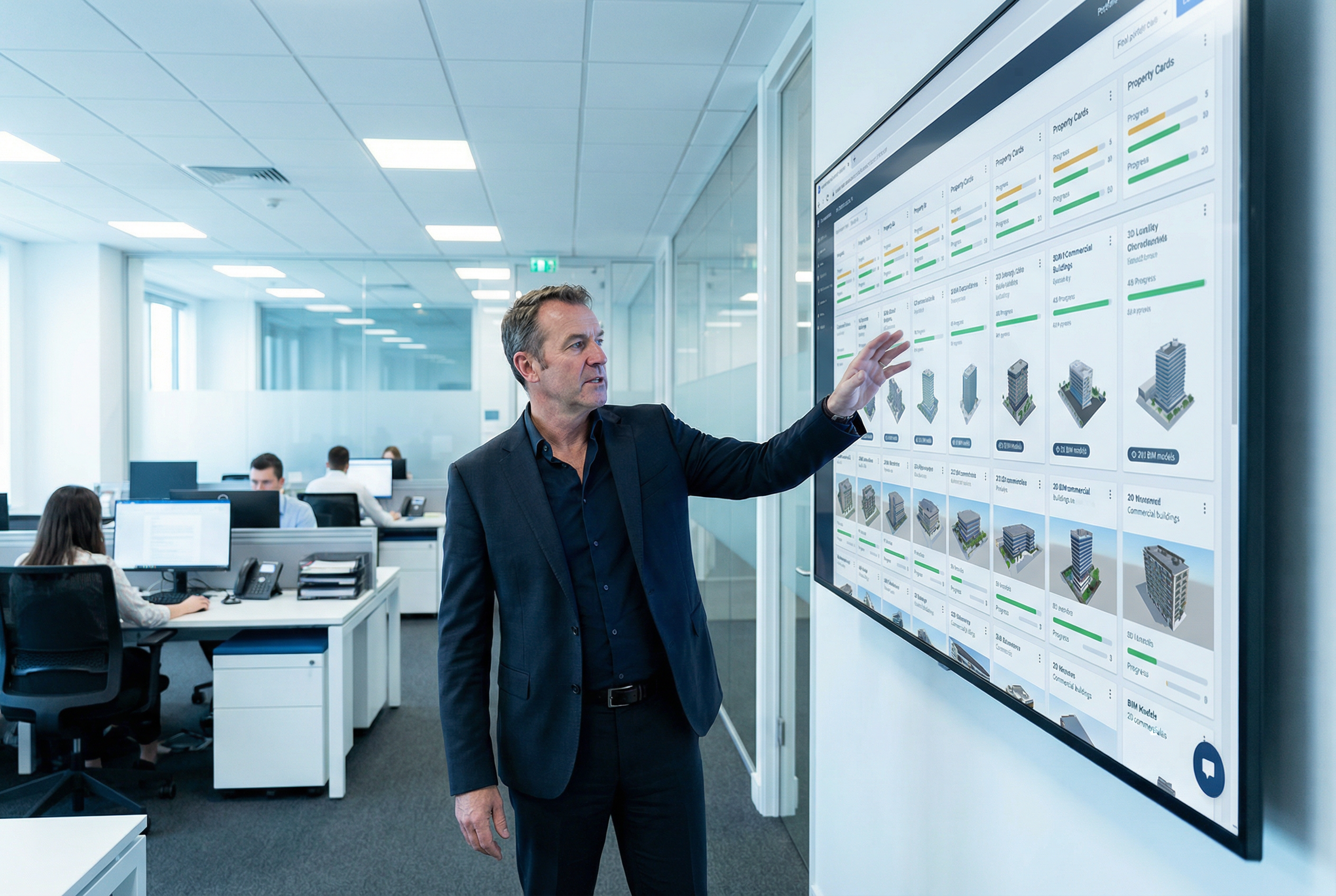
Corporate dashboard visibility: Robotic Imaging's proprietary web platform provides real-time visibility into documentation status across all active properties simultaneously. Corporate real estate directors and asset management teams can monitor which properties are in field capture, processing, or BIM modeling — and access delivered models through the same platform. Customizable reporting enables different visibility levels for different stakeholders (director-level portfolio status vs. property-level project detail).
IWMS/CAFM integration: Delivered BIM models in Revit .rvt format are compatible with leading facility management platforms. Robotic Imaging's team supports data handoff and integration requirements at program initiation to confirm deliverable specifications match the client's platform requirements.
Strategic Value and Next Steps for Corporate Real Estate Programs
Corporate real estate Scan-to-BIM delivers verified asset data that changes the quality of decisions across the portfolio lifecycle: capital planning built on verified building conditions rather than assumptions, acquisition due diligence that identifies undisclosed conditions before closing, dispositions that move faster with professional documentation, and portfolio benchmarking enabled by a common LOD 300 data standard.
The verified differentiators that matter for enterprise programs:
- JLL (Jones Lang LaSalle) as a verified corporate real estate client — the peer credibility signal that CRE directors recognize
- 100+ million square feet documented — demonstrated portfolio-scale execution
- 10–14 business days per property — fits acquisition due diligence windows with buffer
- Concurrent multi-property deployment — 10–50+ properties documented simultaneously, not sequentially
- Proprietary corporate dashboard — real-time portfolio-wide progress visibility
- Master service agreement structure — enterprise procurement with fixed per-property pricing
Frequently Asked Questions:
Can Robotic Imaging maintain quality standards across 50 properties simultaneously? Yes. Concurrent deployment applies the same LEICA RTC 360 equipment, the same ±2–4mm accuracy standard, and the same LOD 300 deliverable specification across all properties in a portfolio program. Verified retail programs have documented hundreds of sites concurrently using the same methodology applied to corporate real estate portfolios.
How does portfolio-wide progress tracking work? Robotic Imaging's proprietary web dashboard provides real-time status visibility across all active properties simultaneously — field capture status, processing progress, and BIM model delivery confirmation. Customizable by property, market, or portfolio segment.
Does the 10–14 day timeline fit acquisition due diligence windows? Yes. With standard due diligence periods of 30–60 days, the 10–14 business day delivery timeline provides meaningful buffer for internal review, negotiation, and closing preparation.
What LOD is appropriate for corporate real estate capital planning? LOD 300 is the standard for corporate real estate capital planning — sufficient MEP and architectural detail for accurate system replacement forecasting without the fabrication-level detail of LOD 400, which is construction-specific.
Corporate real estate portfolio documentation is a strategic capability, not a vendor service. The data quality of your building documentation determines the accuracy of your capital forecasts, the reliability of your acquisition underwriting, the speed of your dispositions, and the credibility of your ESG reporting. Robotic Imaging builds that data foundation — at portfolio scale, with verified accuracy, under enterprise contract structures that fit how corporate real estate teams operate.
Request a Portfolio Strategy Session — discuss your portfolio scale, documentation gaps, and program structure with Robotic Imaging's enterprise team.
Schedule a Corporate Demonstration — see the platform dashboard, LOD 300 deliverable quality, and concurrent deployment methodology for your specific portfolio context.
Download the CRE Portfolio Documentation Guide — detailed specifications, deliverable standards, and program structure overview for corporate real estate directors evaluating portfolio scan to BIM programs.