
Distributed Team Asset Tracking: 100+ Concurrent Users
Robotic ImagingMarch 31, 2026
Distributed Team Asset Tracking Workflows
For regional operations managers coordinating asset documentation across 50-500 retail locations, distributed team asset tracking presents a fundamental workflow challenge: how do store managers, maintenance technicians, regional managers, and corporate operations coordinate concurrent documentation across hundreds of locations without creating quality inconsistencies, access control gaps, or coordination bottlenecks? Traditional centralized approaches — dispatching professional audit teams location by location — cannot scale to 500+ sites without prohibitive cost and time investment. Robotic Imaging's distributed workflow platform delivers role-based permissions, multi-step approval workflows, and centralized visibility that transforms sequential centralized documentation into scalable concurrent distributed operations.
At $5K-15K per location in professional audit fees, a 100-store portfolio costs $500K-$1.5M per documentation cycle. Robotic Imaging's distributed team asset tracking model eliminates that cost structure entirely — delivering $600K+ annual value by empowering internal teams to document concurrently rather than sequentially.
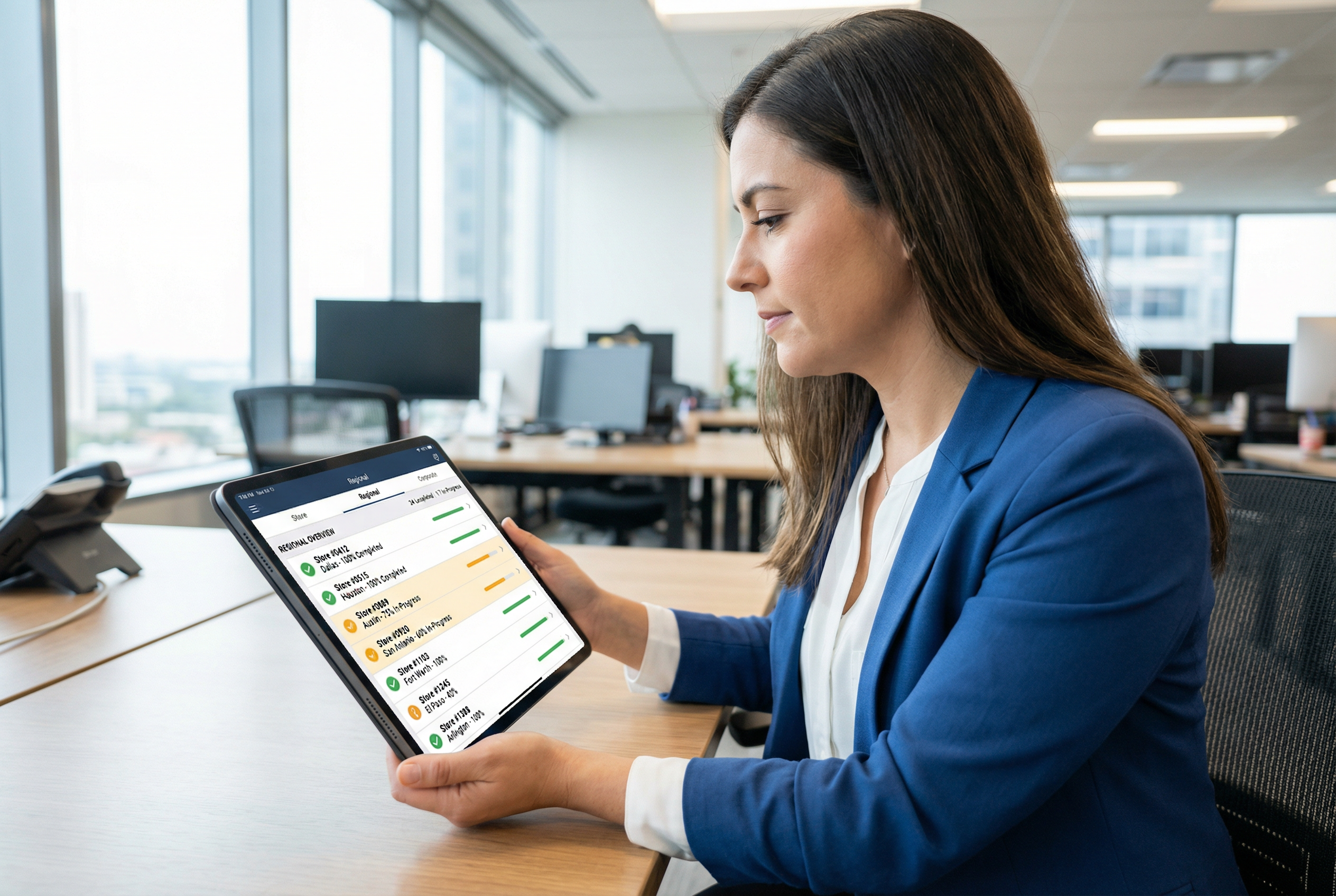
The Distributed Team Coordination Challenge
Centralized asset documentation creates a compounding bottleneck: one professional team, one location at a time, with corporate visibility only after the entire sequence completes. For a 200-store retailer, this means months of sequential work, inconsistent data freshness across the portfolio, and zero ability to parallelize effort.
Distributed team asset tracking solves this by deploying documentation work to the people already present at each location — store managers, maintenance technicians, and facilities staff — under a governance framework that maintains quality, enforces access control, and aggregates results in real time. The model requires a platform architected specifically for concurrent multi-team coordination: role-differentiated access, workflow orchestration that prevents conflicts, quality control mechanisms that don't require regional managers to manually review every submission, and mobile-first field capability that works in equipment rooms without connectivity.
Robotic Imaging's platform was built for precisely this distributed operations tracking model — validated at enterprise scale across Fortune 500 retail deployments.
> Ready to see distributed workflow coordination in action? Schedule a focused demo of Robotic Imaging's distributed team asset tracking platform.
Distributed Team Roles and Responsibilities
Effective distributed team collaboration across a retail portfolio requires each participant to have a clearly defined scope — what they can document, what they can approve, and what they can see. Robotic Imaging's platform structures five distinct roles within the distributed workflow model.
Store Managers serve as the primary documentation contributors. They initiate equipment records at their assigned location, photograph equipment using the native iOS or Android app, and submit documentation through structured checklists that ensure completeness. AI-powered spec extraction achieves 85-90% accuracy pulling manufacturer, model, and serial number from smartphone photos — eliminating the need for store managers to manually type technical specifications. This capability is critical: it enables non-technical staff to produce technically accurate records without equipment expertise.
Maintenance Technicians handle equipment-level documentation that requires technical depth — HVAC units, electrical panels, refrigeration systems. In distributed operations tracking, technicians move across multiple locations and document in the field, often without connectivity. Their role includes QR code scanning for equipment identification, service logging, and condition assessments that feed directly into regional maintenance planning.
Regional Managers function as the quality governance layer between store-level contributors and corporate oversight. Rather than visiting each location, regional managers review submitted documentation in their dashboard, approve records meeting quality standards, and request improvements on submissions that don't meet the threshold. With 10-50 stores in a typical regional scope, this review function is made feasible by quality scoring and structured checklists that filter submissions before they reach the regional review queue.
Corporate Operations and Real Estate Directors access aggregated portfolio intelligence without involvement in individual submission workflows. Their role centers on executive-level visibility: progress tracking across regions, capital planning data, and portfolio-wide equipment condition summaries.
External Vendors and Contractors receive scoped access to specific equipment records or location data relevant to their service scope — without visibility into broader portfolio data. This controlled vendor access enables service coordination without compromising data governance.
Role-Based Permission Architecture
Role-based access control in Robotic Imaging's platform operates across four hierarchical tiers: store, regional, corporate, and vendor. Each tier carries distinct functional permissions, location restrictions, and data visibility rules that enforce governance across the distributed documentation program.
Store-tier permissions restrict access to a single location's equipment records. Store managers can create, photograph, and submit equipment documentation for their assigned location only. They cannot view peer-store data, access regional aggregations, or modify records after regional approval. This location restriction is deliberate — it ensures data integrity by preventing cross-location record contamination while empowering store-level contribution.
Regional-tier permissions span all locations within an assigned geographic territory. Regional managers can review and approve store submissions, request documentation improvements with structured feedback, initiate spot-check audits at specific locations, and access completion progress dashboards across their region. They cannot access locations outside their territory or modify corporate-level configuration settings.
Corporate-tier permissions provide portfolio-wide visibility and program administration capabilities. Corporate users configure documentation templates, define quality standards, set regional boundaries, manage user assignments, and access the full portfolio dashboard. Corporate-tier access is read-only for historical records — creating a clean audit trail that cannot be retroactively altered.
Vendor-tier permissions represent the most restricted scope: specific equipment categories or individual location records explicitly shared by corporate or regional administrators. Vendors receive no visibility into broader portfolio data, user information, or documentation outside their scoped assignment.
A concrete example illustrates the architecture: a Dollar General facilities manager can review documentation submissions across 4,000 planned locations through corporate-tier access, while the store manager at a single location submits only her store's HVAC and refrigeration records — with no visibility into neighboring stores, no ability to modify submitted records after approval, and no access to regional planning dashboards. The permission tiers enforce this separation automatically, without manual access management at each location.
Workflow Orchestration and Enterprise Asset Coordination
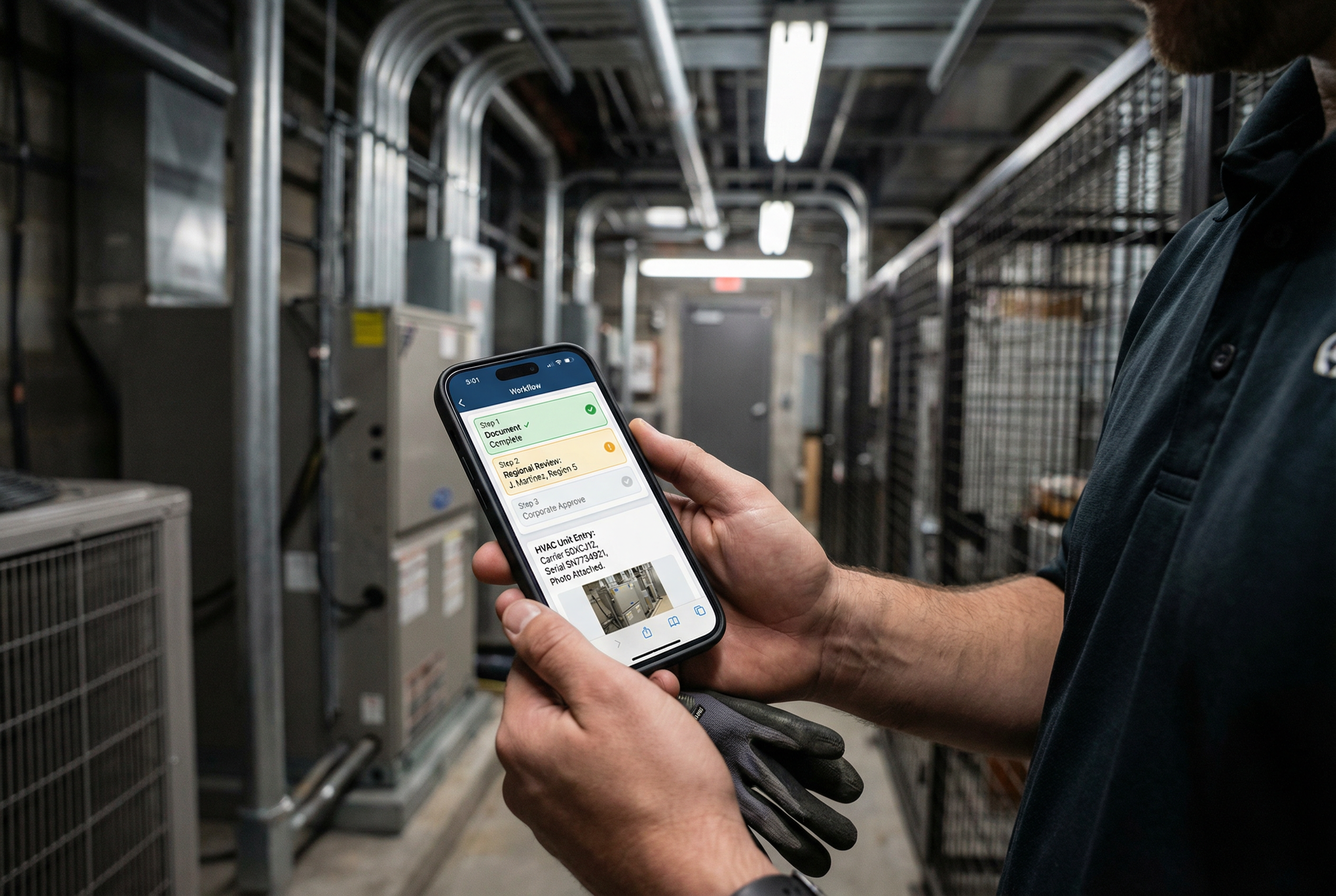
Distributed team asset tracking at enterprise scale requires more than access control — it requires workflow orchestration that coordinates concurrent activity across hundreds of locations without creating submission conflicts, approval bottlenecks, or data integrity gaps.
Robotic Imaging's multi-step workflow chain operates as: Document → Review → Approve, with escalation paths for non-responsive contributors and improvement request loops for incomplete submissions.
Assignment and initiation: Corporate or regional administrators assign documentation tasks to specific store managers with defined completion timelines. Store managers receive push notifications on their mobile devices with task scope, equipment categories, and deadline. This structured assignment model — rather than open self-service contribution — ensures every location receives a documented task owner.
Concurrent documentation support: The platform supports 100+ simultaneous users documenting independently without record conflicts. When 7-Eleven deploys distributed documentation across 1,000+ stores, store managers at each location document equipment concurrently — not sequentially. The platform's architecture prevents duplicate record creation, manages version control when multiple technicians access the same equipment record, and queues submissions for regional review without creating approval backlogs. This concurrent multi-team asset tracking capability is what separates purpose-built distributed platforms from CMMS tools adapted for multi-location use.
Progress tracking: Regional managers monitor real-time completion progress across assigned stores — which locations have submitted, which are in-progress, and which haven't initiated documentation. Automated reminders and escalation alerts surface non-responsive locations without requiring regional managers to manually follow up with each store manager.
Improvement request loops: When a submission doesn't meet quality standards, regional managers return it to the store manager with structured feedback rather than approving incomplete records. The store manager receives a push notification with specific improvement requirements, makes corrections, and resubmits — all within the same workflow thread, creating a documented revision history.
Quality Control in the Distributed Documentation Model
The most significant concern for operations leaders evaluating distributed workforce asset tracking is consistency: how do you maintain documentation quality when 500 people are documenting independently, with varying levels of technical knowledge and attention to detail?
Robotic Imaging's quality control framework addresses this through structured documentation standards, AI-powered data extraction, and regional review governance — rather than relying on contributor skill.
Structured checklists define exactly what each documentation submission must include: required photo angles, mandatory specification fields, equipment condition ratings with defined criteria. Store managers cannot submit incomplete records — the mobile app enforces completeness before the submission becomes available for regional review. This prevents the most common distributed documentation failure: partial records that require back-and-forth correction cycles.
AI spec extraction eliminates the manual entry accuracy problem. Because 85-90% of manufacturer, model, and serial number data is extracted automatically from photos — improving to 90%+ accuracy at the 12-month mark as the AI learns portfolio-specific equipment — store managers aren't transcribing specifications manually. The human error vector that makes distributed documentation inconsistent is substantially reduced at the point of data entry.
Regional review workflows provide the governance layer that catches quality issues before records are finalized. Rather than reviewing 100% of submissions manually — which would overwhelm regional managers with 30-50 stores — the platform's quality scoring surfaces submissions that fall below threshold for targeted review. High-scoring submissions pass through with spot-check auditing; flagged submissions enter the improvement request loop.
This layered quality control approach means corporate receives aggregated documentation that meets consistent standards — not a patchwork of detailed records from engaged store managers and incomplete records from disengaged ones.
Mobile-First Field Enablement
Field reality for distributed documentation teams includes a critical infrastructure constraint: equipment rooms, building basements, and utility areas — where the most critical mechanical equipment lives — frequently lack WiFi or cellular connectivity. A distributed team asset tracking platform that requires connectivity to function fails the moment technicians enter these spaces.
Robotic Imaging's native iOS and Android apps (not mobile web) provide full offline functionality with 1,000+ equipment records cached locally. Technicians scan QR codes, log service records, photograph equipment, and complete documentation checklists entirely offline. When connectivity is restored — walking back to the sales floor, exiting the building, or connecting to store WiFi — the platform automatically syncs all offline activity to the centralized record without technician intervention.
This remote team asset management capability translates directly to productivity: technicians complete equipment rooms in a single pass without interruption, rather than returning to connected areas between equipment to upload records. Combined with AI-powered spec extraction at 30-60x faster than manual entry (5-10 seconds versus 3-5 minutes per equipment item), field documentation workflows at each location complete significantly faster than manual methods regardless of connectivity environment.
Push notification delivery for task assignments, approval status updates, and improvement requests keeps distributed team members informed without requiring them to actively monitor the platform between documentation sessions.
Centralized Visibility of Distributed Activity

Corporate facilities visibility requires aggregating distributed documentation activity into executive-level intelligence — without requiring portfolio directors to coordinate manually with regional managers for status updates.
Robotic Imaging's portfolio dashboard aggregates documentation activity across all locations in real time, presenting corporate facilities visibility through geographic views (regional completion rates mapped visually), drill-down navigation (portfolio → region → store → individual equipment record), and progress analytics (submissions received, under review, approved, pending initiation). Capital planning data — equipment age, condition ratings, and replacement priority scores — surfaces as portfolio-level summaries for real estate and facilities directors assessing multi-site asset workflows across the full location network.
For Dollar General's planned 4,000-location documentation program, this centralized aggregation eliminates the manual status consolidation that would otherwise require regional managers to compile location-by-location reports for corporate review.
Distributed Workflow Value at Enterprise Scale
Robotic Imaging's distributed team asset tracking platform resolves the fundamental tension in multi-location documentation programs: scale requires distributed contribution, but distributed contribution typically sacrifices governance and consistency. The role-based permission architecture, multi-step approval workflows, AI-powered quality control, and mobile-first field enablement deliver concurrent documentation at 100+ simultaneous users — proven across 7-Eleven's 1,000+ store deployment — without sacrificing the data integrity that corporate facilities programs require.
For a 100-store portfolio eliminating $5K-15K per-location professional audit fees, that translates to $600K+ in annual documentation cost reduction — while producing a continuously updated equipment record that professional audit cycles, by definition, cannot maintain.
See distributed workflow coordination in action. Schedule a focused demo of Robotic Imaging's distributed team asset tracking platform to explore role configuration, approval workflow setup, and portfolio dashboard capabilities for your location network.
Evaluating platform options? Download the Distributed Workflow Guide for a framework comparing distributed self-service documentation against centralized professional audit approaches across key decision criteria.
Written by
Robotic Imaging