
Field-Ready: Retail Facilities Manager Asset Platform
Filed under
Robotic ImagingApril 14, 2026
Retail Facilities Manager Mobile Asset Intelligence Platform
For retail facilities managers coordinating equipment maintenance, capital planning, and vendor oversight across dozens or hundreds of stores, portfolio intelligence has historically lived on a desktop — accessible when you're at a desk, invisible when you're in the field making decisions. Robotic Imaging's mobile asset intelligence platform changes that calculus, delivering complete multi-store equipment visibility, lifecycle analytics, maintenance coordination, and capital planning tools accessible from any smartphone or tablet — during store visits, vendor meetings, budget presentations, or the Monday morning commute.
Retail chains including 7-Eleven (1,000+ site deployment) and Dollar General (4,000 locations planned) have replaced desktop-bound asset management workflows with Robotic Imaging's mobile-first platform, giving facilities leadership the portfolio intelligence they need where decisions actually happen: in the field.
The Mobile Facilities Portfolio Management Gap
The retail facilities manager asset platform problem isn't a software shortage — it's an architecture problem. Most facilities management platforms were designed for desktop workflows first, with mobile added later as a secondary interface for technicians submitting work orders. The result: a facilities manager standing in front of a 16-year-old HVAC unit in Store #247 has no immediate access to that unit's installation date, service history, replacement cost, or warranty status. The data exists — it's just locked in a system that requires a desktop browser, a VPN, and an office chair.
This gap has compounding consequences. Equipment replacement decisions get deferred because the data isn't accessible when the decision moment arrives. Capital forecasting happens reactively, after emergencies, rather than proactively during store walk-throughs. Vendor coordination happens by phone and email because work order systems don't travel well on smartphones. And professional audits — costing $5,000-$15,000 per location — become the only systematic way to capture equipment data across a growing portfolio.
A facilities manager mobile software solution built specifically for portfolio leadership — not just technician dispatch — eliminates each of these gaps. Robotic Imaging's platform was designed as a native iOS/Android application from the ground up, not a desktop platform adapted for mobile. The difference shows in the performance metrics: <2 second load times, 60fps scrolling, full offline functionality with 1,000+ equipment units cached locally, and real-time portfolio synchronization when connectivity resumes.
> Ready to see the platform in action? Request a Facilities Manager Platform Demo and we'll walk through your specific portfolio scenarios.
Mobile Portfolio Dashboard and Multi-Store Visibility

Monday morning scenario: A regional facilities director opens Robotic Imaging's platform dashboard on her smartphone during the commute. Overnight, the platform flagged two refrigeration alerts at stores in the same metro cluster. She reviews the equipment age data (both units are 14+ years), confirms the service contractor assigned to that region, and initiates a priority work order — before reaching the office. By the time she's at her desk, the dispatcher has confirmed the technician routing. The issue that would have surfaced as a reactive emergency call at noon is now a managed maintenance event by 9am.
This is what retail asset intelligence looks like when it's built mobile-first.
The portfolio dashboard surfaces executive-level facility intelligence in a format optimized for smartphone navigation:
- Multi-store equipment inventory — searchable across all locations, filterable by equipment type, age, condition status, and geographic region
- Age distribution analytics — equipment aging curves by category (HVAC, refrigeration, electrical) showing percentage of fleet beyond expected lifecycle
- Real-time alerts — condition flags, maintenance overdue notifications, and warranty expirations pushed to mobile with drill-down access to equipment records
- Geographic store visualization — regional map view enabling facilities leaders to see equipment status distribution across geographic clusters, not just alphabetical store lists
- QR code instant access — during store visits, scanning equipment QR labels ($0.01-0.05 per label) pulls the complete equipment record instantly, without manual search
For multi-store asset tracking across 50-500 locations, the geographic visualization feature addresses a specific pain that flat store lists cannot: regional patterns. When three stores in the same market show refrigeration alerts in the same month, a map view reveals the cluster. A store list does not.
The platform's offline capability directly addresses one of the most common objections from retail facilities teams: store WiFi reliability. With 1,000+ equipment units cached locally on the device, facilities managers conduct complete store walk-throughs — accessing equipment histories, pulling spec sheets, reviewing maintenance records — in stores with no WiFi connectivity whatsoever. When the device reconnects, data synchronizes automatically.
Equipment Lifecycle Management from Mobile
Facilities managers managing equipment across 100+ locations face a structural forecasting problem: without systematic documentation, capital planning defaults to reactive replacement after failure rather than proactive planning based on equipment age and condition data.
Robotic Imaging's platform addresses this at the documentation layer. Store-level staff photograph equipment with their smartphones; the platform's AI engine extracts manufacturer, model number, serial number, and installation date at 85-90% accuracy — eliminating manual data entry entirely. At the 12-month mark, AI accuracy improves to 90%+ as the model learns equipment patterns specific to the operator's portfolio.
For context on what this replaces: professional equipment audits for a 100-store portfolio cost $5,000-$15,000 per location in professional fees — representing $500,000-$1,500,000 in documentation spend that self-service mobile documentation eliminates. The $600,000+ net annual value calculated for a 100-store portfolio reflects this audit cost elimination alongside technician efficiency gains.
The lifecycle management view within Robotic Imaging's mobile asset intelligence platform provides:
- Equipment age by category — HVAC, refrigeration, electrical, and specialty equipment segmented by years in service and percentage of expected lifecycle consumed
- Replacement forecasting — projected capital requirements over 1, 3, and 5-year horizons based on equipment age distributions across the portfolio
- Condition flags — equipment records updated by technician field notes, flagging units showing early failure indicators ahead of lifecycle-based replacement schedules
- Installation and warranty tracking — warranty expiration alerts surfaced before coverage lapses, enabling claims that would otherwise be missed
This data, accessible from a smartphone during a store visit, transforms how facilities managers make equipment decisions. Instead of noting "HVAC looks old, follow up when back at desk," a facilities manager standing next to the unit opens the equipment record, confirms it's 17 years old with a 15-year expected lifecycle, reviews the service history showing two compressor repairs in 18 months, and flags it for budget inclusion in the upcoming capital cycle — on the spot, during the store walk.
Mobile Maintenance Coordination and Vendor Management
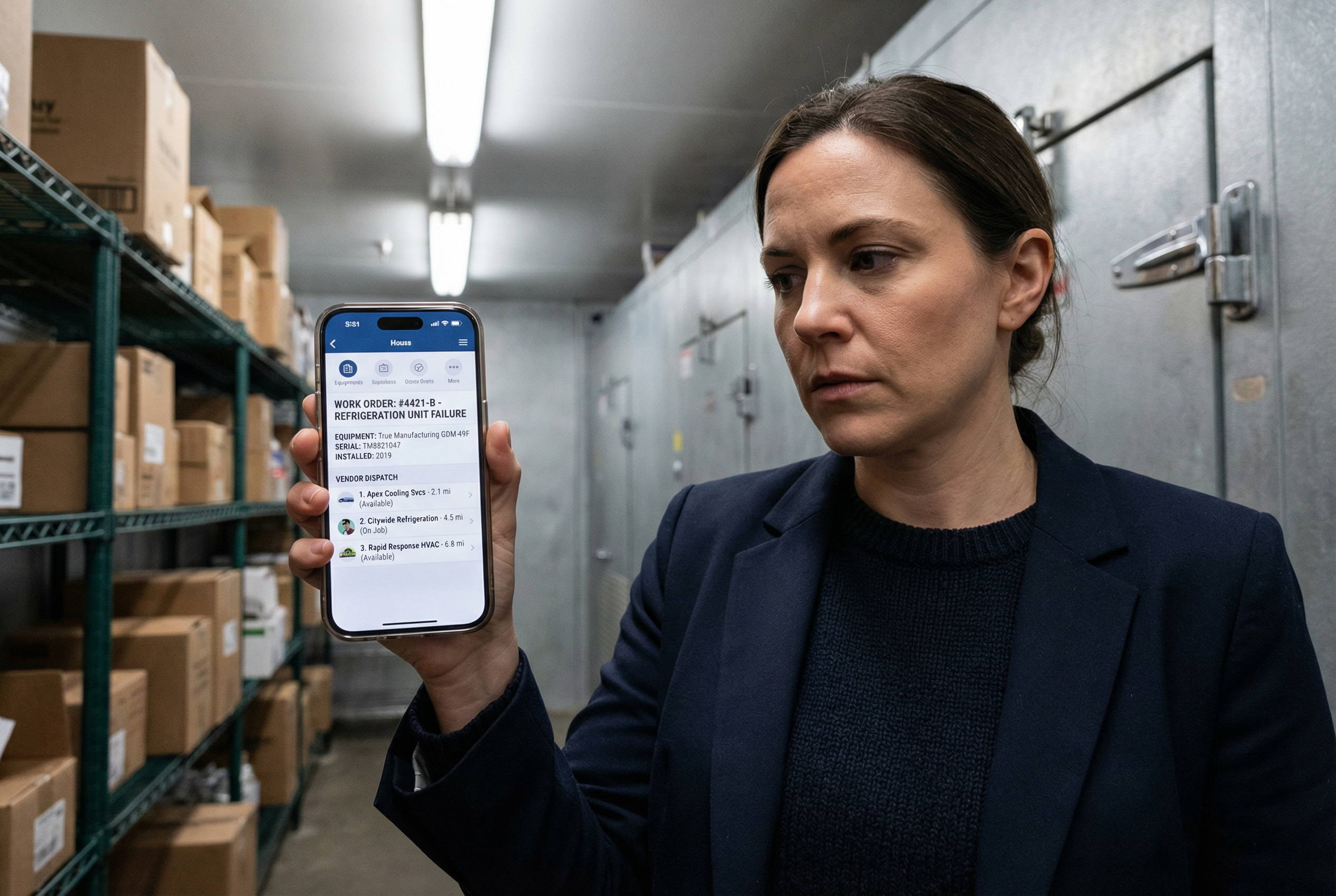
Friday 3pm scenario: A store manager calls reporting a refrigeration failure in the dairy case. Without a mobile facilities intelligence platform, this triggers a phone chain: store manager to district manager to facilities coordinator to vendor dispatch, with status updates by text message and no documentation trail.
With Robotic Imaging's platform on a smartphone, the facilities manager pulls the refrigeration unit's equipment record from the store's asset registry, confirms the assigned service vendor for that equipment category in that geographic region, initiates the work order with equipment specs pre-populated, and monitors dispatch status — all within minutes of the initial call. When the technician completes the repair, the completion record and any photos document directly to the equipment history. The entire event — dispatch, repair, documentation — is captured in the asset record without a single email or manual data entry.
Mobile maintenance coordination in multi-location retail software operates across several dimensions:
Work Order Assignment from Mobile Facilities managers assign, escalate, and track work orders directly from smartphones without requiring desktop access. Work orders include equipment records automatically, giving technicians complete context — model number, installation date, service history — at dispatch.
Vendor Management and Routing Service vendor assignments by equipment category and geography are accessible in the mobile platform, enabling facilities managers to identify the right contractor for any equipment failure at any location without consulting separate spreadsheets or calling a coordinator.
Technician Productivity Impact The 20-30% field technician productivity improvement associated with Robotic Imaging's platform reflects the reduction in administrative friction: technicians receive pre-populated work orders with equipment specs, spend less time gathering information on-site, and complete service documentation within the platform rather than paper-based or after-hours digital entry.
Service History Access Every work order completed against an equipment record builds the service history that lifecycle analytics draw from. Facilities managers reviewing a failing unit can see not just the current failure, but the pattern: three service calls in 24 months on a unit 18 years into a 15-year expected lifecycle is a replacement case, not another repair authorization.
Field-Based Strategic Decision-Making
The most direct argument for mobile facilities portfolio management is not efficiency — it's decision quality.
Facilities managers who manage 50-200 stores spend a significant portion of their time in stores, with vendors, and in meetings. Desktop-dependent systems create a systematic gap between where decisions are made and where data lives. The outcome: decisions made on incomplete information, deferred until return to the office, or based on outdated printed reports.
Mobile facilities intelligence closes this gap at the decision moment. Three scenarios illustrate the difference:
Store Visit Decision: A facilities manager walking a store flags an aging rooftop HVAC unit. With Robotic Imaging's platform, she scans the QR code on the unit, pulls the equipment record showing a 16-year installation date, reviews two recent service calls totaling $4,200 in repairs, and confirms the unit is 107% of expected lifecycle. She opens the capital planning tool, adds the unit to the replacement forecast for the next budget cycle, and captures a photo note documenting current condition — all before leaving the rooftop. The data enters the capital plan during the store visit, not three days later when she returns to her desk.
Vendor Meeting Decision: A regional contractor proposes a preventive maintenance program for refrigeration equipment across 12 stores. The facilities manager opens the portfolio dashboard on a tablet during the meeting, pulls the refrigeration age distribution for those 12 stores (average 11.3 years, 40% beyond lifecycle), and evaluates the PM proposal against replacement proximity. The decision to structure the contract as a 2-year bridge rather than a 5-year commitment is informed by data accessible in real time, not estimated from memory.
Emergency Authorization Decision: A Saturday morning equipment failure requires emergency repair authorization. The facilities manager approves from a smartphone, with the work order tied to the equipment record, vendor confirmed, and authorization documented — without requiring a return to the office.
These are not hypothetical efficiencies. They are the specific scenarios where retail facilities managers operating 50-500 location portfolios lose decision quality and operational speed when data lives only on a desktop.
Capital Planning Mobile Tools
Budget presentation scenario: A quarterly capital planning meeting with the CFO. The facilities director opens Robotic Imaging's platform on a tablet and navigates directly to the capital forecast dashboard — no printed reports, no PDF attachments, no pre-meeting preparation to export data.
The dashboard shows the portfolio's equipment aging profile: 340 HVAC units across 120 stores, 28% beyond expected lifecycle, projected replacement cost of $2.1M over 36 months distributed by fiscal year. The CFO asks which stores have the oldest concentration of equipment. The facilities director drills into the geographic view, identifies a cluster of 12 stores in the Southeast with above-average equipment age, and pulls the specific equipment list with estimated replacement values — during the meeting, on the tablet, in response to a live question.
This is what facilities portfolio management mobile tools make possible that desktop-dependent workflows cannot: live data access in decision contexts, without pre-meeting preparation overhead.
The capital planning capability within Robotic Imaging's retail asset oversight platform includes:
- Portfolio-level replacement forecasting across 1, 3, and 5-year time horizons by equipment category
- Store-level drill-down from portfolio summary to individual location equipment lists with replacement cost estimates
- Age distribution visualization showing equipment lifecycle status across the fleet
- Budget cycle integration — facilities managers flag equipment for capital plans during store visits; those flags aggregate into planning dashboards accessible by leadership
For 100-store portfolios, the combination of AI-powered asset documentation and mobile capital planning tools delivers $600,000+ net annual value, with a payback period under two months. The primary driver is elimination of professional audit costs ($5,000-$15,000 per location) — replaced by self-service mobile documentation by store-level staff who photograph equipment during daily walks.
Regional Oversight and Geographic Intelligence
For regional facilities directors managing 50-200 stores across geographic territories, the portfolio view that matters most is not alphabetical or numerical — it's spatial.
Robotic Imaging's platform provides geographic visualization of equipment status across retail portfolios, enabling regional directors to identify patterns that store lists obscure. A cluster of refrigeration alerts in a coastal market may reflect humidity-related accelerated aging. A concentration of HVAC replacements needed in a northern region may align with severe winter cycle impact on specific equipment categories. Seeing these patterns on a map — rather than scrolling a store list — changes how regional oversight operates.
The geographic intelligence features within the retail asset oversight platform support:
- Regional equipment status maps — color-coded by alert status, equipment age profile, or maintenance overdue flags
- Territory-based filtering — regional directors see their assigned stores with drill-down to individual locations
- Cross-location pattern recognition — age distribution and failure patterns visible at regional cluster level, not just individual store level
- Remote store oversight — regional directors conduct equipment status reviews for stores they haven't physically visited, using the asset registry and maintenance history to assess facility conditions remotely
For secondary personas — Regional Facilities Directors managing distributed teams and multi-state portfolios — this geographic intelligence layer is the specific capability that transforms the platform from a maintenance tool into a portfolio oversight system.
From Office-Bound to Mobile Field Leader
The shift from desktop-dependent facilities management to mobile asset intelligence is not a technology upgrade — it's an operational model change. Facilities managers who previously deferred field decisions pending a return to the office, printed capital reports before CFO meetings, or relied on phone chains to coordinate vendor dispatch now operate with full portfolio intelligence at every decision point.
Robotic Imaging's mobile asset intelligence platform delivers this transition for retail facilities managers and regional directors managing 50-500 location portfolios:
- AI-powered asset documentation at 85-90% accuracy — store staff photograph equipment, the platform builds the registry
- Native iOS/Android performance with <2 second load, 60fps scrolling, and full offline capability for 1,000+ equipment units
- Portfolio dashboards with geographic visualization, real-time alerts, and drill-down navigation
- Capital planning tools accessible during CFO meetings, store visits, and vendor negotiations
- Work order and vendor management from smartphone, with equipment records pre-populated at dispatch
7-Eleven store teams document equipment during daily walks without specialist involvement. Dollar General is deploying the platform across 4,000 locations. Both represent the self-service model that makes portfolio-scale asset intelligence achievable without enterprise implementation overhead.
The platform manages 50,000 equipment units across 500 locations — the scale proof for facilities leaders evaluating capability against large, growing portfolios.
Ready to move from office-bound to mobile-first portfolio management?
- Request a Facilities Manager Platform Demo — See the mobile dashboard with your portfolio scale in mind
- Schedule a Facilities Leadership Briefing — Structured overview for directors and VP-level facilities leadership
- Download the Facilities Manager Mobile Guide — ROI framework, implementation overview, and field scenario walkthroughs for 100+ location portfolios
Written by
Robotic Imaging