In-House vs Outsourced Scan-to-BIM: Decision Framework

Robotic ImagingMarch 16, 2026
In-House vs Outsourced Scan-to-BIM: Decision Framework
Organizations considering whether to build an in-house Scan-to-BIM capability or outsource Laser Scanning to specialized providers face a decision that turns on three variables: project volume, expertise requirements, and true cost of ownership. This framework provides the analytical tools — including a break-even ROI model — to make that decision with data rather than intuition.
In-house Scan-to-BIM requires a minimum $30,000–$40,000 equipment investment plus $130,000–$180,000 in annual staff costs, with 12-18 months to develop consistent quality deliverables. Break-even typically requires 24+ projects annually. Organizations with fewer than 20 projects per year or variable volume generally achieve better ROI through outsourced Scan-to-BIM services.
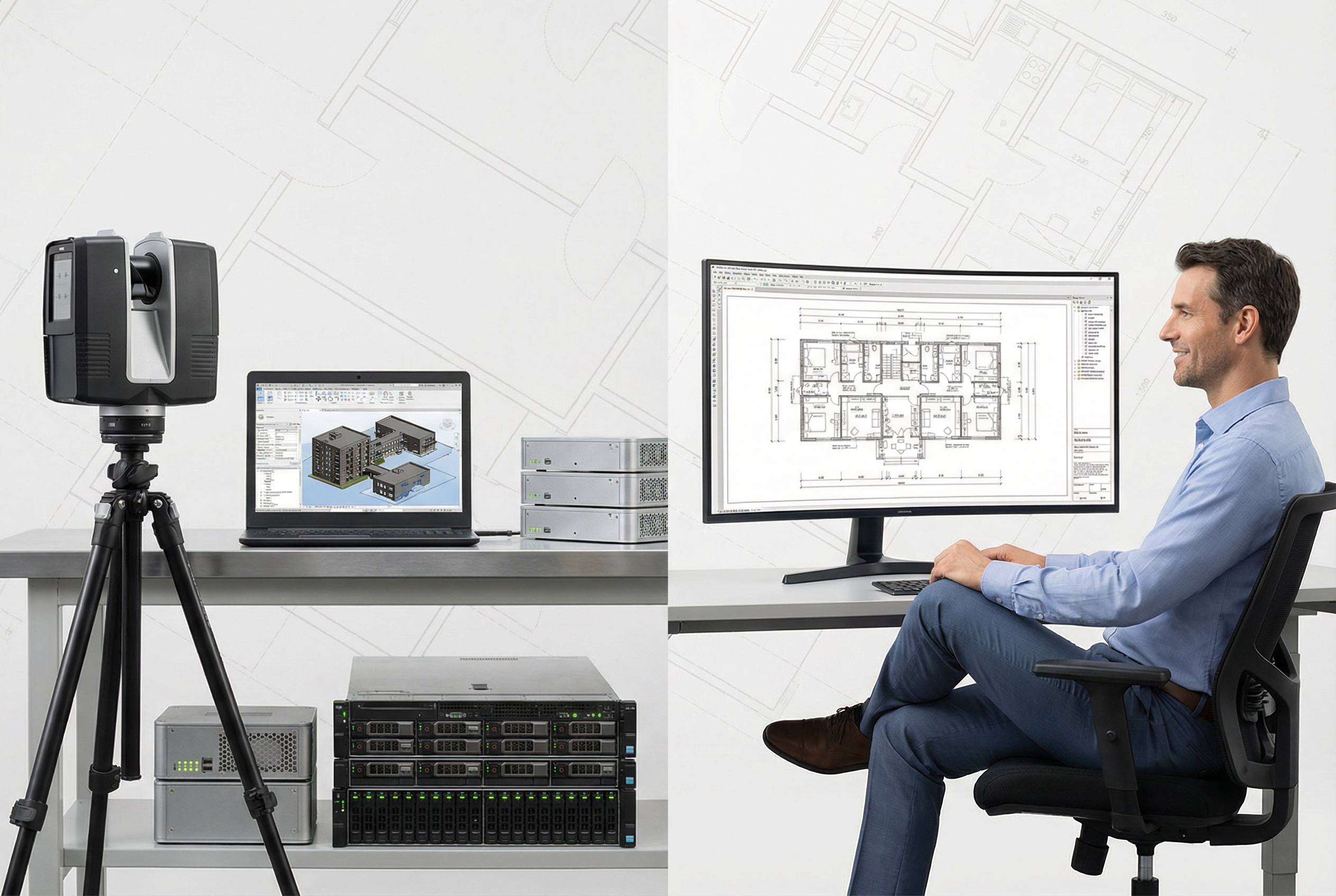
The Build vs Buy Decision in Scan-to-BIM
The most common mistake organizations make when evaluating in-house vs outsourced Scan-to-BIM is conflating equipment purchase with operational capability. Buying a laser scanner is not the same as building a scanning program. The equipment is the entry fee — staffing, software, workflow development, and quality control infrastructure are where the real investment accumulates.
A second common mistake is underestimating the proficiency timeline. Even experienced BIM professionals require 12-18 months of consistent project work to develop the scan registration, point cloud cleanup, and model creation workflows that specialized providers execute routinely. During that ramp period, deliverable quality is variable, rework rates are elevated, and client-facing timelines are less predictable.
The in-house vs outsourced Scan-to-BIM question deserves a structured answer — one that accounts for all costs, realistic utilization rates, and the operational factors that don't appear in initial budget estimates. Before deciding to outsource laser scanning or build internally, organizations need the full picture on both sides.
What In-House Scan-to-BIM Actually Costs
Building an in-house scanning team involves four distinct cost categories that must all be counted to reach a defensible total cost of ownership.
Equipment: Professional-grade scanners used by established providers — such as the LEICA RTC 360 at approximately $80,000 or the LEICA BLK 360 at approximately $28,000 — represent only the first line item. For mid-volume organizations evaluating in-house capability, the LEICA BLK 360 (680,000 points/second, 60m range) is the most realistic starting point. Add registration targets, tripods, transport cases, and field accessories, and initial equipment investment runs $35,000–$45,000 for a single-scanner setup.
Software: Scan-to-BIM requires multiple licensed platforms. Point cloud processing (Autodesk ReCap or FARO SCENE), BIM authoring (Revit), and potentially registration software (Cyclone or NavVis) carry combined annual licensing costs of $15,000–$25,000 depending on seat count and subscription tiers.
Staff: A functional in-house scanning team requires at minimum one experienced BIM technician capable of both field capture and model production. Loaded salary cost (salary, benefits, overhead) for a qualified professional runs $130,000–$180,000 annually in most US markets. Organizations requiring consistent throughput typically need 1.5–2 FTE to maintain coverage during field days, processing, and revision cycles.
Hidden Costs: This is where most in-house business cases underperform their projections. Idle time between projects is a real cost — a salaried BIM technician costs the same whether scanning 3 days this week or 0 days. Quality rework on early-stage deliverables adds 15–25% to per-project hours during the proficiency development period. Equipment calibration, maintenance, and eventual replacement create irregular capital expenditures that rarely appear in Year 1 projections.
Total annual fixed cost for a realistic single-scanner, one-FTE in-house capability: $175,000–$230,000.
Outsourced Scan-to-BIM: Cost Structure and Capabilities
Outsourced Scan-to-BIM services convert fixed infrastructure costs into variable, per-project expenses. Pricing typically scales with square footage and Level of Development (LOD) requirements — with LOD 200 documentation priced meaningfully lower than LOD 350 or LOD 400 coordination models requiring full MEP system modeling.
The structural advantage of the outsourced model is utilization efficiency. You pay for productive work, not for staff availability. There are no idle labor costs between projects, no software license overhead, and no equipment depreciation exposure.
Beyond cost structure, specialized providers bring accumulated expertise that has direct quality implications. Robotic Imaging, for example, has documented 100+ million square feet for Fortune 500 clients including 7-Eleven, Kroger, and Burlington — a project library that informs registration workflows, common MEP configurations, and LOD decision-making in ways a nascent in-house team cannot replicate from launch.
Capacity flexibility is a second structural advantage. Project demand is rarely linear — many architecture and facilities organizations have seasonal peaks or portfolio-driven surges. Outsourced providers absorb volume variability without requiring organizations to staff for peak capacity. Established providers offer committed delivery timelines — typically 10-14 days from field capture to final BIM deliverables — with no dependency on internal staff availability or learning-curve variability.
ROI Break-Even Analysis: How Many Projects Justify In-House?
The break-even calculation for this outsourcing decision framework follows a straightforward model:
Break-Even Volume = Total Annual Fixed Costs ÷ Per-Project Savings
Using conservative estimates:
- Annual fixed in-house cost: $190,000 (midpoint of $175K–$230K range)
- Average outsourced project cost: $12,000 (mid-size commercial project)
- Average in-house variable cost per project (materials, incremental time): $4,000
- Per-project savings from in-house: $8,000
$190,000 ÷ $8,000 = approximately 24 projects annually to break even
This calculation assumes full utilization — every available scanning week producing billable work. In practice, utilization rates for in-house teams run 60–75% of theoretical capacity once accounting for travel, administrative overhead, rework, and the proficiency ramp period. Adjusted for realistic utilization, the break-even threshold rises to 28–32 projects annually.
For organizations running 30+ projects per year with predictable volume and consistent project types, in-house investment becomes financially defensible. For organizations below 20 projects annually, or with high variability in project scale and complexity, outsourced Scan-to-BIM services deliver better cost-per-deliverable with lower operational risk.
The 20–30 project range is genuinely ambiguous — which is why the hybrid model discussed below is worth examining for organizations in that band.
Decision Factors Beyond Cost
The scan-to-BIM vendor vs in-house comparison involves several factors that the ROI model doesn't fully capture.
Quality Control: Specialized providers have established QA processes, LOD verification workflows, and error-detection systems refined across hundreds of projects. In-house teams develop these processes over time, but early deliverables carry higher variance. For client-facing deliverables or projects with tight accuracy requirements (±2-4mm for structural work), this quality consistency gap matters.
Data Security: Some clients and project types — federal facilities, healthcare, financial institutions — have data handling requirements that complicate third-party provider engagement. If your organization routinely works in high-security environments, in-house control over scan data and BIM files may be a non-negotiable requirement regardless of cost.
Strategic Fit: Scan-to-BIM is a core competency for specialty firms that have built service offerings around it. For architecture, engineering, or facilities management organizations where scanning is a support function rather than a revenue driver, maintaining specialized internal expertise may represent a distraction from core business development.
Capacity Management: In-house teams create scheduling dependencies. When a key BIM technician is unavailable, projects stall. Outsourced providers offer staffing redundancy and geographic coverage that internal teams cannot match without significant headcount investment.
The Hybrid Model: Partial In-House + Strategic Outsourcing
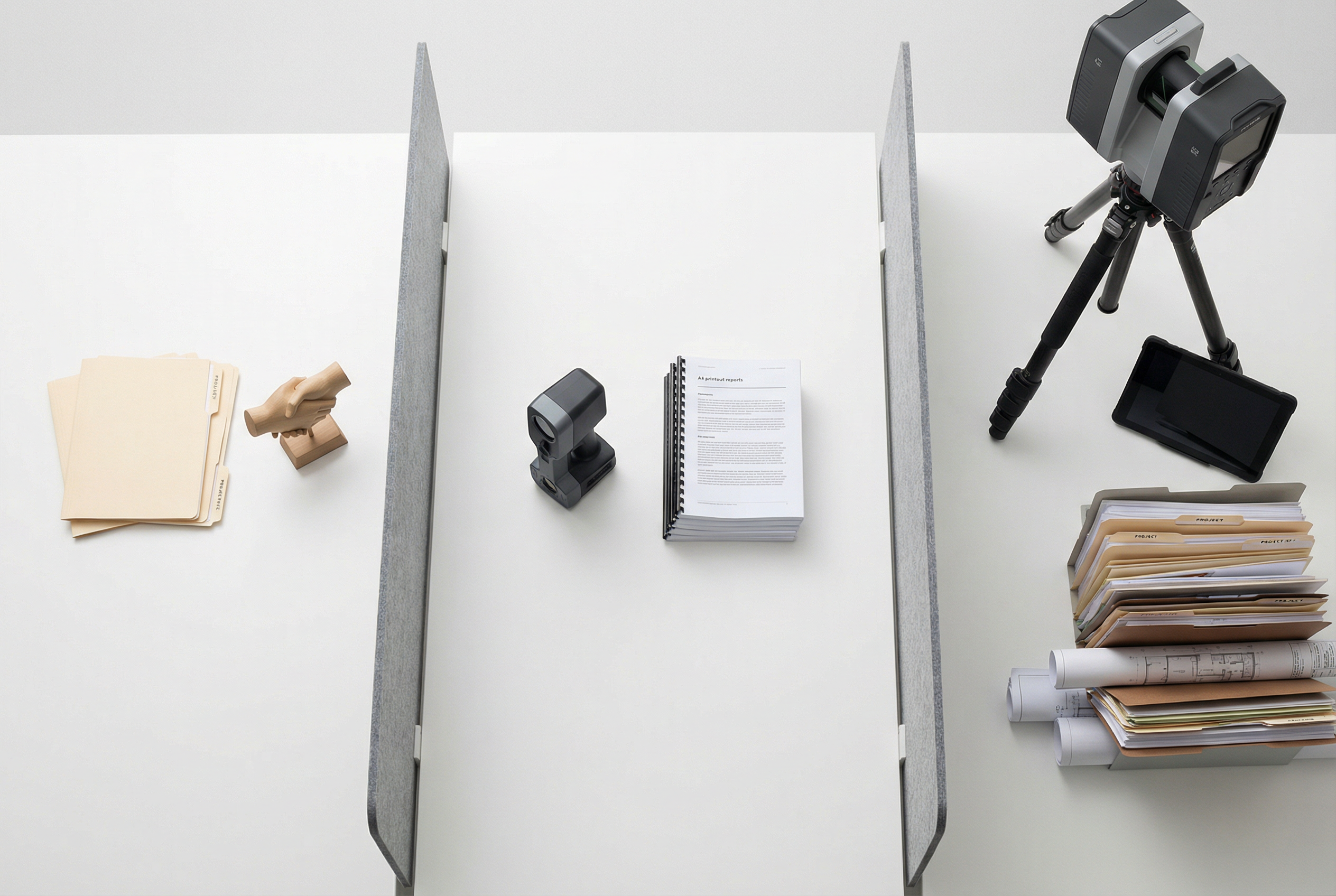
Organizations in the 20–30 project range, or those with a mix of routine documentation and complex coordination work, may find the most value in a hybrid approach rather than a binary choice.
A practical hybrid structure: invest in a lower-cost scanner such as the MATTERPORT Pro3 (~$6,000) for routine as-built documentation — simple floor plan capture, facilities condition surveys, straightforward 2D deliverables. Reserve outsourced Scan-to-BIM services for projects requiring LOD 300+ BIM models, complex MEP coordination, or high-accuracy structural documentation where specialized expertise and professional-grade equipment (LEICA RTC 360-class scanners at ~$80,000) justify the per-project cost.
This hybrid model reduces fixed overhead while preserving access to specialized capability for projects that genuinely require it. It also provides an organizational learning path — internal staff gain scanning familiarity on routine work while outsourced providers handle complexity, with the option to migrate more work in-house as volume and competency develop together.
Decision Framework: In-House, Outsourced, or Hybrid?
Use these thresholds to structure your recommendation:
Choose In-House if:
- Consistent volume of 30+ Scan-to-BIM projects annually
- Predictable project types enabling workflow standardization
- Data security requirements prohibit third-party data handling
- Scan-to-BIM is a billable service line, not a support function
Choose Outsourced if:
- Fewer than 20 projects annually
- High variability in project scale, type, or scheduling
- LOD 300–LOD 400 deliverables are the primary requirement
- Speed and delivery predictability are critical (10-14 day turnaround)
Choose Hybrid if:
- 20–30 projects annually with mixed complexity
- Mix of routine documentation and complex BIM coordination
- Building toward in-house capability over a 2–3 year horizon
- Want internal competency development without full fixed cost exposure
The in-house vs outsourced Scan-to-BIM decision is ultimately a volume and variability question wrapped in a cost structure decision. Organizations that approach it with realistic utilization assumptions, full-stack cost accounting, and honest assessment of their project pipeline will arrive at the right answer for their specific context — whether that means building internal capability, partnering with a specialized provider, or combining both.
For organizations evaluating outsourced options, consulting with a provider who can share project-specific pricing based on your actual deliverable requirements and volume profile is the most direct path to completing the ROI model with your real numbers.