Industrial Facility Laser Scanning: LOD 300 in 10-14 Days
Robotic ImagingMarch 2, 2026
Industrial Facility Laser Scanning and BIM Documentation
For facility managers planning production line reconfigurations and construction project managers coordinating equipment installations, industrial facility laser scanning solves a problem that standard documentation methods cannot: capturing 100,000–500,000 square foot manufacturing plants and warehouses — with 40-80 foot high-bay ceilings, active production equipment, and operational constraints — accurately enough to drive critical capital decisions.
Robotic Imaging's industrial facility Laser Scanning delivers verified as-built documentation of manufacturing plants and warehouses using long-range LEICA equipment that reaches ceilings standard scanners cannot, coordinated around your production schedule to minimize disruption. Field capture completes in 3-5 days for facilities up to 500,000 SF, with LOD 300 Revit models delivered within 10-14 business days — timelines aligned to production restart windows, not documentation convenience.
The Documentation Challenges Industrial Facilities Present
Industrial facilities expose every limitation of conventional documentation methods. High-bay spaces with 40-80 foot ceilings exceed the operational range of most scanning equipment. Floor plates of 100,000–500,000 SF require efficient, systematic capture at scale. Active production environments create access constraints that manual surveyors cannot accommodate without halting operations.
The result: most industrial facilities operate from drawings that are decades old and demonstrably wrong — or from no drawings at all. Equipment installation projects discover field conditions during installation rather than during planning. Change orders follow. Production restart windows get missed.
Industrial facility laser scanning addresses these conditions directly:
> Industrial facility laser scanning uses long-range equipment — including the LEICA RTC 360 with 130-meter range and ±1/16 inch accuracy — to document manufacturing plants and warehouses with high ceilings up to 80-100 feet and floor areas of 100,000–500,000 square feet, delivering LOD 300 BIM models for production line reconfigurations, equipment installations, facility expansions, and safety compliance documentation within 10-14 business days.
Ready to document your facility? Request an Industrial Facility Quote
Long-Range Scanning Technology for Industrial Environments
The single most common technical question from industrial facility managers: "Our ceilings are 60 feet — can your equipment actually reach that?"
The answer depends entirely on which equipment is deployed. Most scanning platforms marketed as "commercial" or "general purpose" are not engineered for industrial high-bay environments.
Equipment comparison for industrial high-bay environments:
| Scanner | Maximum Range | Points/Second | Accuracy | Industrial Suitability |
|---|---|---|---|---|
| MATTERPORT Pro3 | 20m (standard) | — | General | Not suitable for high-bay |
| LEICA BLK 360 | 60m | — | ±4mm | Limited — marginal for 60ft ceilings |
| LEICA RTC 360 | 130m | 2,000,000 | ±1/16 inch (±2mm) | Designed for industrial high-bay |
| ScanStation P40 | 270m | — | Survey-grade | Extreme-range industrial + outdoor |
| ScanStation P50 | 1,000m | — | Survey-grade | Campus-scale, outdoor yards |
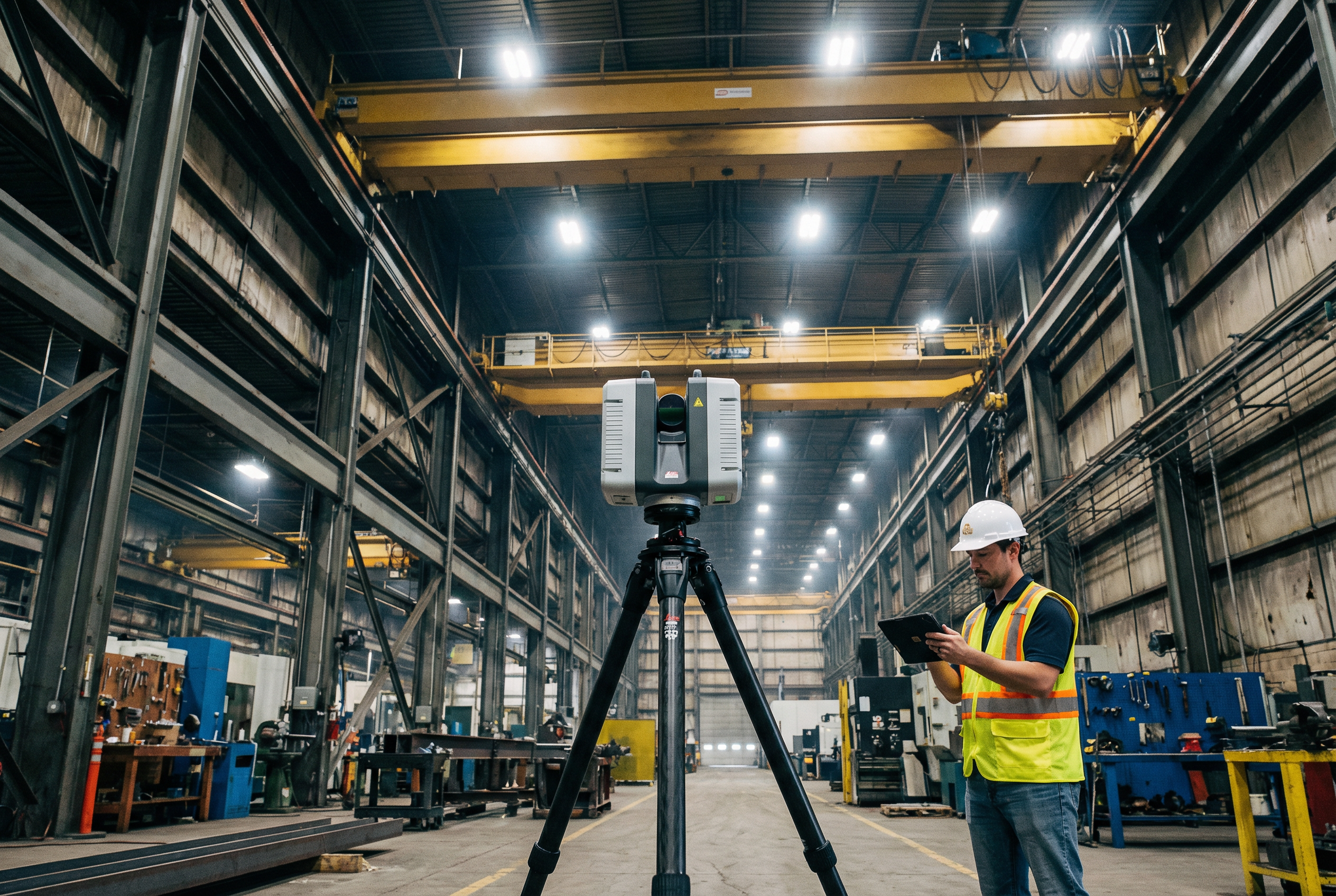
Robotic Imaging deploys the LEICA RTC 360 as the primary instrument for industrial facility documentation. Its 130-meter range covers 80-100 foot ceilings from a single scan position on the production floor — capturing structural steel, overhead cranes, suspended MEP systems, and high-bay lighting infrastructure without repositioning equipment into elevated or hazardous locations.
For extreme-scale applications — outdoor equipment yards, campus-scale industrial sites, or facilities requiring survey-grade control — the ScanStation P40 (270m range) and ScanStation P50 (1,000m range) extend Robotic Imaging's capability to virtually any industrial environment. This multi-scanner arsenal means the right tool is matched to each facility's specific geometry, not the other way around.
The accuracy specification matters for industrial applications specifically: ±1/16 inch (±2mm) at range enables equipment vendors to design around verified clearance envelopes, confirm fit before purchase orders are issued, and coordinate mechanical installations with confidence that field conditions match the model.
Industrial Facility Documentation Scope
A comprehensive large-scale facility scanning engagement captures the full as-built condition across four primary categories:
Building Structure
Structural steel framing, columns, beams, and bracing. High-bay ceiling geometry and elevation at verified intervals. Mezzanine platforms, elevated walkways, stairs, and guardrails. Floor slab conditions, trench locations, and embedded anchors. Exterior walls, loading dock openings, and overhead door locations.
Production Equipment
Assembly lines, CNC machine centers, robotic work cells, press equipment, and stamping lines — documented to equipment footprint and clearance envelope. Conveyor systems including elevation profiles and transfer points. Equipment pads, anchor bolt patterns, and utility connection points. Clearance corridors between production cells for forklift access and safety egress.
Manufacturing plant scanning at this level of detail enables equipment vendors to verify fit, confirm utility stub-out locations, and pre-fabricate support structures before mobilizing to site — eliminating the field coordination failures that generate change orders.
Utilities and MEP Systems
Overhead process piping systems — steam, compressed air, process gases, cooling water — including pipe diameter, routing, and support locations. Electrical distribution: cable trays, conduit runs, panel locations, transformer pads. HVAC ductwork, make-up air units, and exhaust systems. Facility-specific process utilities relevant to manufacturing operations.
Industrial BIM modeling of MEP systems to LOD 300 gives mechanical contractors and equipment vendors the clash detection capability to identify routing conflicts before steel is cut or equipment is moved into position.
Material Handling Infrastructure
Overhead crane systems: bridge crane runway beams, end trucks, and hook height envelope documentation. Jib cranes and monorail systems. Forklift travel paths and aisle dimensions. Loading dock equipment, dock levelers, and trailer restraint locations.
Operational Coordination and Production Continuity
The objection Robotic Imaging hears most consistently from facility managers: "We can't shut down production for documentation."
The answer: you don't have to.
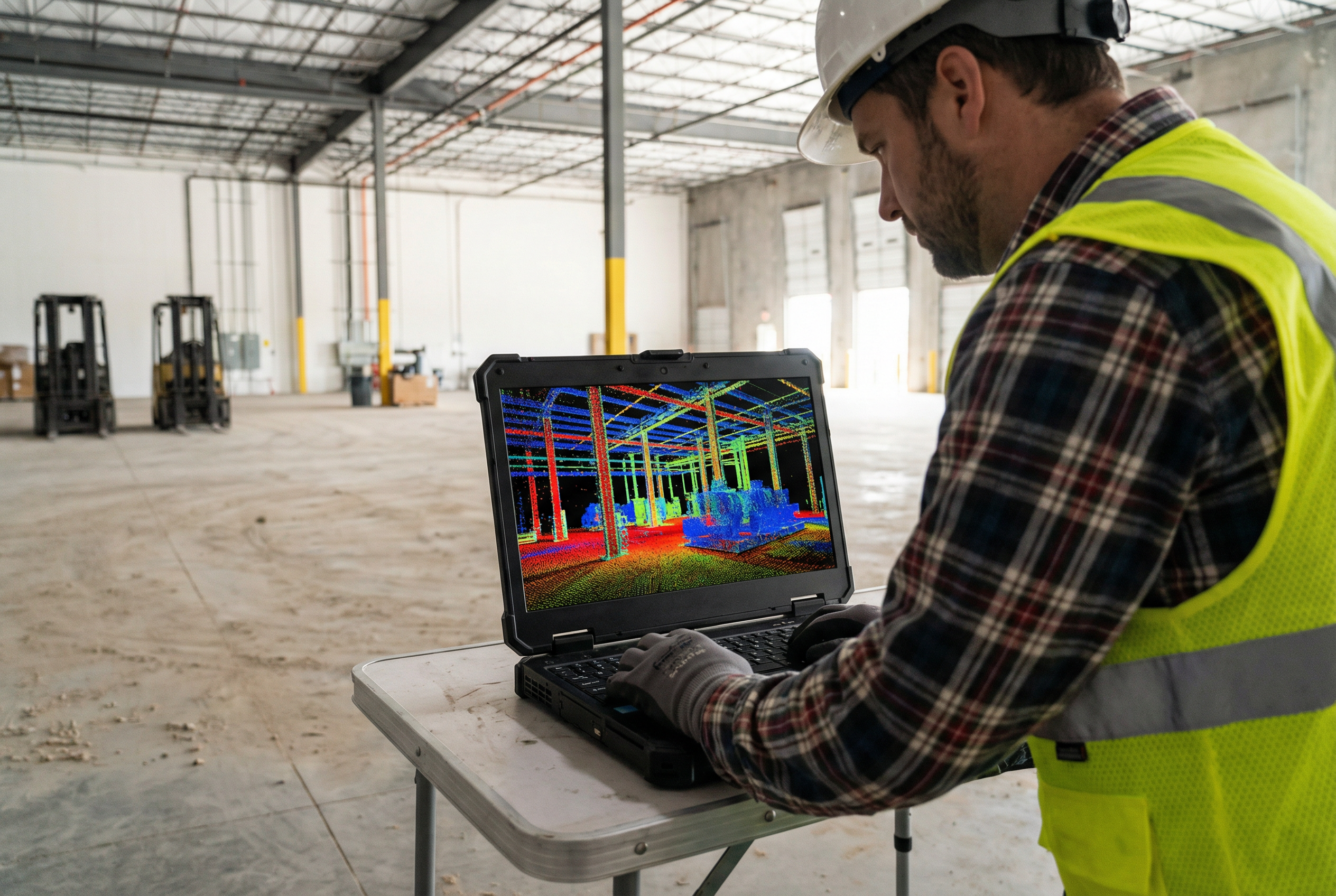
Phased scanning by production zone allows documentation to proceed in sections — capturing one production area during a shift change while adjacent lines remain operational. The LEICA RTC 360's 2,000,000 points-per-second capture rate minimizes time at each scan position, reducing the footprint of any single disruption window.
Production schedule integration begins before mobilization. Robotic Imaging's 24/7 scheduling system allows facility managers and construction PMs to coordinate scan sessions during planned maintenance windows, weekend shutdowns, or overnight shifts — without requiring real-time phone scheduling. Night-shift and weekend scanning options mean production restarts on Monday morning against a documentation schedule that was confirmed weeks in advance.
Safety protocol compliance is a non-negotiable element of industrial facility access. Our field teams operate with full awareness of Lockout/Tagout (LOTO) procedures, PPE requirements by zone, hot work permit protocols, and escort coordination with your safety department. We treat your safety program as a project constraint to be planned around, not an obstacle to be managed around.
For facilities with existing drawings — regardless of accuracy — our scan-first methodology captures verified current conditions as the documentation baseline. Thirty-year-old drawings become reference context, not the source of truth. The point cloud becomes the record.
Applications and Deliverables
Equipment Installation Planning
The highest-value application for manufacturing plant scanning: verify equipment fit, clearance envelopes, and utility connection points before purchase orders are issued. Equipment vendors receive LOD 300 Revit models and native point cloud files (RCS, E57) they can work within directly — designing support structures, coordinating mechanical connections, and confirming dimensional fit against verified existing conditions rather than drawings of uncertain accuracy.
Facility Expansions
Connecting new construction to existing industrial facilities requires verified as-built conditions at the interface — column locations, floor elevations, utility stub-outs, and structural embed locations. Warehouse as-built documentation at LOD 300 gives design teams the foundation to detail new work without field verification trips that delay design schedules.
Safety Compliance Documentation
Egress path documentation to verified dimensions. Equipment clearance corridor verification against OSHA standards. Documentation of aisle widths, overhead clearances, and emergency equipment access paths for safety compliance records.
Capital Planning and Facility Management
Production facility as-built documentation supports long-term capital planning: identifying deferred maintenance conditions, documenting current equipment layouts before reconfiguration projects, and establishing a verified baseline for ongoing facility management. Facilities with 100+ million square feet of documented space across our enterprise client relationships consistently report that the documentation cost is returned on the first avoided change order.
Deliverable Formats
- Revit (.rvt): LOD 300 BIM models for equipment vendor coordination, design integration, and facility planning
- RCS / RCP: Registered point cloud files for Revit and AutoCAD integration
- E57 / LAS: Open format point clouds for third-party software compatibility
- 2D CAD floor plans and sections (.dwg): Dimensioned drawings for facilities without BIM workflows
Frequently Asked Questions
Can laser scanners reach 60-foot ceilings in a manufacturing plant? Yes — with the right equipment. The LEICA RTC 360's 130-meter range covers 80-100 foot high-bay ceilings from a single floor-level scan position. Standard commercial scanners with 20-60 meter ranges cannot reliably capture overhead structure, suspended MEP, or crane infrastructure at these elevations from safe, accessible positions.
How long does it take to scan a large industrial facility? Robotic Imaging completes field capture for facilities of 100,000–500,000 SF in 3-5 days, coordinated around your production schedule. Total delivery — from field capture through LOD 300 Revit model — is 10-14 business days.
Will laser scanning disrupt production operations? Not if coordinated properly. Our phased scanning approach documents production zones in sections during shift changes, maintenance windows, or overnight shifts. The 24/7 scheduling system allows production managers to confirm scan session timing without real-time coordination overhead.
Getting Started with Industrial Facility Documentation
Industrial facility laser scanning works when equipment, methodology, and operational coordination align with the specific challenges of your environment. Robotic Imaging's combination of the LEICA RTC 360 (130-meter range, ±1/16 inch accuracy), ScanStation P40/P50 long-range capability for extreme applications, phased operational coordination, and LOD 300 deliverables within 10-14 business days is purpose-built for the scale and complexity of industrial documentation.
With 100+ million square feet documented for Fortune 500 enterprise clients across large-scale facility programs, Robotic Imaging brings verified industrial documentation experience to every engagement — from single-plant equipment installation projects to multi-site capital planning programs.
Request an Industrial Facility Quote to discuss your facility's specific ceiling heights, floor area, production schedule constraints, and deliverable requirements. Or see manufacturing facility samples to evaluate LOD 300 deliverable quality before committing to a scope.