Mobile Asset Documentation & Intelligence | Robotic Imaging
Robotic ImagingFebruary 26, 2026
Complete Guide to Mobile Asset Documentation and Intelligence
Robotic Imaging's Mobile Asset Documentation and Intelligence platform delivers comprehensive self-service equipment documentation for distributed retail operations. With verified deployments across 7-Eleven's 1,000+ store network and Dollar General's planned 4,000-location rollout, the platform provides smartphone-based photo capture, AI spec sheet extraction achieving 85-90% accuracy, real-time cloud synchronization, and mobile portfolio intelligence dashboards — enabling store managers, maintenance technicians, and facility directors to own their equipment data without professional audit dependencies.
For multi-location retail operators, the fundamental challenge isn't equipment maintenance — it's knowing what equipment exists, where it is, what condition it's in, and when it needs replacement. Traditional approaches force a choice between expensive professional audit services running $5,000-$15,000 per location or perpetually outdated spreadsheets maintained by store staff with no standardized tools. Mobile asset documentation and intelligence software resolves this trade-off: distributed teams document equipment themselves using existing smartphones, AI automates the data extraction burden, and portfolio-wide intelligence becomes available in real time.
A 100-store portfolio operating on professional audit cycles carries $500,000-$1,500,000 in annual audit exposure. Robotic Imaging's platform delivers $600,000+ net annual value against that baseline, with payback periods under two months. The sections that follow break down exactly how each platform capability creates that outcome.
The Mobile-First Platform Architecture That Changes Asset Documentation
Mobile asset documentation and intelligence software enables distributed retail teams to capture, catalog, and manage equipment data using smartphones — with AI spec extraction, real-time cloud synchronization, self-service workflows for non-technical store staff, QR code asset tagging, and mobile portfolio dashboards delivering multi-location visibility without desktop-bound systems or professional audit service dependencies.
This category differs fundamentally from mobile CMMS tools positioned by platforms like UpKeep, Limble, ServiceMax, and Fiix. Those platforms mobilize maintenance workflows — work orders, technician dispatch, preventive maintenance scheduling — but they assume asset records already exist. Creating those records still requires manual data entry, dedicated technicians, or periodic professional audits. Mobile asset documentation platforms solve the upstream problem: how does a distributed retail organization build and maintain accurate equipment registries across hundreds or thousands of locations without sending specialists to every site?
Robotic Imaging's platform architecture answers that question through five integrated capabilities: native mobile applications designed for field-first use, photo-based equipment capture with AI extraction, real-time cloud synchronization, self-service distributed team workflows, and intelligent portfolio dashboards. Each layer depends on the others — a photo-capture workflow without AI extraction shifts burden to manual typing; AI extraction without real-time sync creates data silos; portfolio dashboards without self-service documentation reflect perpetually outdated assets.
The platform runs on native iOS and Android applications — not mobile web wrappers — delivering sub-2-second load times and 60fps scrolling performance. This distinction matters in retail environments where store managers abandon slow applications during morning walk routines. Performance is a prerequisite for adoption, and adoption is a prerequisite for data quality.
> Ready to see the platform in action? Request a mobile platform demo to explore how Robotic Imaging can support your distributed retail documentation program.
Smartphone-Based Photo Capture: Field-First Documentation at Scale
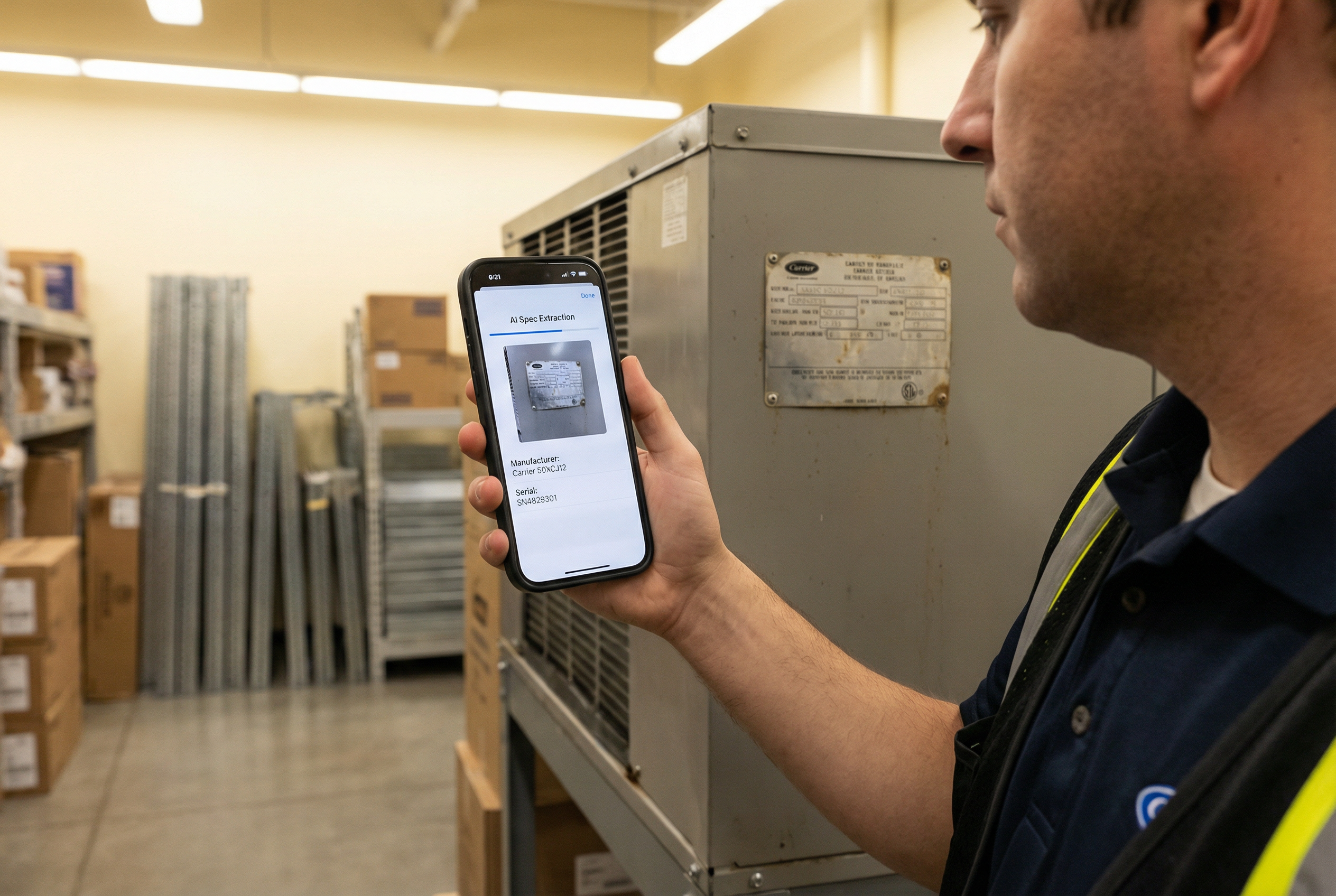
The equipment documentation process begins with a smartphone camera pointed at an equipment nameplate. No specialized hardware. No training on laser measurement tools. No RFID readers or barcode scanners requiring setup and calibration. Store managers document during existing morning walk routines — the documentation workflow integrates into normal operations rather than requiring dedicated trips.
Robotic Imaging's photo-based equipment capture methodology guides users through each step with real-time feedback. The mobile application evaluates photo quality at capture — lighting adequacy, image sharpness, nameplate visibility — and prompts re-capture before the user moves to the next equipment unit. This quality gate eliminates the most common failure mode of self-service documentation: poor-quality images that generate incomplete records discovered only after the field team has left the location.
Offline capability is non-negotiable for retail environments. Back-of-house equipment rooms, walk-in refrigeration areas, basement mechanical spaces, and remote rural locations routinely operate with no WiFi coverage and limited cellular signal. Robotic Imaging's platform caches 1,000+ equipment records locally on the device, enabling full documentation functionality without connectivity. Captured data queues automatically and synchronizes to the cloud in the background when connectivity restores — no manual upload step, no lost documentation sessions.
This offline architecture is materially different from competitors that require connectivity for core functions. A store manager documenting a 150-unit equipment portfolio in a low-signal location completes the full documentation session without interruption. The regional manager reviewing that documentation sees it in their portfolio dashboard within minutes of the store manager reaching parking lot connectivity — not the next business day after a manual export.
Documentation scope includes rooftop HVAC units, kitchen equipment, refrigeration systems, electrical panels, POS hardware, and any equipment category relevant to the operational portfolio. The platform's guided workflow ensures consistent coverage across every location — the same equipment categories captured in the same sequence regardless of which store manager or technician performs the documentation.
At enterprise scale, photo-based equipment capture methodology transforms what was a multi-month professional audit program into a concurrent self-service initiative. When 7-Eleven deployed across 1,000+ locations, store managers documented simultaneously — compressing a sequential audit timeline into weeks of parallel execution.
AI Spec Sheet Extraction: Eliminating the Manual Data Entry Barrier
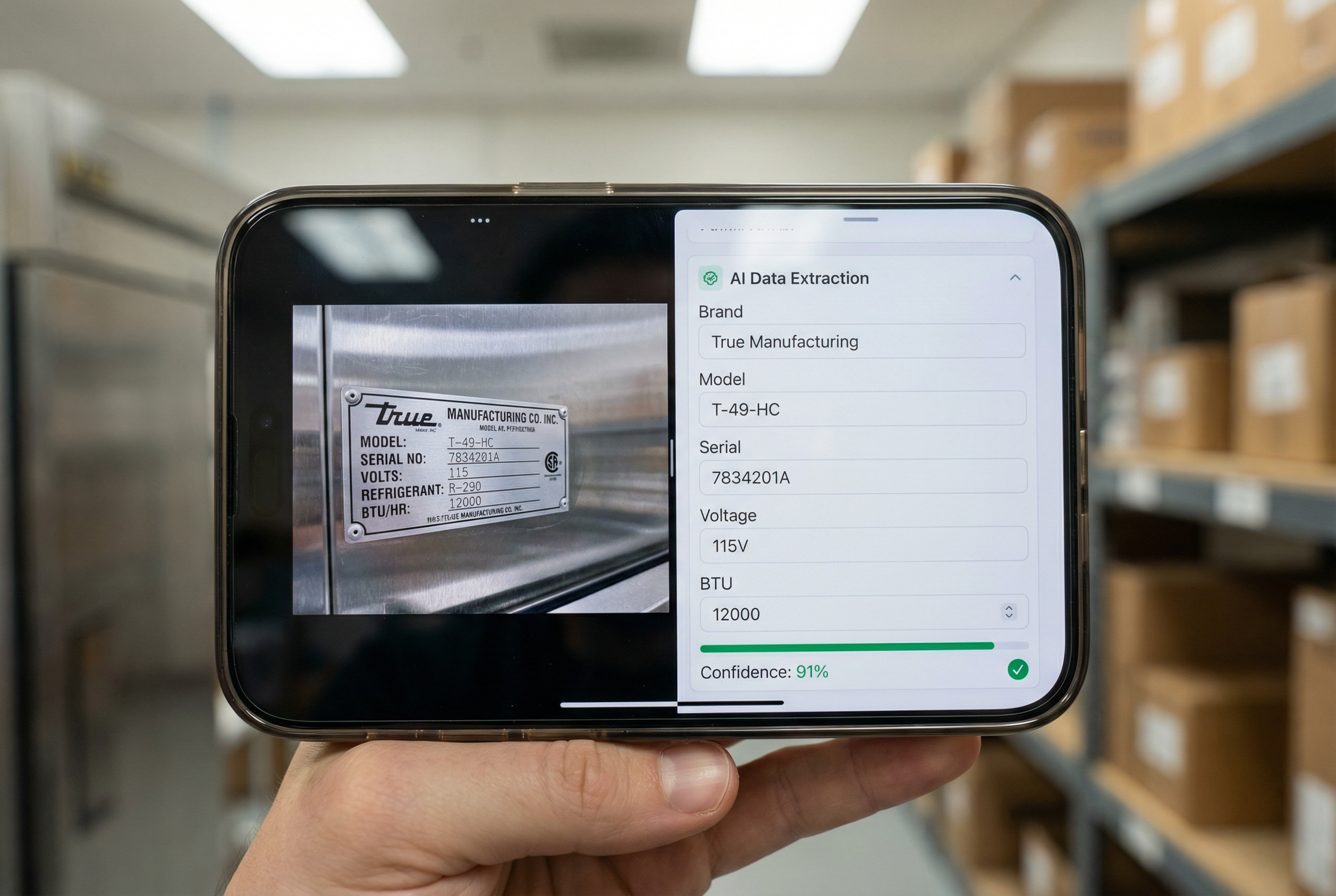
Manual data entry is the reason self-service asset documentation fails in practice. Asking a store manager to photograph equipment and then type make, model, serial number, manufacture date, voltage specifications, refrigerant type, and model number into form fields adds 3-5 minutes per equipment unit. For a 150-unit store, that's 7-12 hours of data entry per location — a burden no operations team will sustain across a portfolio rollout.
Robotic Imaging's AI spec sheet extraction from equipment photos eliminates this barrier by automating the data population step. The AI analyzes nameplate photographs and extracts specifications directly into structured data fields — make, model, serial number, manufacture year, and technical specifications populate automatically from the image. This process takes 5-10 seconds per equipment unit versus 3-5 minutes for manual entry: a verified 30-60x speed improvement.
How accurate is AI equipment spec extraction from photos? Robotic Imaging's AI achieves 85-90% automated extraction accuracy from smartphone nameplate photographs. The platform is transparent about the remaining 10-15%: lower-confidence extractions are flagged for human review rather than silently accepting uncertain data. Regional managers or facility directors review flagged items through a dedicated quality control queue — not re-documenting from scratch, but confirming or correcting AI-populated fields from existing photos.
This human-in-the-loop architecture is what differentiates Robotic Imaging's approach from both fully manual entry (slow, error-prone, inconsistent) and fully automated claims (overstated and brittle). The 85-90% baseline means a 150-unit store generates approximately 15-22 items for human review — a 20-minute quality check compared to 7-12 hours of full manual entry.
Accuracy improves over time. The AI's extraction model learns continuously from the portfolio's specific equipment types, nameplate formats, and manufacturer conventions. Portfolios operating on the platform for 12 months achieve extraction accuracy exceeding 90%. For retail chains with standardized equipment procurement — the same HVAC brands, the same refrigeration manufacturers across hundreds of locations — the learning curve accelerates significantly.
No competitor platform offers photo-to-spec extraction at any accuracy level. UpKeep, Limble CMMS, Fiix, and ServiceMax all require manual data entry for asset creation — a fundamental workflow difference that defines the category gap Robotic Imaging occupies alone.
Real-Time Cloud Synchronization and Portfolio Visibility
Data captured in the field has no operational value until it's accessible to the people making decisions. Robotic Imaging's real-time cloud synchronization architecture ensures that equipment documented by a store manager at 7:00 AM is visible to the district manager's portfolio dashboard by 7:05 AM — not after a nightly batch sync, not after a manual export, not after someone emails a spreadsheet.
The synchronization layer operates in the background across all devices simultaneously. When multiple store managers document concurrently across a district rollout, each store's data streams to the portfolio in real time. The regional manager doesn't wait for all locations to complete before reviewing results — they watch the portfolio populate location by location as documentation progresses.
Concurrent scale matters at enterprise deployment. When Dollar General's 4,000-location program reaches full execution, the platform architecture supports hundreds of simultaneous documentation sessions without performance degradation. The 100+ concurrent user capacity isn't a theoretical specification — it's validated by the operational demands of enterprise retail rollouts where waves of stores document in parallel to meet program timelines.
Real-time sync also enables immediate quality control intervention. Regional managers monitoring an active documentation session identify issues — incomplete equipment coverage, low-quality photo batches, missed equipment categories — while store staff are still on-site. Corrections happen during the original visit rather than requiring a return trip or accepting incomplete data.
For facility directors managing capital planning decisions, real-time portfolio visibility shifts the analytical timeframe from quarterly audit reports to continuous intelligence. Equipment age distributions, warranty expiration clusters, and lifecycle replacement forecasts update automatically as documentation progresses rather than requiring a new audit cycle to refresh.
Self-Service Distributed Team Workflows: Documentation Without Technical Specialists
The defining characteristic of Robotic Imaging's platform — the capability that no competing CMMS or field service platform replicates — is enabling non-technical store managers to execute professional-quality equipment documentation without training, technical background, or support from maintenance specialists.
Can store managers document equipment themselves without technical training? Yes — the guided mobile workflow is designed specifically for store operations staff. The application presents one task at a time: navigate to this equipment category, photograph this nameplate, confirm this coverage area. Decision points are eliminated; the workflow advances automatically. A store manager who has never used asset management software completes a full documentation session on their first attempt.
This self-service asset management approach for retail operations matters operationally for a specific reason: it decouples documentation scale from specialist headcount. Traditional audit and documentation programs scale linearly — more locations require more specialists, longer timelines, higher costs. Self-service distributed documentation scales with the store count itself, because the workforce executing the documentation grows proportionally with the portfolio.
The workflow supports multiple documentation roles simultaneously. Store managers document their own locations. Maintenance technicians contribute equipment specifications during service visits. Regional managers oversee quality control and coverage completeness. Facility directors monitor portfolio-wide progress. All four roles operate through the same platform with role-appropriate access and task visibility.
The 100-store concurrent documentation example: When a retail operator runs a full-portfolio documentation initiative across 100 stores simultaneously, Robotic Imaging's platform coordinates all 100 documentation sessions in parallel. Progress dashboards show completion percentages by region, district, and individual location. Quality control queues aggregate flagged items across all stores into a single review workflow for regional managers. Portfolio dashboards update in real time as each location reaches documentation milestones.
Distributed team asset tracking workflows that coordinate this scale of concurrent activity represent a capability gap competitors have not addressed — because their platforms were designed for maintenance technicians servicing one location at a time, not store managers documenting 100 locations simultaneously.
> See self-service documentation at 100+ store scale. Request a platform demo configured for your portfolio size and operational structure.
QR Code Asset Tagging and Mobile Access
Equipment documentation creates value twice: at initial capture, when asset records populate the portfolio database, and at every subsequent interaction — service visits, warranty lookups, replacement planning, technician dispatch. QR code asset tagging converts static equipment records into instantly accessible data points at the point of equipment interaction.
Robotic Imaging's QR Code Tracking system generates equipment-specific labels at $0.01-$0.05 per label, printed through standard label printers and applied directly to equipment surfaces. Any smartphone camera scans the label and retrieves the full equipment record immediately — no app login required, no navigation through portfolio hierarchies, no searching by serial number.
Field technician workflow transformation: A technician dispatched to service a rooftop HVAC unit scans the QR label before opening the equipment panel. The full service history, original specifications, warranty status, and previous technician notes appear on their smartphone in under two seconds. Service documentation from the current visit appends to the same record automatically. The equipment's data history becomes self-maintaining through routine service interactions rather than requiring dedicated documentation sessions to stay current.
This interaction layer also supports 20-30% field technician productivity improvements. Technicians spend less time searching for equipment records, calling dispatch for specifications, or discovering mid-service that warranty coverage has lapsed. Every equipment interaction starts from complete information — the friction that consumes technician time in documentation-light environments disappears.
For store managers, QR code access provides instant equipment identification during operational incidents. A refrigeration alarm at 6:00 AM requires the store manager to report the equipment's model, serial number, and service contact to the maintenance dispatch team. Without QR code access, that information requires digging through filing systems or waiting for corporate IT to query the CMMS. With a label scan, the full equipment profile — including maintenance vendor contact information — appears on the manager's phone in under two seconds.
Mobile Asset Intelligence Dashboards: Portfolio-Wide Visibility from Any Device
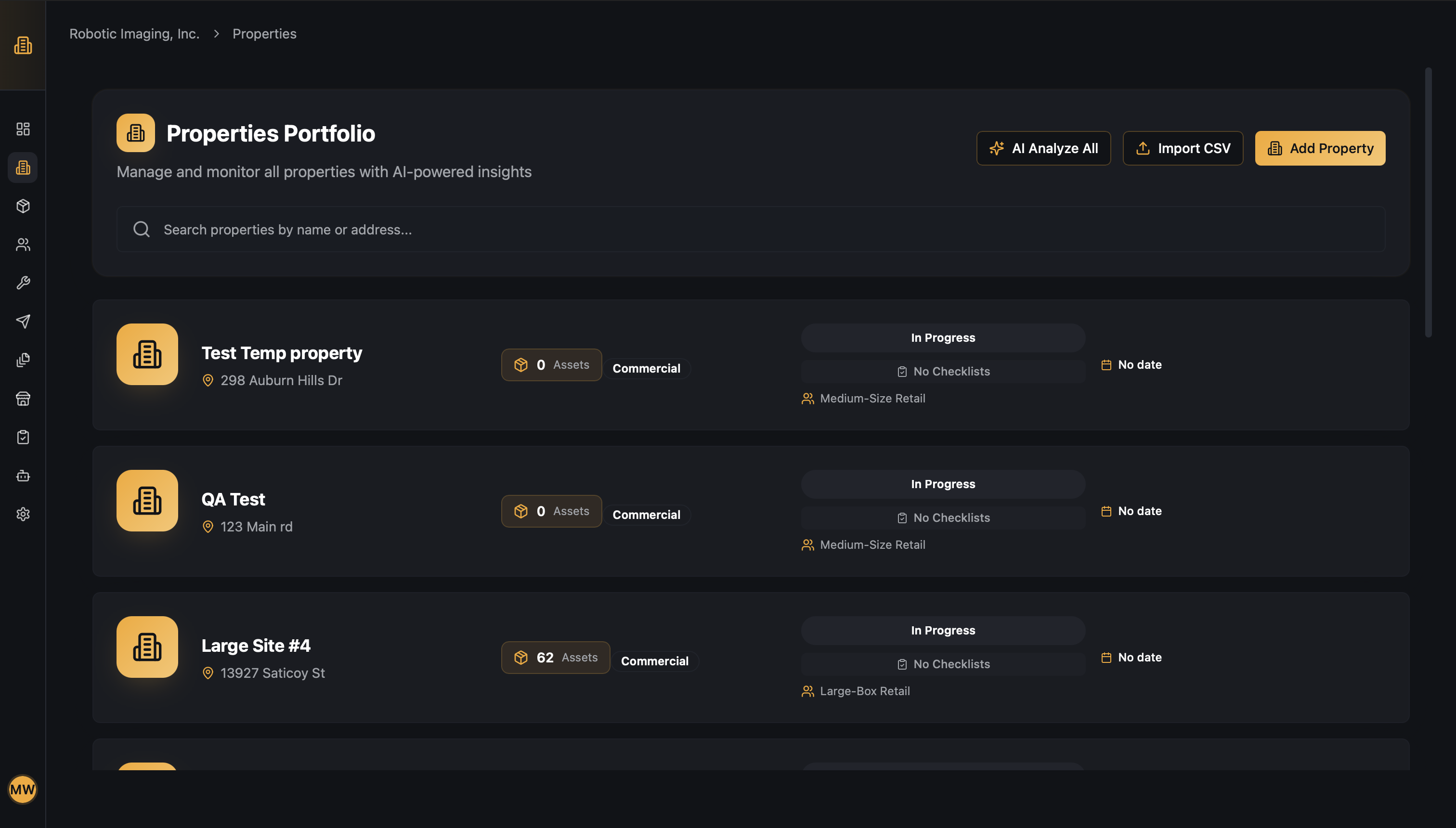
Documentation is the means. Portfolio intelligence is the outcome. Robotic Imaging's mobile asset intelligence dashboards convert distributed equipment documentation into capital planning, lifecycle forecasting, and operational decision support accessible from any device — including the mobile devices that field and regional staff carry during normal operations.
The dashboard architecture follows the organizational hierarchy of multi-location retail: Corporate → Regional → District → Store → Equipment. A facility director reviewing the full portfolio sees aggregate equipment age distributions, category-level lifecycle exposure, and documentation completeness across all locations. Drilling into a region surfaces the same view filtered to regional scope. Drilling to a single store surfaces individual equipment records with full specification and service history detail.
This drill-down capability addresses the specific intelligence gap that drives facility directors toward self-service documentation platforms. Professional audit services provide point-in-time snapshots — accurate when delivered, degrading immediately as equipment ages, fails, or gets replaced without record updates. Portfolio dashboards built on self-service documentation with real-time sync provide continuous intelligence rather than periodic snapshots. Equipment age calculations update as new documentation arrives. Lifecycle replacement forecasts refresh as service records accumulate.
At the scale of 50,000 equipment units across 500 locations — a representative enterprise retail portfolio — this intelligence layer enables capital planning decisions that are impossible from periodic audit data. Which equipment categories are approaching end-of-life simultaneously across multiple districts? Which regions have documentation gaps requiring follow-up? Which locations have equipment warranties expiring within 90 days? These questions are answerable in minutes from portfolio dashboards rather than requiring analyst time to compile and interpret audit reports.
The mobile accessibility of these dashboards reflects the operational reality of facility director and regional manager roles: decision-relevant intelligence accessed from a conference room laptop is less valuable than the same intelligence accessible on a mobile device during a store visit or board presentation. Real-time mobile access to portfolio intelligence is an architectural decision, not a convenience feature.
Platform Use Cases: Documented Workflows by Role
Robotic Imaging's Mobile Asset Documentation and Intelligence platform serves six distinct operational personas, each with documented ROI proof and specific workflow integration.
Store Managers execute initial equipment documentation and maintain ongoing records through QR code-enabled service interactions. The guided mobile workflow requires no prior training. Documentation integrates with morning walk routines — a 150-unit store completes initial documentation in under four hours on first pass. 7-Eleven's 1,000+ store deployment validated this workflow at scale: store managers across a four-timezone network documented simultaneously, compressing what would have been an 18-month sequential audit program into a coordinated multi-week initiative.
Facility Directors use portfolio intelligence dashboards for capital planning, budget forecasting, and lifecycle management. The $600K+ annual value figure for a 100-store portfolio derives primarily from audit fee elimination — but the secondary value driver is capital planning precision. Equipment replacement budgets based on accurate, current age data require smaller contingency reserves than budgets built on estimated ages from periodic audits.
Regional Managers oversee documentation quality, coordinate district-level initiatives, and review AI-flagged extractions through the quality control queue. The concurrent documentation model means regional managers supervise multiple store documentation sessions simultaneously from their dashboard — not sequentially visiting each location.
Maintenance Technicians contribute equipment specifications during service visits and access full equipment history through QR code scans. The 20-30% productivity improvement comes directly from eliminating information-search time at equipment locations.
District Managers monitor documentation completeness across their location portfolios and track capital expenditure exposure by equipment category and age cohort.
Operations Leadership accesses executive dashboard views of portfolio-wide equipment status, documentation progress, and lifecycle forecasting relevant to board-level capital planning discussions.
The Enterprise Deployment Advantage: Why Scale Proof Matters
Platform evaluation at the BOFU stage surfaces one critical question that feature comparisons cannot answer: has this platform actually executed at enterprise scale in environments identical to ours?
Robotic Imaging's answer is documented and verifiable. The 7-Eleven deployment across 1,000+ stores demonstrates that store-manager self-service documentation works across a geographically distributed convenience retail network — not in a controlled pilot, not in a single region, but across a national portfolio with variable store sizes, equipment mixes, connectivity conditions, and staff technology comfort levels.
Dollar General's planned 4,000-location rollout represents the largest self-service retail documentation program in the industry — a commitment by a Fortune 500 retailer that reflects platform confidence at a scale that eliminates "will this work at our size?" as an evaluation objection for any retail operator below that threshold.
The 50,000 equipment / 500 locations portfolio benchmark provides the mid-market reference point: a multi-regional retail operator with a fully documented portfolio, real-time dashboard visibility, and AI extraction accuracy exceeding 90% at the 12-month operating mark.
No competitor platform — UpKeep, Limble CMMS, ServiceMax, or Fiix — demonstrates self-service retail documentation deployments at this scale because their platform architectures don't support the use case. Their mobile capabilities are real; their enterprise customer lists are real; their category is simply different. Mobile CMMS tools manage maintenance workflows for equipment that has already been documented. Robotic Imaging's platform creates the documentation those systems depend on — and does it at retail scale without specialist staff.
Build Your Mobile Asset Documentation Program
Multi-location retail operations that continue relying on professional audit cycles face compounding cost exposure as portfolios grow and audit fees scale linearly with location counts. Operators that deploy self-service mobile asset documentation compress that cost curve, build continuously updated portfolio intelligence, and eliminate the data latency that makes capital planning reactive rather than predictive.
Robotic Imaging's Mobile Asset Documentation and Intelligence platform delivers $600,000+ net annual value for 100-store portfolios, with payback periods under two months. The platform's verified deployment across 7-Eleven's 1,000+ store network and Dollar General's 4,000-location program provides the enterprise proof that distinguishes platform selection from platform speculation.
The documentation capability your facility operations require is available today on the smartphones your store managers already carry. The AI spec extraction, offline functionality, real-time synchronization, and portfolio intelligence infrastructure are production-validated at enterprise scale. The remaining question is how quickly your portfolio transitions from periodic audit dependency to continuous self-service documentation intelligence.
Three ways to move forward:
1. Request a Mobile Platform Demo — See store-manager documentation workflow, AI spec extraction, and portfolio dashboards configured for your retail environment. [Request Demo]
1. Schedule a Strategic Consultation — Discuss your portfolio scale, current audit program costs, and phased deployment approach with a Robotic Imaging solutions specialist. [Schedule Consultation]
1. Download the Mobile Asset Management Guide — Detailed deployment planning framework, ROI calculation methodology, and distributed team workflow specifications for multi-location retail operators. [Download Guide]