Mobile Procurement Asset Vendor Platform for Retail
Robotic ImagingMay 12, 2026
Procurement Asset and Vendor Management Platform: Mobile Intelligence for Multi-Location Retail
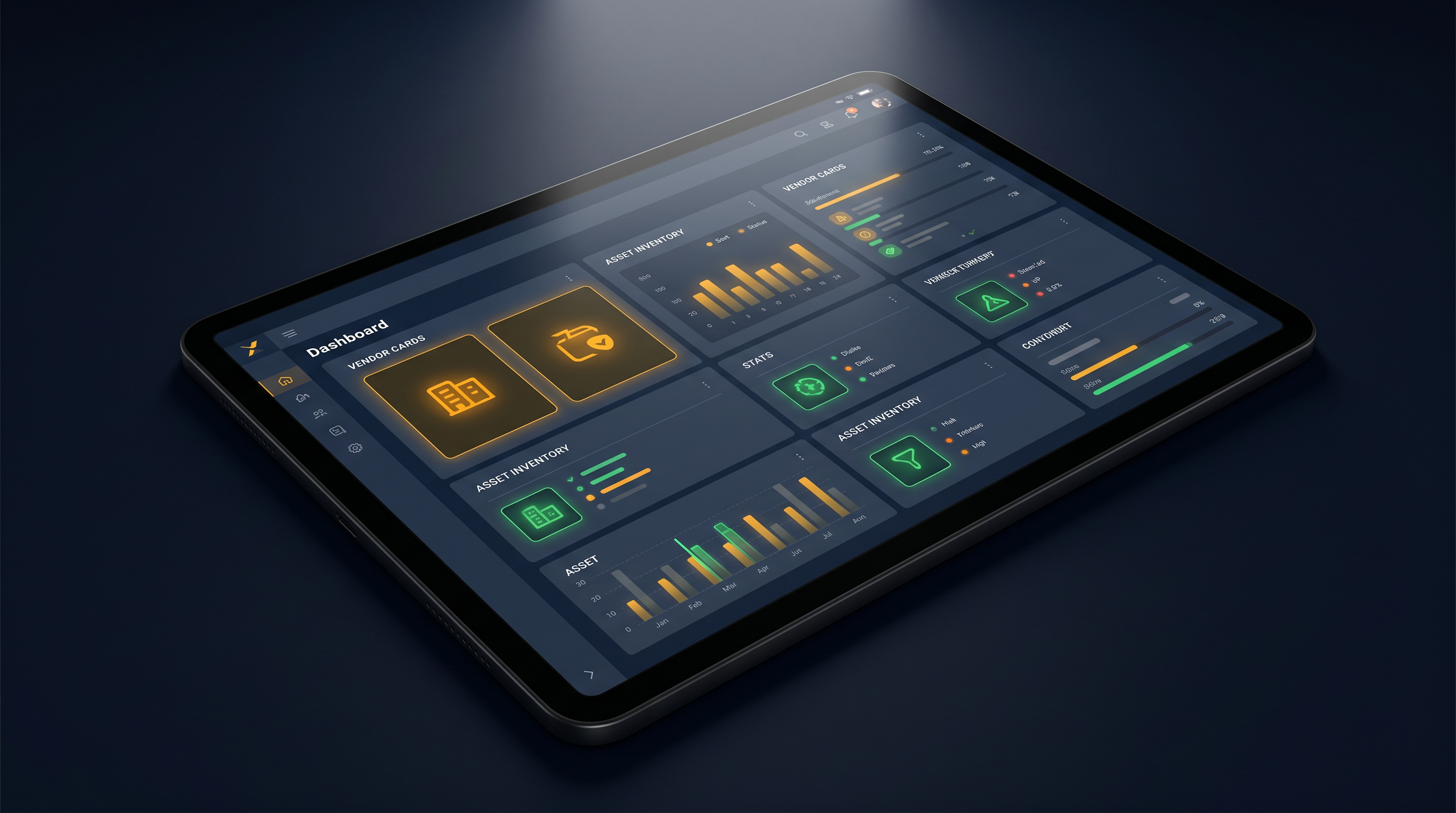
For procurement managers overseeing equipment purchasing across multi-location retail portfolios, desktop-bound procurement systems create a critical gap: vendor meetings happen in the field, site visits happen at stores, and strategic planning sessions happen in conference rooms — but equipment specifications, vendor performance data, and purchase order status remain locked in office-bound systems. Robotic Imaging's procurement asset and vendor management platform delivers equipment specifications, vendor scorecards, purchase order workflows, and procurement portfolio analytics from native iOS and Android mobile apps — enabling strategic sourcing from anywhere, not just the office. With deployments across 7-Eleven's 1,000+ store network and Dollar General's 4,000-location rollout, the platform brings retail-scale procurement intelligence directly to the devices procurement managers already carry.
A procurement asset and vendor management platform provides multi-location retail procurement teams with: (1) an equipment specifications database accessible from smartphones and tablets for accurate vendor sourcing; (2) vendor performance tracking monitoring delivery, quality, and cost competitiveness; (3) equipment standardization analysis identifying vendor consolidation opportunities achieving 12-18% cost reduction; (4) mobile purchase order approval and delivery tracking; and (5) portfolio spend analytics accessible from mobile devices during vendor negotiations and planning sessions.
Why Desktop-Bound Procurement Systems Fail Multi-Location Retail
The fundamental problem isn't that procurement managers lack tools — it's that their tools don't travel with them. A VP of Procurement overseeing equipment purchasing across 200 retail locations spends significant time outside the office: visiting vendor facilities, conducting store walk-throughs, attending capital planning meetings, reviewing equipment installations. Every one of those scenarios demands procurement intelligence — and desktop-bound systems deliver none of it.
The consequences compound quickly. A procurement manager walks a vendor's showroom comparing refrigeration units without verified specifications from actually installed equipment. A purchase order sits pending approval for three days because the approving manager is traveling. A vendor negotiation proceeds without objective performance data, leaving $200,000 in potential contract savings on the table. Equipment arrives on-site that doesn't match installation requirements because the RFQ was built from paper specs rather than verified installed configurations.
Platforms like ServiceChannel address vendor compliance through work order workflows, and enterprise procurement solutions like Coupa handle purchase order management and supplier tracking — but neither connects equipment asset reality at the store level to the procurement decisions being made in the field. The intersection of equipment asset intelligence and mobile procurement workflow is where multi-location retail procurement consistently underperforms.
Robotic Imaging's platform was built specifically for this intersection: verified equipment specifications at every location, vendor performance intelligence accessible from any device, and purchase order workflows that follow procurement managers into the field rather than anchoring them to the office.
> Ready to replace desktop-bound procurement with mobile intelligence? Request a Procurement Platform Demo to see how Robotic Imaging delivers specification accuracy, vendor performance tracking, and PO management from your smartphone or tablet.
Mobile Equipment Specifications Access: Sourcing Accuracy Starts with Verified Data

The most expensive procurement error in multi-location retail equipment purchasing isn't vendor fraud or contract mismanagement — it's ordering the wrong equipment because the specification was wrong. A single incorrect refrigeration unit order runs $10,000-$40,000 in equipment cost alone, before accounting for return freight, expedited replacement sourcing, installation rescheduling, and lost selling time during the delay.
Specification errors happen because procurement teams are sourcing from memory, paper maintenance records, or information passed through three organizational layers from a technician who documented the original installation two years ago. The installed equipment at Store #847 may be a different model variant than Store #848 despite purchasing them in the same order cycle — equipment replacement programs, emergency substitutions, and vendor substitutions create portfolio divergence that paper records never capture accurately.
Robotic Imaging's platform solves this at the source. Store-level staff photograph equipment using standard smartphones, and the platform's AI extraction achieves 85-90% accuracy automatically capturing manufacturer, model number, and serial number from those photos — 30-60x faster than manual data entry. No technical expertise required. The same approach 7-Eleven uses across 1,000+ sites scales to any retail portfolio without requiring specialized staff or external audit firms.
The procurement impact is direct: when a category manager needs to source replacement walk-in cooler compressors across 40 locations, the equipment specifications database provides verified manufacturer and model data for every unit — not estimated, not recalled, verified. RFQs built from verified specifications match actual installation requirements, reducing specification-driven order errors and the costly rework cascade they trigger.
The mobile access dimension matters as much as the accuracy. During a vendor meeting evaluating HVAC equipment options, procurement managers access complete installed specifications for every location in the portfolio from an iPad — comparing proposed equipment against what's actually installed, identifying compatibility requirements, and validating vendor claims against real configuration data. Specification accuracy and mobile accessibility together transform vendor meetings from reactive conversations into informed sourcing negotiations.
The platform's offline capability extends this advantage into low-connectivity environments: 1,000+ equipment units cached locally on the device, accessible without a network connection during store visits or vendor facility tours where cellular reliability varies. Procurement intelligence doesn't fail when the conference room has poor Wi-Fi.
Vendor Performance Tracking: Objective Scorecard Data for Every Negotiation
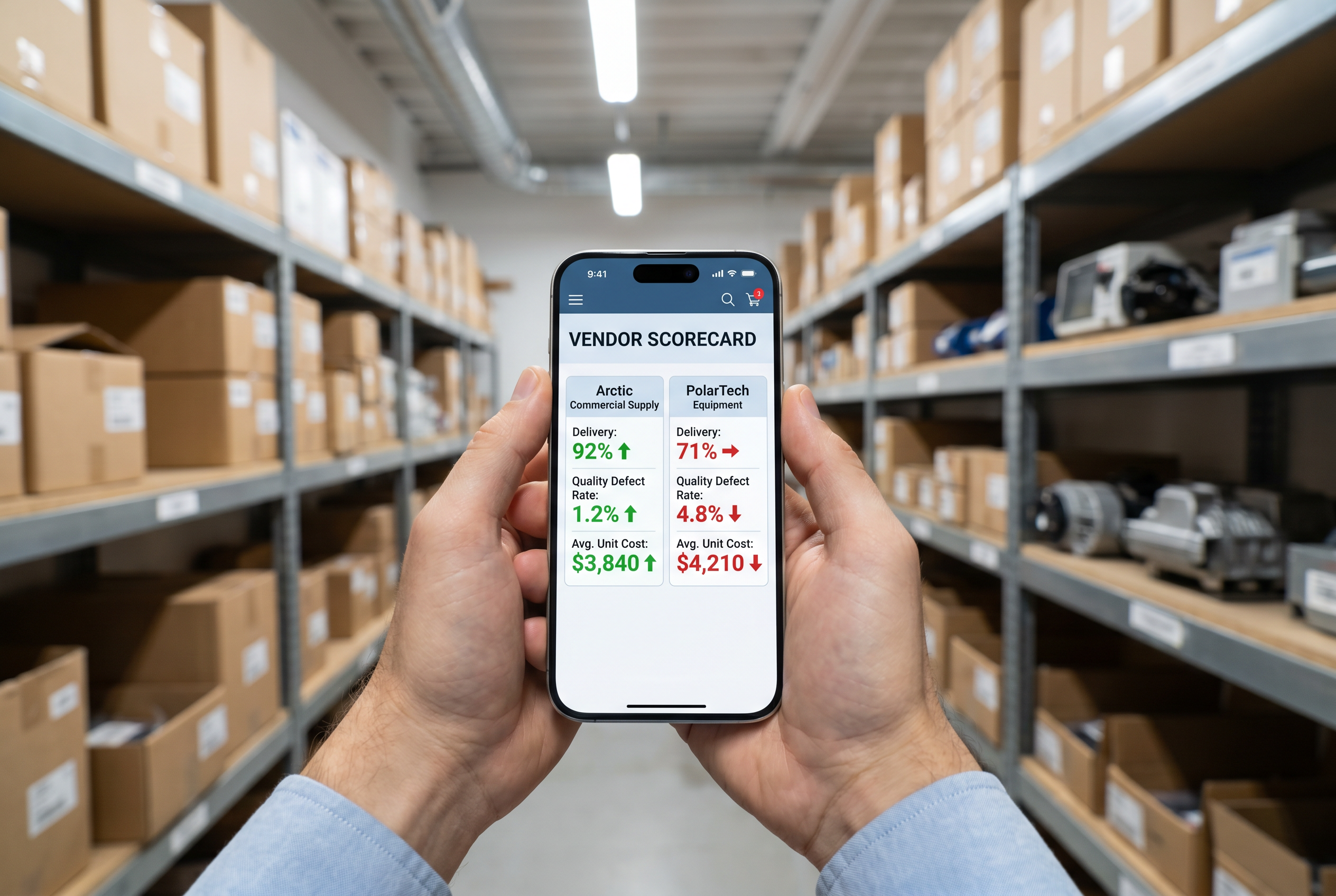
Vendor negotiations without objective performance data are exercises in leverage guesswork. A vendor claims 98% on-time delivery — but procurement's experience across 40 locations suggests otherwise. Without tracked data, the vendor's assertion stands. With Robotic Imaging's vendor performance tracking, the procurement manager opens a tablet and presents: "Your on-time delivery rate across our portfolio is 3.1 out of 5.0 over the last 18 months, compared to your competitor's 4.3 out of 5.0 over the same period and portfolio size. Here's the location-by-location breakdown."
That's a different negotiation.
The platform tracks vendor performance across the dimensions that determine total cost of ownership in retail equipment procurement:
- Delivery performance: On-time rate, lead time accuracy, expedite frequency
- Equipment quality: Installation defect rates, warranty claim frequency, return rates
- Cost competitiveness: Price trend tracking, quote accuracy versus invoice, invoice discrepancy rates
- Service responsiveness: Response time to issues, resolution completion rates
These metrics aggregate across the entire portfolio — not just the locations a procurement manager happens to remember — and they surface from mobile devices during negotiations, planning meetings, and vendor review sessions. The VP of Procurement walking into an annual vendor review carries objective data for every location in the portfolio, accessible from a smartphone, without needing to request a report from an analyst the day before.
For multi-location retail procurement, this transforms vendor relationship management from subjective to analytical. Dollar General's planned 4,000-location deployment illustrates the scale at which this matters: tracking vendor performance across thousands of locations manually is operationally impossible. Automated performance tracking at portfolio scale is the only viable path to objective vendor management.
Procurement software like Coupa provides supplier management functionality, but the performance data it captures is disconnected from physical equipment at store locations. A vendor's invoice accuracy tracks through Coupa; whether their equipment actually performs at specifications across 200 installed units at diverse store configurations requires the equipment asset connection that only a purpose-built procurement asset platform provides.
Equipment Standardization and Cost Optimization: From 12 Vendors to 3
The hidden cost of equipment vendor proliferation in multi-location retail isn't visible in any single purchase order — it accumulates across thousands of transactions, parts inventories, technician training requirements, and missed volume commitments. A portfolio operating with 12 refrigeration vendors across 300 locations is spending the same annual equipment budget as a portfolio with 3 preferred vendors, but capturing none of the volume leverage that consolidation enables.
The challenge isn't that procurement managers don't understand consolidation — it's that they lack the portfolio-level equipment data to execute it analytically. Recommending consolidation to a CFO requires answering: which vendors are present across the portfolio, what percentage of total equipment spend they represent, what their performance track records show, and what preferred pricing tiers volume commitment would unlock. Without an equipment asset database connected to procurement intelligence, that analysis requires weeks of manual data gathering across locations, maintenance records, and vendor contracts.

Robotic Imaging's platform delivers that analysis from a dashboard. A 300-location portfolio with $8.4M in annual refrigeration equipment spend might distribute across 12 vendors, averaging $700K per vendor — insufficient volume for preferred pricing at any of them. Portfolio analytics surface this fragmentation and model consolidation scenarios: redirect 80% of spend to 3 preferred vendors at $2.24M each, cross the volume threshold for preferred pricing tiers, and achieve 12-18% cost reduction on committed vendor spend. On an $8.4M equipment budget, that range represents $1.0M-$1.5M in annual savings.
The executive dashboard presents this analysis in a format built for CFO conversations: total portfolio equipment spend by category, vendor distribution across locations, standardization opportunity score, and projected savings from consolidation scenarios — accessible from a tablet during capital planning sessions without pulling an analyst report. For VP Procurement making the case for procurement platform investment, the ROI conversation is straightforward: $600K+ annual net value for a 100-store portfolio, with platform cost representing a fraction of the annual equipment spend it optimizes.
Standardization analytics also reduce operational costs beyond equipment purchasing. A portfolio standardized on 3 refrigeration vendors requires parts inventory for 3 equipment lines, not 12. Technicians develop expertise on 3 platforms, not 12. Warranty management covers 3 vendor relationships, not 12. The savings from equipment procurement standardization ripple through maintenance, operations, and facilities management in ways that extend procurement's strategic contribution well beyond the purchasing transaction.
Purchase Order Mobile Management: Approvals That Follow You, Not the Reverse
The purchase order approval bottleneck is one of the most operationally expensive inefficiencies in multi-location retail procurement — and one of the most easily solved with mobile workflow capability. A procurement manager traveling Tuesday through Thursday shouldn't create a three-day delay in equipment orders that affect store operations. Yet desktop-bound PO systems create exactly that pattern: approvals wait for office return, equipment orders sit pending, store timelines slip.
Robotic Imaging's platform delivers complete purchase order workflow management from native iOS and Android apps. A $45,000 equipment order requiring VP approval doesn't wait three days for an office visit — it routes to the approving manager's smartphone, displays full order detail against specification data from the equipment asset database, and completes approval in under two minutes from wherever the approver is located.
The mobile PO capability extends beyond approvals to the full procurement workflow:
- PO creation with specification data pre-populated from the equipment asset database — eliminating manual spec entry and the transcription errors it produces
- Approval routing with mobile notification and one-tap review against complete order context
- Delivery tracking against committed timelines with vendor performance data automatically updating
- Invoice reconciliation comparing received equipment against ordered specifications
For field procurement managers visiting store locations, this means a site visit that identifies equipment requiring replacement can initiate a purchase order the same day — specifications pulled from the installed equipment database, vendor selected based on portfolio performance data, approval routed from the parking lot. The entire procurement initiation cycle completes before the manager drives to the next location.
The offline capability matters particularly for PO management during store visits in low-connectivity environments: equipment specifications remain accessible without network connectivity, and workflows synchronize automatically when connectivity restores. Procurement intelligence doesn't depend on whether the store's back-of-house has reliable cellular service.
Vendor Negotiation Mobile Support: Portfolio Intelligence at the Table
The most effective vendor negotiations aren't won in the preparation phase — they're won because the procurement manager arrives with data the vendor doesn't expect them to have. Walking into an annual vendor review with location-level performance data, portfolio-wide equipment specification counts, and real-time standardization analytics creates a fundamentally different negotiation dynamic than arriving with general category knowledge and relationship history.
Robotic Imaging's platform puts this intelligence on a tablet during vendor meetings. A category manager negotiating refrigeration equipment contracts accesses:
- Total installed unit count across the portfolio by this vendor — establishing volume commitment context
- Performance scorecard compared to competing vendors across delivery, quality, and cost dimensions
- Equipment model distribution showing standardization progress and future volume trajectory
- Portfolio expansion plans with projected equipment volume by category
Volume analytics from 50,000 equipment units across 500 locations give procurement managers the data infrastructure to negotiate preferred pricing tiers credibly — not as aspirational commitments, but as documented portfolio reality. "We have 1,847 installed units of your equipment across 312 locations and project 400 additional units in the next 18 months" is a negotiation position, not a sales conversation.
The tablet accessibility makes this intelligence active during negotiations rather than reference material prepared in advance. When a vendor disputes a performance claim or proposes alternative equipment specifications, the procurement manager responds with current data from the platform — not memory, not yesterday's report, current data.
Procurement Portfolio Analytics: Strategic Intelligence for Capital Planning
The evolution from tactical procurement to strategic procurement leadership requires a data foundation that connects equipment asset reality to spend patterns, vendor performance, and capital planning priorities. Robotic Imaging's platform provides executive dashboard analytics that deliver this connection across the full portfolio scale.
A VP of Procurement managing $8M+ in annual equipment spend across 200 locations accesses portfolio-wide analytics from a mobile device: total equipment count by category and location, vendor distribution and spend concentration, standardization progress against consolidation targets, and capital replacement forecasting based on equipment age and condition data. This is the data infrastructure for CFO-level conversations about procurement strategy — not just tracking, but predictive intelligence.
Real-time sync across the portfolio means analytics reflect current data: a new equipment installation at Store #312 yesterday updates portfolio counts today. A vendor's delivery failure last week reflects in their performance score this week. Capital planning sessions can proceed from current portfolio intelligence rather than last quarter's static reports.
For procurement managers whose role is evolving from purchase order processing to strategic capital oversight, this analytics capability represents a fundamental shift in organizational positioning. Procurement intelligence that was previously only accessible through multi-week data gathering exercises from multiple systems becomes a daily operational tool — accessible from the same device used for vendor negotiations and store visits.
The Procurement Transformation: From Desktop Tool to Mobile Platform
The gap between how multi-location retail procurement actually operates — in the field, in vendor meetings, in stores — and where procurement intelligence has historically lived — locked in desktop systems — is the core inefficiency Robotic Imaging's platform resolves.
The transformation follows a clear sequence: AI-powered equipment documentation by store staff (85-90% extraction accuracy, no technical expertise required) builds a verified specifications database across the portfolio. That database feeds procurement workflows — accurate RFQs, specification-matched purchase orders, delivery tracking against verified requirements. Vendor performance data accumulates automatically across every transaction and location. Portfolio standardization analytics identify consolidation opportunities. Procurement managers access all of it from mobile devices during vendor meetings, store visits, and capital planning sessions.
The financial case is direct: for a 100-store retail portfolio, Robotic Imaging's platform delivers $600K+ annual net value with a payback period under two months. Against an $8M+ annual equipment spend, 12-18% savings through vendor consolidation enabled by portfolio standardization analytics represents $960K-$1.4M annually — making the platform cost negligible relative to the procurement intelligence it delivers.
Enterprise deployments at 7-Eleven (1,000+ sites) and Dollar General (4,000 locations planned) demonstrate that the platform scales reliably across the retail portfolio sizes where procurement complexity is highest and the cost of desktop-bound systems is most significant.
The question for VP Procurement evaluating procurement asset platforms isn't whether mobile intelligence improves procurement outcomes — it's whether the current desktop-bound approach is acceptable given what it's costing in specification errors, vendor negotiation weakness, approval bottlenecks, and missed standardization savings.
Ready to replace desktop-bound procurement with mobile intelligence?
Request a Procurement Platform Demo — See equipment specifications, vendor scorecards, purchase order workflows, and portfolio analytics from the devices your procurement team uses in the field.
Schedule a Procurement Strategy Briefing — A focused session for VP Procurement evaluating platform options, with ROI modeling specific to your portfolio size and equipment spend.
Download the Procurement Guide — Vendor consolidation and equipment standardization strategies for multi-location retail procurement teams.