Multi-Location Scan-to-BIM: 50+ Concurrent Teams
Robotic ImagingMarch 3, 2026
Multi-Location Scan-to-BIM Programs for Enterprise Portfolios
For corporate real estate managers overseeing 50 to 2,000+ locations, the gap between "we need as-built documentation across our portfolio" and "we have a vendor who can actually execute it" is where most programs stall. Managing 10–15 regional scanning firms creates inconsistent BIM deliverables, billing complexity, and coordination overhead that consumes internal resources without producing a coherent dataset. Sequential project-by-project scanning is mathematically unworkable at scale — 500 locations at two weeks each is nearly 20 years of sequential delivery.
Robotic Imaging's multi-location Scan-to-BIM programs are structured specifically for this operational reality. Using concurrent deployment of 10–50+ scan teams, standardized LOD 300 deliverable templates, and a proprietary corporate dashboard, Robotic Imaging has executed portfolio documentation programs for 7-Eleven's 2,400+ store network and Kroger's 1,800+ location portfolio — the scale of proof enterprise buyers need before committing to a multi-year master service agreement.
Ready to evaluate whether your portfolio qualifies for an enterprise program? Request an Enterprise Program Consultation to discuss deployment capacity, per-site pricing, and pilot phase options.
Enterprise Program Structure: Concurrent vs. Sequential Deployment
The foundational question for any multi-location Scan-to-BIM program is not which scanner to use — it's whether the vendor can deploy concurrently or only sequentially.
Sequential deployment means one team finishes Site A, travels to Site B, completes it, travels to Site C. At that pace, a 2,400-site program completes in well over a decade. A 500-location program takes years. No capital planning cycle accommodates that timeline, and no renovation rollout program can launch against incomplete documentation.
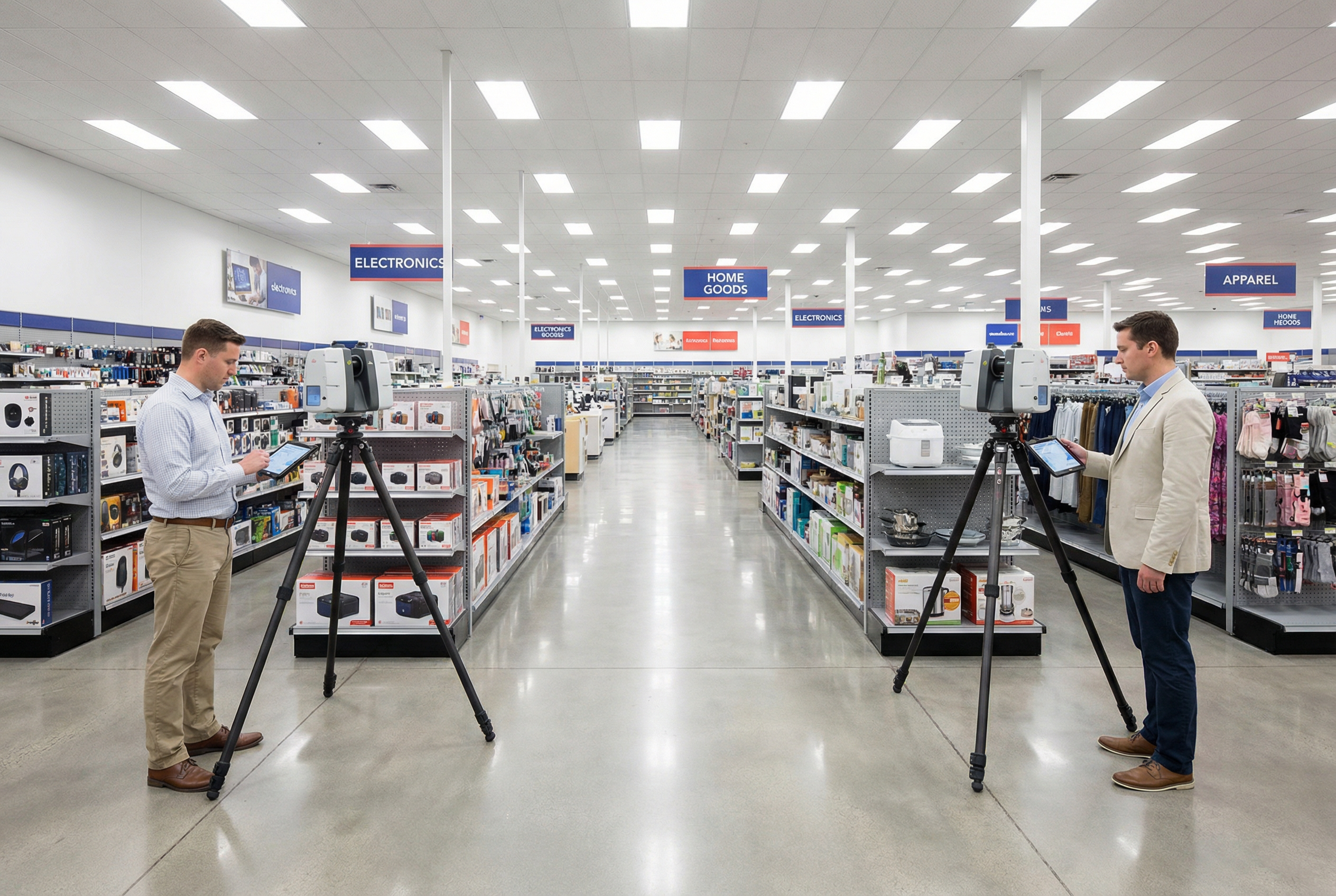
Robotic Imaging's enterprise scanning program is structured around concurrent deployment: 10–50+ field teams operating simultaneously across geographically distributed sites. Each team deploys LEICA RTC 360 scanners capturing 2,000,000 points per second at ±1/16 inch accuracy — ensuring identical precision whether documenting a store in Texas or Maine. Field capture runs 2–3 days per site, processing takes 3–5 days, and BIM modeling delivers final LOD 300 models within 7–10 additional days. Total per-site turnaround: 10–14 business days.
At concurrent scale, Robotic Imaging completed 7-Eleven's 2,400+ store documentation program in approximately 18 months — a timeline that would require over 46 years using sequential deployment at the same per-site pace.
Enterprise program phases follow a structured rollout:
- Pilot Phase (5–10 locations): Validates LOD standards, access protocols, and deliverable format with your design team before full commitment
- Regional Expansion: Scales deployment across priority markets with confirmed standards
- Portfolio Rollout: Full concurrent deployment across remaining locations with established infrastructure
This phased structure means enterprise buyers can validate quality and fit before committing to full MSA scope — reducing the scale risk that has burned corporate real estate teams with vendors who overpromised.
Standardized Deliverable Framework: Consistent BIM Across Every Site
The most common failure point in multi-site BIM documentation programs isn't scan quality — it's deliverable inconsistency. When different scan teams, vendors, or regional firms each model in their own conventions, the result is a portfolio of BIM files that can't support a coherent renovation rollout. Design teams encounter different family naming conventions, inconsistent wall modeling approaches, and varying organizational structures that require rework before any drawings can be produced.
Robotic Imaging addresses this through a standardized deliverable framework applied identically across every site in the portfolio:
LOD 300 Corporate Template Files: Every site is modeled against a corporate Revit template established during the pilot phase. Wall types, door families, MEP routing conventions, and room naming structures are defined once and applied to site 1 through site 2,400. The LOD 300 standard captures geometry, size, location, and quantity sufficient for construction document production — the right specification for facilities renovation programs at portfolio scale.
Centralized QC Before Every Delivery: Rather than each field team self-certifying their work, Robotic Imaging runs all deliverables through centralized quality control review. Accuracy is validated against ±2–4mm standards, model organization is checked against corporate template specifications, and any site-specific anomalies are flagged before the file reaches the client. No model leaves the pipeline without passing centralized review.
File Format Standardization: Enterprise programs deliver Revit .rvt files against the corporate template, with point cloud data in RCS, RCP, E57, LAS formats for downstream use. File naming conventions follow agreed corporate taxonomy so FM teams, design teams, and real estate analysts can locate any site's documentation without a translation layer.
For multi-site BIM modeling programs supporting portfolio-wide renovation initiatives — the kind Dollar General, AutoZone, Ross, and Burlington have executed — this standardization is what makes the documentation dataset actually usable rather than an archive of incompatible files.
Program Management and Corporate Visibility
A multi-location Scan-to-BIM program at 500+ sites creates a coordination challenge that exceeds what any corporate real estate team can manage through email threads and biweekly status calls. Access scheduling, site-specific complications, phased delivery tracking, and executive reporting demand infrastructure — not improvisation.
Robotic Imaging's nationwide facility documentation programs are supported by three management layers that eliminate the coordination overhead that defines multi-vendor approaches:
Dedicated Program Manager: A single point of contact owns the enterprise program — coordinating field team scheduling across all active sites, managing access requests with regional operators, escalating site-specific issues, and communicating program status to the corporate account team. Enterprise buyers replace a network of vendor relationships with one accountable point of contact.
Centralized 24/7 Scheduling System: Site access is coordinated through a centralized scheduling infrastructure that accommodates store operating hours, regional time zones, and access-specific requirements without requiring corporate real estate involvement in individual site logistics. Scheduling conflicts are resolved at the program management level.
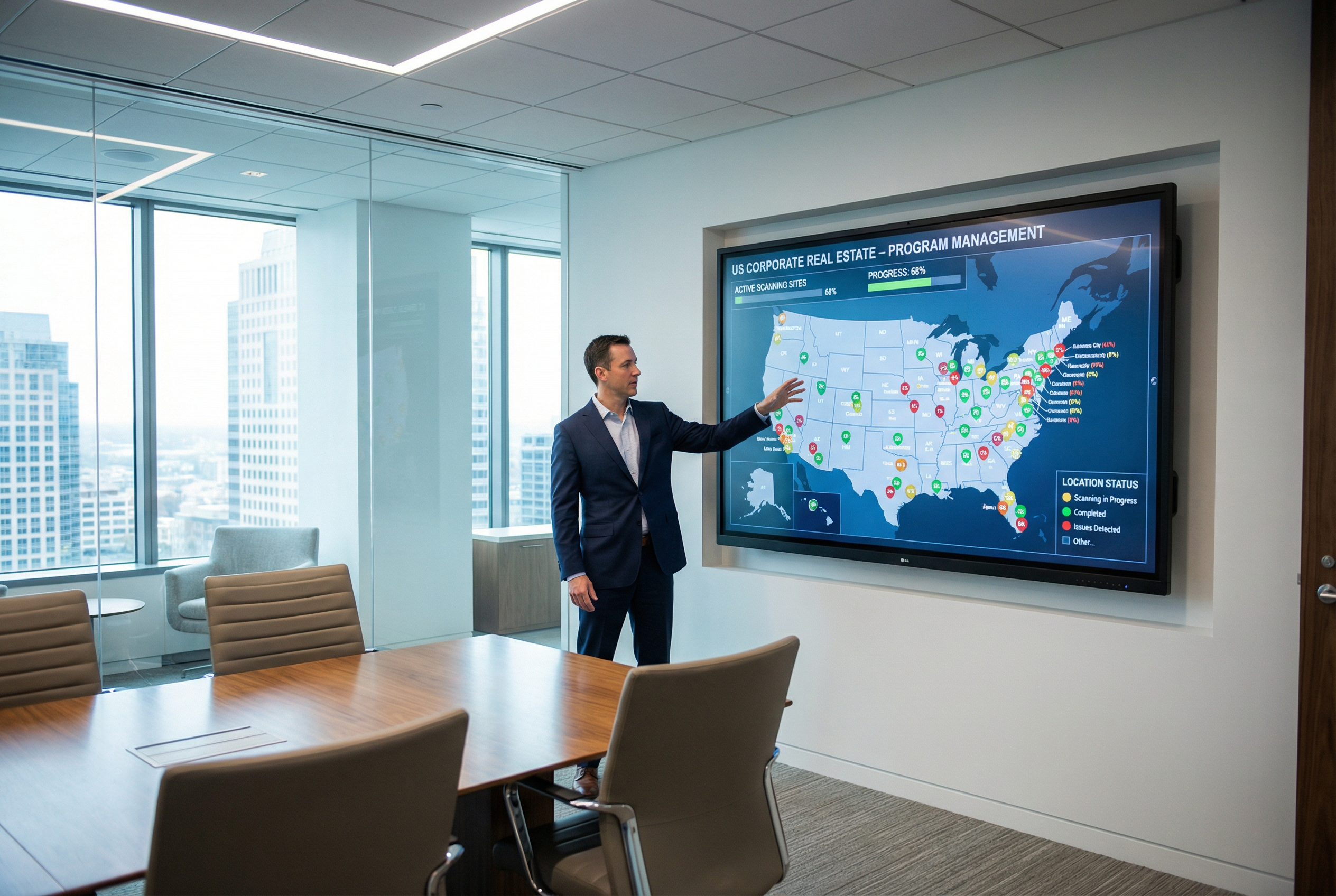
Proprietary Corporate Dashboard: Real-time program progress is visible through Robotic Imaging's proprietary web dashboard, accessible via desktop and iOS/Android mobile applications. Corporate real estate executives can view which sites are in field capture, which are in processing, which deliverables have been QC-approved, and which are available for download — without requesting a status update. Executive reporting pulls directly from dashboard data rather than requiring vendor-generated reports.
This visibility infrastructure directly addresses the most common executive objection to large-scale documentation programs: "How do we know where we are without constant status calls?" The dashboard replaces the overhead with verifiable, real-time data.
Budget and Timeline Predictability for Multi-Year Capital Planning
Enterprise portfolio documentation programs require budget predictability across multiple fiscal years. Per-project pricing — where each site requires individual quoting, scope negotiation, and invoice approval — creates the administrative overhead that makes portfolio programs difficult to approve and impossible to plan.
Robotic Imaging's corporate portfolio scanning programs are structured around fixed per-site pricing within a Master Service Agreement (MSA):
Fixed Per-Site Pricing: Based on LOD specification and square footage bands, per-site rates are established at MSA execution and held for program duration. Per-site pricing typically ranges from $1,500–$8,000 depending on LOD and facility size. Enterprise buyers convert a complex multi-year program into a predictable per-unit cost that supports capital planning with approved budget ranges rather than open-ended estimates.
Volume Structure: Enterprise programs covering 500+ locations access volume pricing structures that reduce per-site cost as program scale increases — enabling larger portfolio commitments to deliver better per-unit economics.
Committed Completion Milestones: Rather than open-ended delivery timelines, enterprise MSAs include committed completion milestones by program phase. Regional deployment windows, phase completion dates, and portfolio completion targets are contractual — giving corporate real estate teams defensible program timelines to present to leadership.
Pilot Validation Before Full Commitment: The 5–10 site pilot phase operates under the same fixed pricing structure as the full program, allowing finance teams to validate per-site economics before full capital commitment. This eliminates the budget risk of committing program-scale capital before verifying deliverable quality and operational fit.
For Directors and VPs managing capital budgets in the $500K–$5M+ range for portfolio documentation initiatives, the MSA structure converts what would otherwise be an unmanageable multi-vendor coordination and billing challenge into a single-line capital commitment with predictable per-site economics and defensible completion milestones.
Starting Your Enterprise Program: From Pilot to Portfolio
The entry point for Robotic Imaging's enterprise multi-location Scan-to-BIM program is a structured pilot — not a full portfolio commitment. Five to ten priority locations establish the LOD 300 corporate template files, validate the access coordination workflow, and produce BIM deliverables your design team can evaluate before regional expansion begins.
For corporate real estate teams who have experienced vendor overpromise at scale before, the pilot phase is the proof mechanism. Robotic Imaging's 7-Eleven and Kroger programs both began with pilot validation before expanding to 2,400+ and 1,800+ locations respectively. The concurrent deployment infrastructure, centralized QC framework, and corporate dashboard that deliver consistent quality at those scales are available from the first pilot site.
Robotic Imaging has documented 100+ million square feet of commercial real estate across Fortune 500 retail, grocery, convenience, and specialty clients. For corporate real estate managers evaluating enterprise scanning program vendors, that scale of verified execution — across clients comparable to your portfolio — is the proof point that distinguishes a capable enterprise program partner from a regional firm scaling beyond its operational model.
No competitor offers a dedicated multi-location Scan-to-BIM program with concurrent deployment infrastructure, portfolio-wide standardized LOD 300 deliverables, and a proprietary corporate visibility dashboard. This is an enterprise program designed for the operational reality of portfolios at 50 to 2,000+ locations.
Ready to begin your portfolio assessment? Request a Portfolio Assessment to receive a program scope estimate, pilot phase proposal, and per-site pricing range for your portfolio. Or Download the Enterprise Program Guide for a detailed overview of deployment methodology, deliverable specifications, and MSA structure — the documentation your procurement team needs to advance vendor qualification.