Photo-Based Equipment Capture: AI Recognition, 85-90%
Robotic ImagingFebruary 27, 2026
Photo-Based Equipment Capture and AI Recognition Technology
Robotic Imaging's photo-based equipment capture technology enables store managers and facility teams to document equipment through smartphone photography alone — without barcode labels, RFID tags, or manual data entry. Computer vision AI analyzes equipment photos, automatically identifying equipment types and extracting specifications with 85-90% accuracy, creating permanent visual equipment records that eliminate the need for specialist audit teams or pre-labeling infrastructure. For multi-site retail operators managing 100 to 4,000+ locations, this capability fundamentally changes how equipment documentation gets done — and who can do it.
The Photo-Based Asset Tracking Paradigm
Traditional asset tracking is built around a fundamental assumption: someone must create the record before the equipment can be documented. A barcode gets printed and affixed. An RFID tag gets purchased, programmed, and installed. A technician manually types model numbers and serial numbers into a spreadsheet or CMMS. The equipment doesn't exist in the system until a human-defined record precedes the documentation.
Photo-based asset tracking inverts this entirely. The photograph comes first. Robotic Imaging's platform opens directly to the camera — not a record list, not a search field, not a data entry form — and the AI recognition engine creates the asset record from what it sees. Equipment that has never been tagged, never been catalogued, and never been manually entered becomes documented in under 30 seconds per unit.
This paradigm shift matters at scale. A 500-location retail portfolio with 40 equipment units per store represents 20,000 individual documentation events. At $5K-$15K per location for a professional audit, traditional approaches cost $2.5M-$7.5M to execute once. Photo-based capture with AI recognition changes both the economics and the operational model — store managers become capable documentation agents without any change to their existing equipment or training requirements.
> Request Technology Architecture Review — See how the platform's camera-first design maps to your facility documentation workflow.
Smartphone Camera Integration and Photo-Driven Workflow
The camera-first interface distinction is not cosmetic. Competing asset management platforms treat camera access as a secondary feature — navigate to an asset record, open an attachment panel, then access the camera to photograph. In Robotic Imaging's platform, opening the app opens the camera. This design signals the architectural difference: documentation-centric rather than record-retrieval-centric.
Camera-first technical specifications:
- Native iOS and Android apps with full camera API access (not compressed mobile web camera)
- 12MP+ full-resolution capture on supported devices
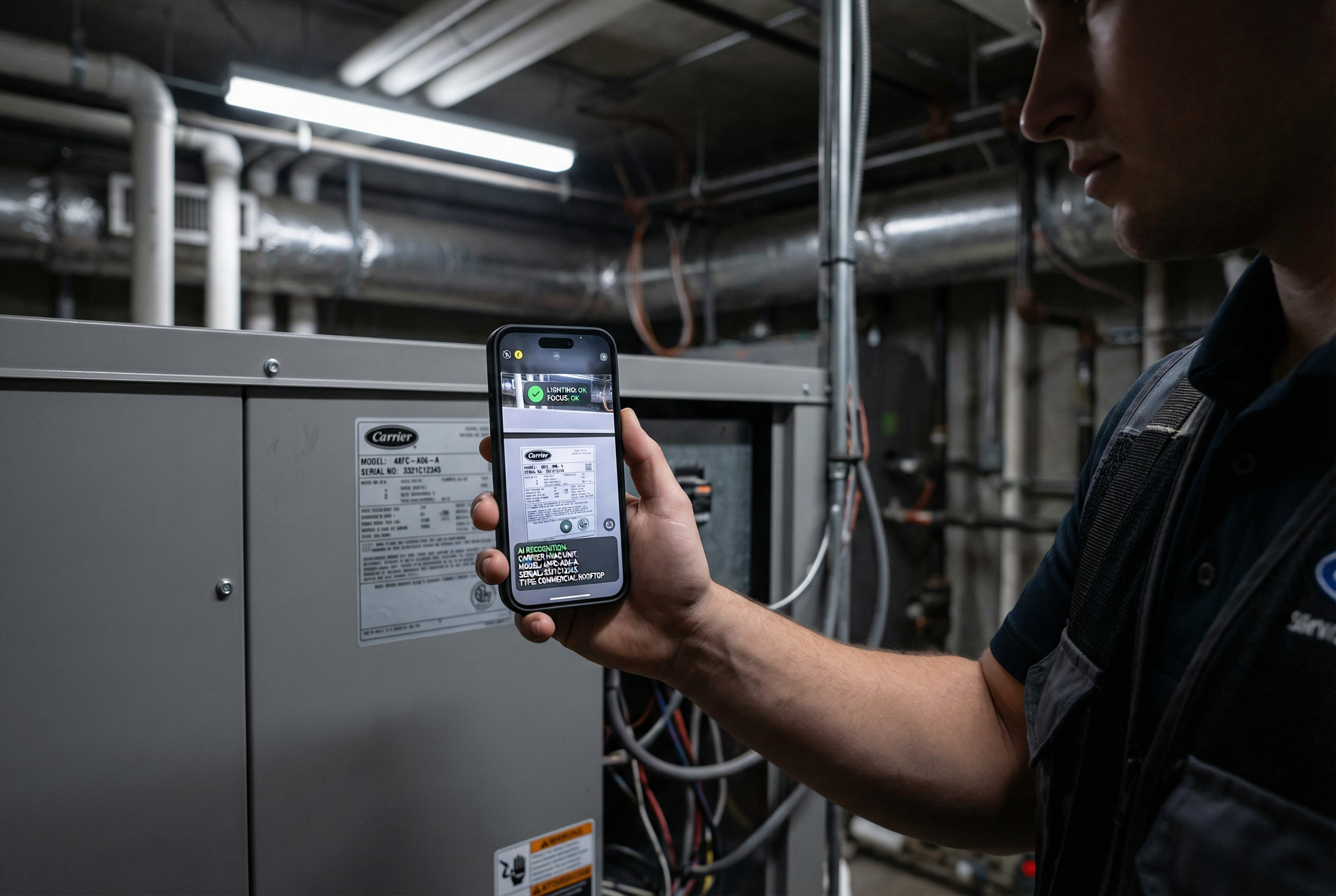
- Real-time photo quality feedback before capture — lighting adequacy, focus confirmation, nameplate visibility guidance
- Multiple photo types captured per unit: nameplate, data plate, full equipment view, installation context
- Offline capture with local cache of 1,000+ equipment records, automatic sync when connectivity restores
Practical workflow example — batch capture in a retail back-of-house:
A store manager with no technical training enters the mechanical room. The Robotic Imaging platform opens directly to camera view. She photographs the HVAC unit nameplate, receives confirmation that the capture meets quality standards, moves to the condenser, repeats. Fifteen equipment units documented in 8 minutes. Offline the entire time — the back-of-house has no reliable WiFi, which is irrelevant. When she walks back to the sales floor and reconnects, all fifteen records sync automatically with AI-extracted specifications populated.
This is the documented reality of Robotic Imaging's deployment at 7-Eleven — store-level staff, not technicians, executing equipment documentation across 1,000+ stores during standard operational hours. The photo-driven workflow requires no specialist knowledge because the camera interface guides quality, and the AI handles the interpretation.
Smartphone photo documentation succeeds in field conditions precisely because real-time quality guidance catches inadequate photos before they become incomplete records. Store managers photograph equipment correctly not because they understand why it matters, but because the platform tells them when it does and doesn't.
AI Computer Vision Equipment Recognition
The AI recognition engine behind Robotic Imaging's platform applies computer vision to equipment photographs — analyzing visual patterns, nameplate text, equipment geometry, manufacturer branding, and installation context to classify and identify equipment without any user input beyond the photograph itself.
How visual asset recognition works:
When a photo reaches the recognition engine, the system runs multiple parallel analyses:
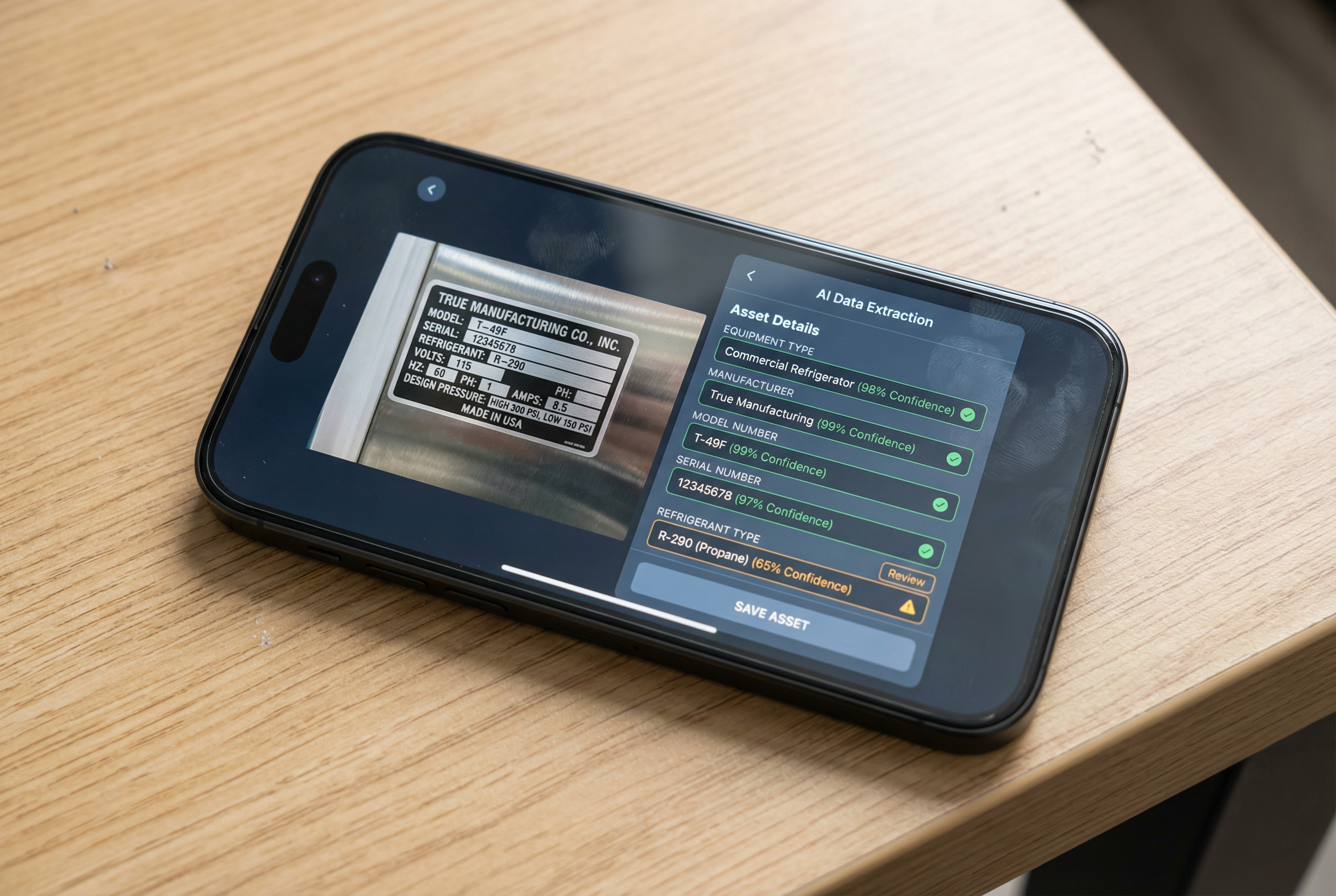
1. Equipment type classification — Visual pattern recognition identifies the broad equipment category from physical characteristics (HVAC unit, refrigeration case, electrical panel, plumbing fixture) independent of any text on the nameplate 2. Manufacturer identification — Branding elements, logo patterns, and casing design characteristics are matched against training dataset profiles across major equipment manufacturers 3. Nameplate OCR extraction — Optical character recognition pulls model numbers, serial numbers, voltage ratings, BTU capacity, and other specification fields from nameplate photography 4. Multi-photo contextual analysis — Full unit photographs and installation context photos supplement nameplate data, providing redundant identification when nameplate legibility is limited 5. Confidence scoring — Each identification receives a confidence score reflecting the certainty level of the classification. High-confidence identifications proceed automatically; low-confidence items enter a human review queue
The training dataset underpinning this recognition spans equipment types encountered across large-format retail, convenience store, and commercial facility operations — the specific equipment populations that 7-Eleven's 1,000+ store deployment and Dollar General's 4,000-location planned rollout represent. This means the AI has been trained on the actual equipment mix that multi-site retail operators encounter, not generic laboratory samples.
Camera-based asset capture succeeds where barcode-dependent systems fail because it requires no pre-existing infrastructure. Equipment that was installed before any documentation program existed — which describes most operational retail equipment — is equally recognizable to AI as equipment installed yesterday with a barcode affixed at the factory.
For IT Managers evaluating the architecture: confidence scoring per identification is the quality control mechanism that separates verified asset records from raw AI output. The system does not auto-accept identifications below a defined confidence threshold. Low-confidence results generate human review events, not automatic database entries.
Recognition Accuracy and Quality Control
Robotic Imaging's platform delivers 85-90% automated recognition accuracy across documented equipment deployments. This metric means that 85-90 out of every 100 equipment units photographed receive complete, verified AI-extracted records without any human review required.
What happens to the 10-15%:
The objection is predictable — and worth addressing directly. Low-confidence identifications do not create errors in the asset database. They create review events. The confidence scoring architecture flags items where recognition certainty falls below threshold and routes them to a structured human review queue. The reviewer sees:
- The original photographs
- The AI's best identification attempt with associated confidence level
- The specific fields where uncertainty is highest
- Suggested alternatives the recognition engine considered
This review process is fast — a human reviewer with the photograph context available can confirm or correct an AI identification in under 30 seconds. The result is a verified record, not a raw AI guess. The 10-15% that requires human review is not a system failure — it is the system correctly identifying what it doesn't know with sufficient certainty to auto-accept.
12-month improvement trajectory:
Robotic Imaging's recognition accuracy follows a continuous learning model. Initial deployment accuracy of 85% improves to 90%+ at 12 months as the platform processes equipment populations specific to each operator's portfolio. Dollar General's 4,000-location deployment will systematically improve recognition accuracy on the specific equipment mix across their store footprint — the AI gets better at recognizing the equipment it encounters repeatedly.
Image recognition asset management quality is measurable at every stage. Operators can monitor confidence score distributions across their portfolio — tracking what percentage of captures are auto-accepted, what percentage enter review, and how accuracy trends over deployment time. This transparency replaces the opacity of manual data entry (where errors simply exist silently in the database) with a systematic quality control framework.
Equipment Type Coverage
Robotic Imaging's AI recognition covers the full equipment categories present in multi-site retail and commercial facility operations:
- Refrigeration — Walk-in coolers, reach-in cases, display refrigerators, ice machines, freezer units (compressors, evaporators, condensing units)
- HVAC — Rooftop units, split systems, air handlers, condensers, exhaust fans, thermostats, building automation components
- Electrical — Panels, switchgear, circuit breakers, transformers, emergency systems, lighting controls
- Plumbing — Water heaters, backflow preventers, pressure regulators, commercial fixtures, pumps
- Lighting — Interior fixtures, exterior signage, emergency lighting, lighting control systems
- Specialty/Retail-Specific — POS infrastructure, security systems, drive-through equipment, food service equipment, compactors
Coverage breadth matters for operators whose equipment mix includes manufacturer combinations the AI hasn't encountered. Robotic Imaging's training dataset is extended through ongoing deployment data — each new equipment type encountered and verified by the human review workflow contributes to expanded recognition capability. Operators with unusual equipment mixes benefit from early deployment precisely because their equipment population trains the system on what it will encounter going forward.
The question "Will AI recognize our equipment?" has a practical answer: for major-manufacturer equipment in categories above, recognition accuracy is high from deployment day one. For specialty or regional-manufacturer equipment, initial accuracy may be lower, with systematic improvement as the human review workflow validates identifications across the deployment period.
Photo-Based vs. Traditional Asset Tracking
The comparison across three alternative approaches clarifies where photo-based capture with AI recognition creates its value:
| Capability | Barcode/QR | RFID | Manual Entry | Photo-Based AI |
|---|---|---|---|---|
| Infrastructure required | Labels + scanner | Tags ($1-5 each) + readers | None | Smartphone only |
| Pre-labeling required | Yes | Yes | No | No |
| Time per unit | 15-30 sec (scan) | 10-20 sec (read) | 3-5 min | 5-10 sec |
| AI extraction | No | No | No | Yes (85-90%) |
| Unlabeled equipment | Manual entry required | Tag installation required | Manual entry required | Fully supported |
| Offline capability | Limited (barcode lookup) | Reader-dependent | N/A | Full capture + 1,000+ cache |
| Staff training required | Moderate | High (reader operation) | High (data accuracy) | Minimal |
Cost comparison for a 200-location portfolio:
- RFID approach: 200 locations × 40 units × $3/tag average = $24,000 in tags alone, plus RFID reader hardware ($500-$2,000/reader), plus installation labor
- Barcode approach: Label printing and affixing labor, scanner hardware, manual data entry time for specification fields barcodes don't contain
- Professional audit approach: 200 locations × $10,000 average audit fee = $2,000,000 one-time (plus re-audit costs as equipment changes)
- Photo-based AI: Platform subscription, no hardware beyond existing smartphones, 5-10 seconds per unit with AI-extracted specifications
The RFID comparison is particularly relevant for IT Managers who have evaluated infrastructure-heavy approaches. Photo asset tracking eliminates the per-asset hardware cost entirely — a portfolio of 8,000 equipment units requires zero tags, zero readers, and zero installation events. The smartphone already in every store manager's pocket is the only hardware required.
Hybrid deployment note: For operators with existing barcode programs on some equipment, Robotic Imaging's platform supports both approaches — barcode scan for labeled equipment, photo capture for everything else. The transition doesn't require choosing one method exclusively.
Technology Value Summary
Photo-based equipment capture and AI recognition technology within Robotic Imaging's platform delivers four verified capabilities that traditional asset tracking approaches cannot match:
1. Zero-infrastructure documentation — No labels, no tags, no pre-existing database records required before capture begins 2. Store-manager execution — 7-Eleven's 1,000+ store deployment demonstrates that non-technical staff can document equipment at enterprise scale without specialist dispatch 3. AI-verified asset records — 85-90% automated accuracy with confidence scoring and human review workflow creates verified records, not error-prone manual entries 4. Offline retail-environment capability — Full capture functionality without WiFi dependency, automatic sync when connectivity restores
For Facility Directors evaluating whether store-level staff can execute this reliably: 7-Eleven answered that question across 1,000+ stores. For IT Managers evaluating whether the AI produces trustworthy data: confidence scoring with threshold-based flagging means uncertain identifications are reviewed, not auto-accepted.
The $5K-$15K per location professional audit fee that photo-based capture eliminates represents $600K+ in annual value for a 100-location portfolio. The per-unit time comparison — 5-10 seconds versus 3-5 minutes manual entry — represents a 30-60x efficiency gain that compounds across every documentation cycle.
See AI recognition in action on your equipment types. Robotic Imaging offers focused AI Recognition Demos that run the platform against your specific equipment categories — so you evaluate accuracy against the HVAC units, refrigeration cases, and electrical panels in your actual portfolio, not generic demonstration equipment.
> Request Technology Architecture Review — For IT Managers evaluating platform integration, offline architecture, and confidence scoring methodology.
> Schedule AI Recognition Demo — For Facility Directors who want to see 85-90% accuracy demonstrated on their equipment types before committing to deployment.
Written by
Robotic Imaging