Renovation Scan-to-BIM Services: LOD 350 in 10-14 Days
Robotic ImagingMarch 3, 2026
Scan-to-BIM Services for Building Renovation and Retrofit Projects
For architects and construction teams managing building renovation projects, Robotic Imaging delivers renovation scan-to-BIM services that replace outdated drawings with verified existing conditions — captured in 2-3 days of field work and delivered as LOD 300-350 Revit models within 10-14 business days. From hospital renovation documentation requiring after-hours access to historic building preservation demanding ±1/16 inch accuracy, our Scan-to-BIM process provides the accurate baseline that eliminates assumptions, reduces change orders, and enables confident MEP coordination.
Renovation scan-to-BIM differs fundamentally from new construction documentation. Where new construction BIM models project what will be built, renovation BIM models capture what already exists — including the conditions your 30-year-old drawings never anticipated: relocated partitions, abandoned MEP runs, structural modifications made without permit, and ceiling plenums packed far beyond original design intent. As-built documentation through laser scanning resolves these unknowns before they become change orders.
Request a Renovation Project Quote to discuss your existing conditions documentation needs with our team.
Existing Conditions Documentation Scope
Comprehensive renovation as-built scanning captures the full physical reality of a building — not just the elements shown on original construction documents, but the accumulated decades of modifications, additions, and field-installed conditions that define what a renovation team will actually encounter.
Architectural Elements
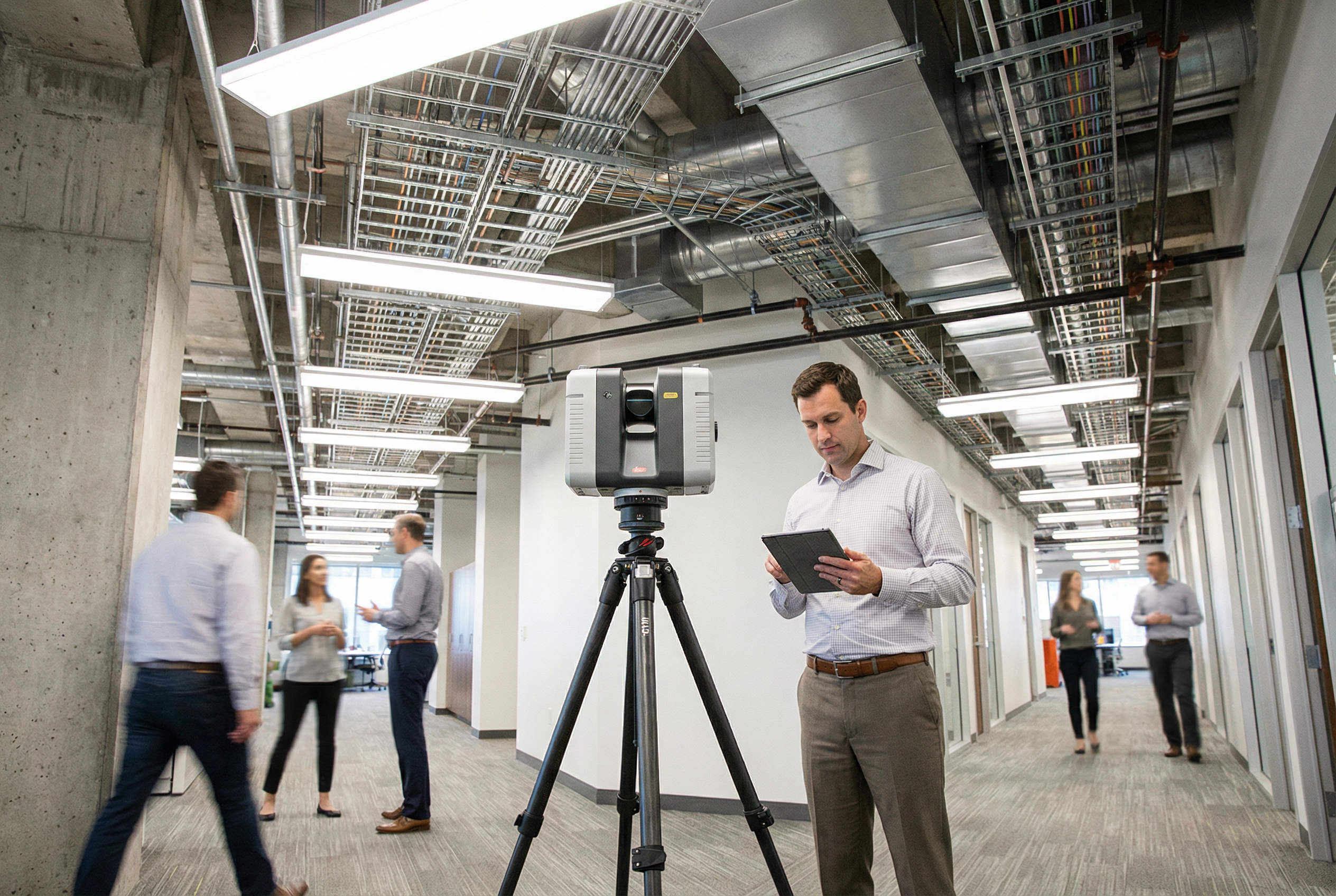
Our field teams document walls, floors, ceilings, openings, stairs, and millwork with the LEICA RTC 360 at ±1/16 inch (±2mm) accuracy. For adaptive reuse and historic preservation projects, this precision level matters enormously: ornate plaster moldings, decorative cornices, irregular masonry openings, and vaulted ceiling geometries cannot be accurately measured by hand — they require the 2,000,000 points-per-second capture density that the LEICA RTC 360 provides.
A renovation architect working from hand measurements of a historic lobby might assume straight walls and level floors. Point cloud data reveals the reality: walls that bow 1.5 inches over their height, floors that slope 3/4 inch across a span, ceiling heights that vary by room quadrant. These conditions, invisible in original drawings, become immediately actionable in a Revit model that reflects actual geometry.
Structural Systems
Retrofit building documentation includes load-bearing elements — columns, beams, shear walls, and transfer structures — that contractors will need to work around, penetrate, or connect to. Our scanning process captures structural geometry at sufficient accuracy to verify member dimensions, connection locations, and clearance conditions without requiring destructive investigation in preliminary design phases.
For adaptive reuse projects where original structural drawings may not exist, the point cloud becomes the primary structural reference for the design team — establishing column grid, beam depths, and floor-to-floor dimensions that drive every subsequent design decision.
MEP Systems to Coordinate Around
Above-ceiling MEP documentation is the critical differentiator between renovation scan-to-BIM and traditional field measurement. Our team accesses ceiling plenums systematically, capturing existing HVAC ductwork routing, plumbing riser locations, electrical conduit runs, and sprinkler mains — all of which must be coordinated against new systems before installation begins.
Robotic Imaging produces point cloud data that reveals actual MEP clearances in ceiling plenums, not the clearances shown on drawings from a 1987 renovation that may have changed multiple times since. For construction project managers coordinating above-ceiling MEP installation, this documentation directly reduces the change order exposure that comes from discovering field conditions mid-construction.
LOD Selection for Renovation Projects
Level of Development selection for renovation projects follows different logic than new construction. The question is not "how much detail do we need for the new work?" but "how much existing conditions detail do we need to design around, coordinate against, and document for permit?"
| Project Type | Recommended LOD | Primary Use |
|---|---|---|
| Standard commercial renovation | LOD 300 | Design development, permit documents |
| Hospital / laboratory MEP retrofit | LOD 350 | Ceiling coordination, MEP clash detection |
| Historic preservation | LOD 300-350 | Architectural detail preservation, permit compliance |
| Adaptive reuse | LOD 300 | Space planning, structural verification |
LOD 300 deliverables model elements at sufficient geometric accuracy for design development and permit documentation. Walls are modeled at actual thickness and location; doors and windows at actual size and position; structural members at actual dimension. This level supports space planning, code compliance analysis, and construction document production for most commercial renovation scopes.
LOD 350 adds the interface and connection detail required for MEP coordination. Ductwork is modeled with actual dimensions and fittings; pipes are modeled with accurate diameters and routing; electrical conduit runs are captured. For hospital renovation documentation where mechanical, electrical, and plumbing systems must be coordinated within tight ceiling plenum clearances — sometimes as little as 1-2 inches of available space — LOD 350 is the appropriate deliverable level. Clash detection between existing and new MEP systems at this level of detail eliminates the field conflicts that generate change orders and schedule overruns.
The decision framework: if your renovation involves significant MEP work in occupied ceiling spaces, specify LOD 350. If your renovation is primarily architectural — finishes, partitions, millwork — LOD 300 provides the existing conditions baseline your design team needs. Our team will confirm the appropriate LOD during project scoping based on your design schedule and coordination requirements.
Occupied Building Coordination
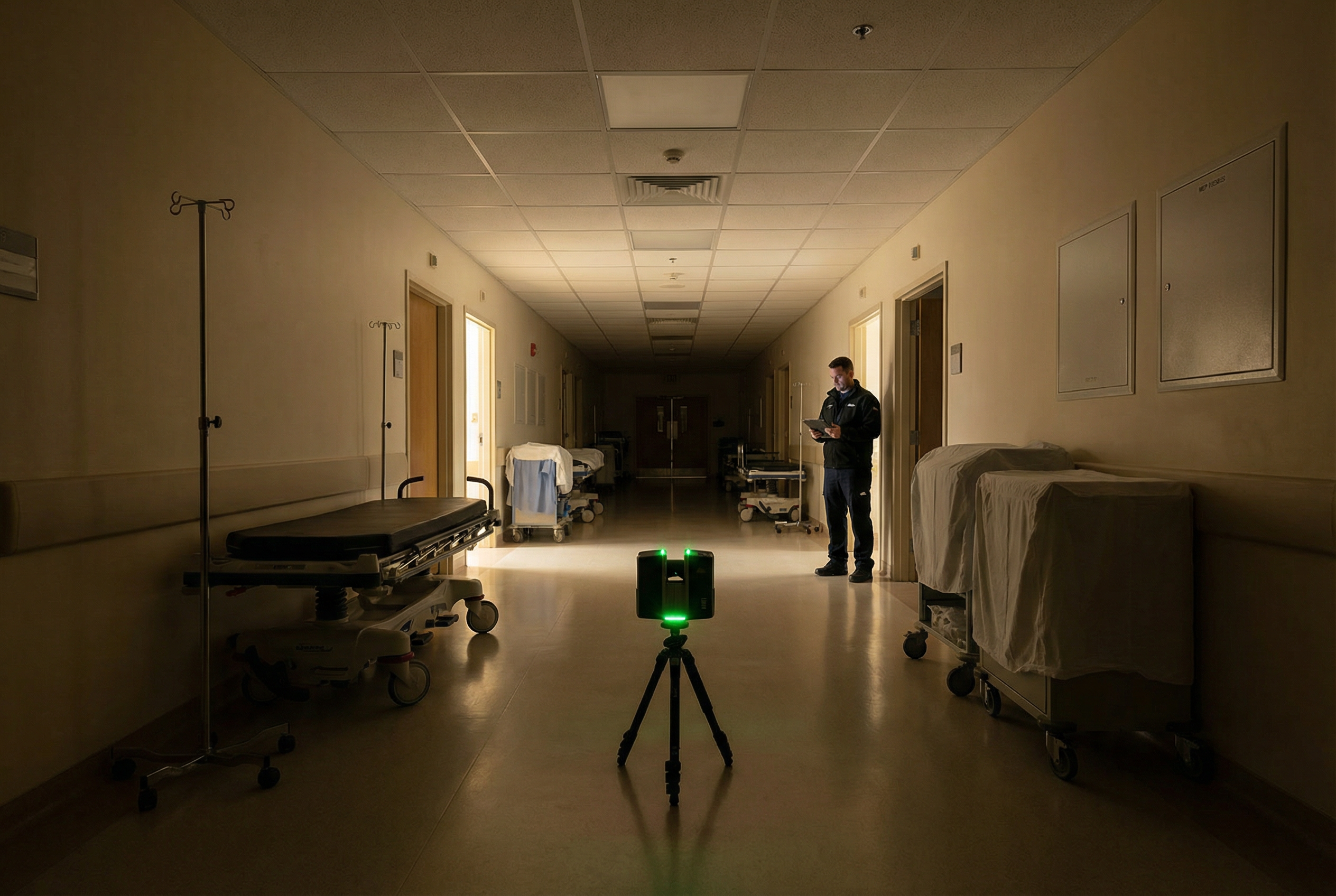
Renovation projects, by definition, occur in occupied or partially occupied buildings. Our occupied building scanning protocols address the operational constraints that make renovation documentation fundamentally different from documenting vacant facilities.
For healthcare facility renovations specifically, Robotic Imaging offers 24/7 scheduling that enables after-hours field capture in clinical areas. The LEICA BLK 360 — with its 60-meter range and quiet, compact form factor — enables floor-by-floor documentation with minimal equipment repositioning, reducing corridor dwell time and eliminating the need for clinical staff to clear areas for extended periods. Scanning equipment does not generate noise, dust, or fumes, making it fully compatible with infection control protocols in active patient care environments.
Our proprietary web dashboard provides real-time project visibility during field operations. For healthcare facilities managers and infection control coordinators, this means the ability to track scan progress by zone without requiring physical presence in scanning areas — a practical advantage when clinical staff need confirmation that documentation is proceeding on schedule before patient care resumes.
For occupied commercial facilities — office buildings, retail environments, hospitality properties — our team coordinates scan access around tenant operations, building security requirements, and after-hours access windows. JLL, which manages facilities across the commercial real estate spectrum, relies on this coordination capability for portfolio documentation programs that cannot interrupt tenant operations.
The practical outcome: Robotic Imaging completes renovation as-built scanning without becoming a construction event. Occupants experience a documentation team moving through the building with compact equipment — not a disruptive measurement crew requiring repeated access over weeks.
Renovation Deliverable Applications
Renovation scan-to-BIM deliverables from Robotic Imaging are delivered in the formats your design and construction teams already use:
- Revit .rvt BIM models — LOD 300 or LOD 350, ready for design development in your firm's Revit environment; Nelson Worldwide and Colliers Engineering integrate these models directly into active project workflows
- Point cloud files — RCS, RCP, and E57 formats compatible with Revit, AutoCAD, and third-party coordination platforms; raw point cloud data remains available for reference against the BIM model throughout design and construction
- Registered scan positions — full project scan data organized by floor and zone, accessible through our web platform for field reference and model QC verification
These deliverables support the full renovation project lifecycle. Architects use LOD 300 Revit models for design development and construction document production. MEP engineers use LOD 350 models and point cloud data for coordination and clash detection. Construction project managers use registered scan data to verify field conditions during construction and confirm as-built accuracy at project closeout.
For firms like Nelson Worldwide managing complex architectural renovation programs, or engineering teams at Colliers Engineering coordinating multi-system MEP retrofits, the 10-14 business day delivery timeline — from first site visit to delivered Revit model — is the difference between maintaining design momentum and waiting for existing conditions data that delays every downstream milestone.
Next Steps: Request Your Renovation Project Quote
Renovation projects carry inherent existing conditions risk. The question is whether you carry that risk into design and construction, or resolve it at the start through accurate renovation scan-to-BIM services.
Robotic Imaging has documented over 100 million square feet across commercial, institutional, and complex occupied facilities — with the equipment precision, LOD flexibility, and occupied building protocols that renovation projects require. Our LEICA RTC 360 delivers ±1/16 inch accuracy for tight MEP coordination and historic detail capture. Our 24/7 scheduling enables after-hours access for infection-control-sensitive healthcare environments. Our 10-14 business day delivery keeps your design schedule intact from existing conditions documentation through construction document production.
Ready to eliminate existing conditions risk on your next renovation project?
Request a Renovation Project Quote — our team will scope your project, confirm the appropriate LOD, and provide a delivery timeline aligned with your design schedule milestones.