Retail Facilities Scan-to-BIM for Store Remodels
Robotic ImagingMarch 2, 2026
Retail Facilities Scan-to-BIM Documentation for Store Remodels and Renovations
The Retail Remodel Documentation Problem
For retail facilities managers overseeing brand refresh programs, store remodel rollouts, or equipment upgrade initiatives across portfolios of hundreds of locations, standardized corporate designs rarely account for the actual conditions found in each store. Retail facilities Scan-to-BIM documentation — delivered via overnight Laser Scanning with zero customer disruption — provides store-specific LOD 300 as-built documentation in 10-14 days that reveals the ceiling heights, column locations, MEP constraints, and refrigeration configurations your design team needs to finalize renovation packages without field surprises.
The core problem is straightforward: corporate design standards are built around ideal conditions. Your stores are not ideal. A brand refresh package assumes 11-foot ceilings — but 40% of your locations have soffits at 9'6". A refrigeration upgrade specifies 24-inch clearance behind cases — but a third of your supermarkets have structural columns that shift the actual available depth to 18 inches. A fixture rollout is designed around a 3,600 square foot sales floor — but store-by-store square footage varies by 800 feet once you account for backroom configurations that evolved over decades.
These discrepancies don't surface during design review. They surface during construction, when the general contractor submits a change order because the equipment doesn't fit. One change order on a refrigeration package can cost more than documenting the entire store properly before design begins.
This is what Scan-to-BIM delivers: store-specific as-built conditions translated into accurate LOD 300 Revit models that your corporate design team can use as the baseline layer beneath any standardized renovation package. For a broader view of how this fits into retail documentation programs, see our Retail Store Scan-to-BIM Documentation Services overview.
Robotic Imaging has documented 2,400+ 7-Eleven stores for brand refresh programs and 1,800+ Kroger locations for standardization initiatives — along with Ross, Burlington, Dollar General, Walgreens, and Albertsons. The scale proof exists because the methodology is built around retail operational reality: overnight access, consistent deliverables, and program-level execution that doesn't degrade across the 50th location or the 500th.
Request Retail Remodel Quote →
How Facilities Managers Use Scan-to-BIM in Their Renovation Workflow
The practical workflow for retail renovation documentation follows a consistent sequence, regardless of store format or program scope. Understanding where Scan-to-BIM integrates — and what it replaces — clarifies why the investment recovers itself quickly.
Step 1: Pre-Design Conditions Capture Before corporate design teams finalize the renovation package, field scanning captures actual store conditions at ±4mm accuracy. This occurs overnight, after store close, using the existing schedule of regional field teams coordinated through a centralized program management platform. No daylight hours consumed. No customer impact.
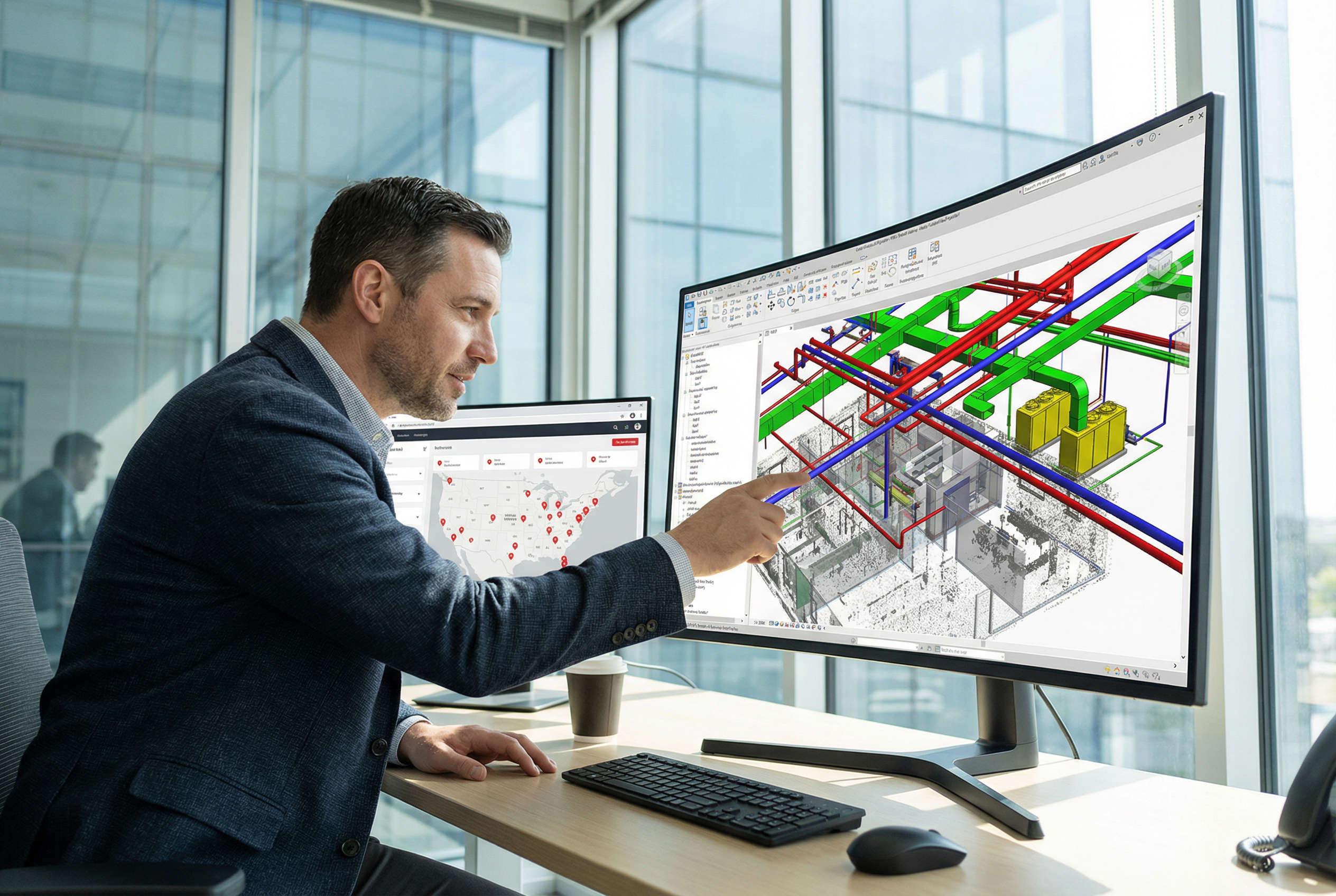
Step 2: LOD 300 Model Delivery Within 10-14 days of field capture, each store location receives a fully registered LOD 300 Revit model representing actual conditions: structural elements, ceiling geometry, MEP routing above tile, refrigeration system footprints, millwork and fixture locations, and complete floor-to-ceiling spatial documentation. The model format is standardized — same file organization, same layer naming, same deliverable package — across every store in the program.
Step 3: Design Team Overlay Corporate architects and design firms overlay the standardized renovation template onto the store-specific as-built model. Conflicts surface in the model — not on the job site. Column locations that conflict with fixture layouts are identified and resolved during design. Ceiling heights that preclude a specified equipment type are flagged before the equipment is ordered. MEP routing that requires rerouting is planned and costed before the GC mobilizes.
Step 4: Construction-Ready Package The design team produces a store-specific construction package that accounts for actual conditions. The GC bids based on accurate information. Change orders from undocumented field conditions are eliminated — or reduced to the genuinely unforeseeable, which is a meaningfully smaller category than "we didn't have good drawings."
This is where the documentation differences between renovation and new construction projects become operationally significant. New construction BIM starts from design intent. Renovation BIM starts from existing reality — and the gap between design intent and existing reality is exactly what change orders are made of.
For retail facilities managers, the ROI calculation is direct: one prevented refrigeration change order covers the documentation cost of four to eight stores. A program of 200 locations, properly documented, routinely avoids seven-figure aggregate change order exposure across the portfolio.
Overnight Scanning Logistics: How It Works Without Disrupting Operations
The operational question facilities managers ask first is always the same: "Will this actually work with our store operations team on-site, and will the store be ready to open normally the next morning?"
The answer is yes — because the protocol is built around retail operations, not retrofitted to them.
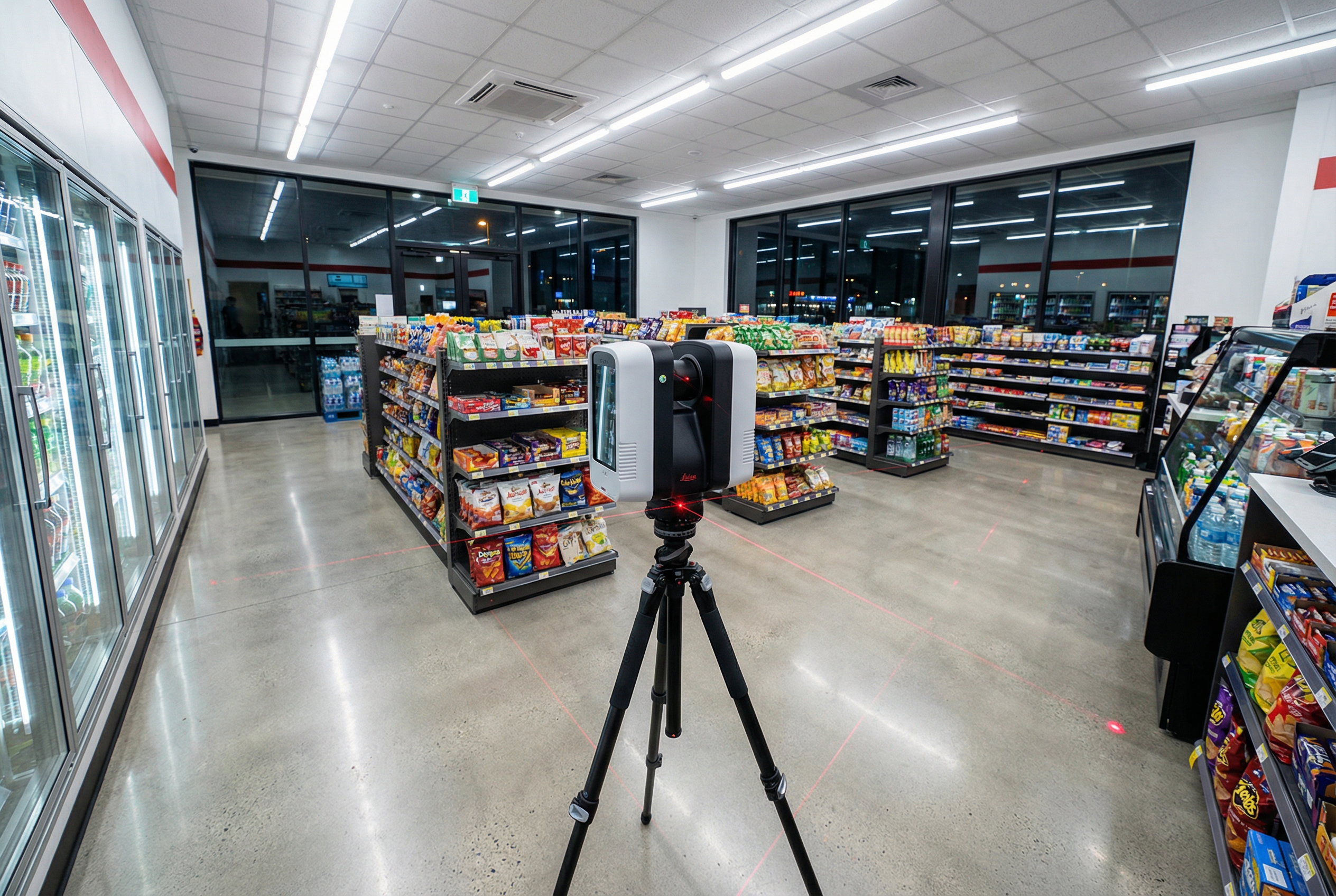
The Overnight Protocol Field teams arrive after store close, typically 10pm, coordinating entry with the store manager or designated keyholder. The LEICA BLK 360 — battery-powered, requiring no external power infrastructure, and operating nearly silently — is deployed across planned scan positions throughout the sales floor, back-of-house, and mechanical areas. By 6am, scanning is complete. Equipment is cleared. The store is ready to open.
The LEICA BLK 360 captures at 680,000 points per second with ±4mm accuracy — sufficient for LOD 300 remodel documentation at every format tier from 2,000 square foot convenience stores to 60,000 square foot supermarkets. Its portability eliminates the infrastructure dependencies that make daytime scanning impractical in active retail environments.
Format-Specific Duration
- Convenience stores (2,000–3,000 SF): 2 nights
- Supermarkets (40,000–60,000 SF): 3 nights
This format-based duration estimate is what enables per-location program scheduling. Facilities managers can budget field time, coordinate regional store manager access windows, and sequence rollouts across geographic clusters without guesswork. For a detailed breakdown of how long Scan-to-BIM documentation takes per store by format and scope, see our dedicated timeline guide.
Coordination at Scale Robotic Imaging's 24/7 scheduling system coordinates overnight access across concurrent multi-location deployments. For programs running 20–50 stores per month, regional field teams deploy simultaneously across geographic clusters, each operating on the same overnight protocol. The facilities manager sees real-time program status through the project management platform — store-by-store scan completion, model delivery queue, and deliverable status — without adding coordination overhead to the internal team.
Store managers receive standardized pre-scan briefings. Access protocols are consistent. The overnight field team operates to the same checklist at every location. This operational consistency is what makes quality sustainable across hundreds of sites.
What Gets Documented: Complete Store Remodel Scope
For retail remodel programs, the documentation scope extends beyond the sales floor. Renovation conflicts most commonly arise from conditions above the ceiling and behind the cases — exactly the areas that hand measurements and walkthroughs miss.
Sales Floor and Fixture Areas
The sales floor capture documents complete spatial geometry: floor plate dimensions with column locations at structural accuracy, ceiling heights across the full footprint (including height variations from soffit drops, structural beams, and HVAC equipment that break the plane), fixture and gondola locations for existing layout baseline, electrical panel locations and circuit routing, lighting fixture positions and mounting heights, and all millwork and built-in display elements.
This spatial baseline is what your design team needs to confirm that the standardized fixture layout fits — or to identify where it doesn't before fabrication begins.
Refrigeration and HVAC Systems
For grocery and convenience formats, refrigeration documentation is the highest-stakes capture. Robotic Imaging documents refrigeration case footprints and clearance dimensions, overhead refrigeration line routing above the ceiling tile, condenser and compressor unit locations in mechanical rooms, HVAC unit positions and duct routing affecting ceiling clearance, and utility infrastructure (gas, water, drain) serving food service areas.
Refrigeration conflicts — inadequate clearance behind cases, overhead line routing that conflicts with new ceiling plans, condenser unit relocation requirements — are consistently the most expensive change orders in grocery renovation programs. Identifying them in the model rather than during installation is the primary financial justification for documentation investment in supermarket format programs.
Back-of-House and Mechanical Areas
Complete back-of-house documentation includes: receiving area dimensions and dock configuration, walk-in cooler and freezer footprints and clearance, mechanical room equipment layouts, electrical room panel configurations, and structural wall and column locations throughout non-public areas.
Back-of-house documentation becomes critical for programs involving back-end equipment upgrades, energy system replacements, or operational workflow changes — all of which require accurate spatial baselines that existing store drawings (where they exist at all) rarely provide reliably.
Managing Multi-Location Programs: Pilot to Portfolio Approach
For facilities managers evaluating a multi-location documentation program, the standard approach is a phased rollout that validates deliverable quality before full portfolio commitment.
Phase 1: Pilot Program (5–10 Stores) The pilot selects a cross-section of store conditions — format variety, geographic spread, age of construction — that represents the range the portfolio will present at scale. Deliverables from the pilot go through your corporate design team for validation: does the LOD 300 Revit model contain what they need? Does the file organization match your CAD standards? Does the accuracy level support the fixture coordination tolerance your renovation package requires?
Pilot validation typically takes 2–3 weeks from deliverable receipt. Most design teams sign off without revision requests — because the LOD 300 standard is calibrated to renovation documentation requirements. When adjustments are needed, they're implemented in the template before regional rollout begins.
Phase 2: Regional Expansion (50–100 Stores) Following pilot validation, regional rollouts deploy concurrent field teams across geographic clusters. A 50-store regional program running 10 stores per month completes in 5 months. A 100-store program running 20 per month completes in the same window. The program management platform provides real-time visibility into scan completion, model delivery, and QA status across all active locations.
Phase 3: Portfolio-Wide Execution (Hundreds to Thousands of Locations) Robotic Imaging's 7-Eleven program — 2,400+ stores for brand refresh documentation — and Kroger initiative — 1,800+ locations for standardization — demonstrate what portfolio-wide execution requires: consistent overnight protocols, standardized deliverable formats, program management infrastructure that scales without quality degradation, and field team capacity that can sustain concurrent multi-state deployment.
For facilities managers managing portfolio-wide store documentation programs, the differentiator at scale is not scanning technology — every provider has a scanner. It's the operational infrastructure: scheduling systems, field team coordination protocols, QA checkpoints at volume, and deliverable consistency that holds across the 300th location as reliably as it held at the 3rd.
For teams coordinating documentation programs within broader corporate real estate documentation at scale initiatives, the program management layer integrates into existing capital program reporting structures without requiring custom development.
Budget and Timeline Predictability Across Your Portfolio
Enterprise procurement for retail documentation programs requires predictable per-unit pricing and reliable per-location timelines. Both are achievable when the program is structured correctly from the start.
Per-Store Pricing Structure Per-store pricing is format-dependent and scope-dependent. Convenience store tier (2,000–3,000 SF, 2-night capture, LOD 300 sales floor and back-of-house) represents a lower per-unit investment. Supermarket tier (40,000–60,000 SF, 3-night capture, full refrigeration and HVAC documentation) reflects the extended capture duration and model complexity. For retail Scan-to-BIM pricing and volume program costs across format tiers, including volume discount thresholds, see the full pricing guide.
Volume programs — typically 500+ locations — negotiate portfolio pricing that reduces the per-store unit cost relative to single-location or small-batch rates. The pricing structure is established at program initiation, enabling facilities managers to budget the full portfolio scope at project kickoff rather than re-negotiating per batch.
Timeline Predictability
- Field capture: 2 nights (convenience) / 3 nights (supermarket) per location
- Model delivery: 10-14 days from scan completion per location
- Concurrent execution: Multiple locations scan simultaneously, compressing overall program timeline
A 100-store convenience portfolio running 15 concurrent locations per month completes field capture in approximately 7 months. Model deliveries begin flowing within 10-14 days of the first scan, meaning your design team receives usable documentation before the full field program concludes.
Standardized Deliverables Every location delivers the same package: LOD 300 Revit model, registered point cloud (RCS, RCP, E57 formats available), and QA documentation confirming scan coverage and accuracy. File organization follows a consistent naming and layer structure, enabling design teams to apply renovation templates without file management overhead for each new location received.
Next Steps: Starting Your Retail Remodel Documentation Program
Robotic Imaging delivers retail facilities Scan-to-BIM programs across convenience, grocery, big-box, and specialty retail formats — with verified execution at the scale your program requires.
Frequently Asked Questions
Can laser scanning actually be done overnight without disrupting store operations? Yes. The overnight protocol — field team arrival at 10pm, completion by 6am, store opens normally — is the standard execution model for all retail location scanning. The LEICA BLK 360 is battery-powered and operates without external infrastructure or noise that would affect overnight staff. Store managers receive a standardized pre-scan briefing. The protocol has been executed across 7-Eleven, Kroger, Walgreens, Dollar General, and other formats nationwide without operational disruption.
How do we validate deliverable quality before committing to 500 locations? The standard program structure begins with a 5–10 store pilot specifically designed for design team validation. Pilot stores are selected to represent the range of conditions the full portfolio will present. Your corporate design team reviews LOD 300 Revit deliverables against your renovation template requirements before regional rollout begins. Adjustments to capture scope or file organization are implemented in the program template, not retrofitted location by location.
What happens when store conditions vary significantly from the design assumption? That's precisely what the documentation reveals — and the point of the exercise. When scanning identifies that a location has ceiling heights 18 inches below the design assumption, or structural columns that conflict with planned fixture positions, the design team receives that information during the design phase, not during construction. The variation is documented in the LOD 300 model, flagged in the QA report, and addressed in the store-specific construction package before the GC mobilizes. The cost of resolving a conflict in the model is a fraction of the cost of resolving it via change order on-site.
What deliverable formats are provided? Standard retail remodel deliverables include LOD 300 Revit models (.rvt), registered point clouds in RCS, RCP, and E57 formats, and QA documentation. File organization follows consistent naming conventions across all locations. Custom deliverable formats or additional scope (as-built CAD, specific MEP documentation layers, or facility condition reports) can be incorporated into the program template at setup.
Ready to scope your retail remodel documentation program?
Robotic Imaging has documented 100M+ square feet across retail portfolios including 7-Eleven (2,400+ stores), Kroger (1,800+ locations), Ross, Burlington, Albertsons, Dollar General, Mavis Tires, and Walgreens. Overnight scheduling, LOD 300 Revit deliverables in 10-14 days, and program management infrastructure that scales from pilot to portfolio.
Request Program Quote → | Schedule Pilot Assessment → | Download Retail Facilities Guide →
For a broader view of how retail documentation fits within your capital program, return to Retail Store Scan-to-BIM Documentation Services or explore the complete Scan-to-BIM Services capability overview.