Retail Scan-to-BIM Services: LOD 300, Overnight Access
Robotic ImagingMarch 2, 2026
Retail Store Scan-to-BIM Documentation Services
Robotic Imaging's retail scan-to-BIM services deliver accurate as-built documentation for convenience stores, supermarkets, and big-box retail locations — using overnight Laser Scanning to capture complete store conditions without disrupting daytime operations. Using the LEICA BLK 360 and LEICA RTC 360, we provide LOD 300 Revit models with ±2–4mm point cloud accuracy, delivered within 10-14 business days per location. For retail facilities managers coordinating documentation across 50–500+ stores, this is the operational standard that portfolio-scale programs require.
Retail Scan-to-BIM is a specialized application of broader as-built documentation — combining field Laser Scanning with BIM modeling to produce construction-ready deliverables that renovation design teams can work from directly, without field verification trips.
Retail Store Documentation Challenges
Multi-location retail documentation programs fail at the coordination layer, not the technology layer. Facilities managers overseeing brand refresh programs or portfolio standardization initiatives face a consistent set of compounding problems: daytime survey crews disrupting store revenue hours, inconsistent as-built data across stores of different ages and formats, and no centralized visibility into documentation progress across hundreds of simultaneous locations.
Traditional surveying firms compound these problems. Manual measurement methods take 3–5 days of daytime presence per store, generate inconsistent data formats across regional vendors, and cannot scale to portfolio-wide programs without a fragmented multi-vendor management burden.
Robotic Imaging's retail scan-to-BIM services solve all three problems simultaneously. 2,400+ 7-Eleven convenience stores documented under a nationwide brand refresh program. 1,800+ Kroger supermarket locations captured for portfolio standardization. Both programs executed with overnight scheduling, standardized LOD 300 deliverables, and zero store-hour disruption.
> Request a Retail Program Quote — Tell us your store count, format mix, and target timeline. We'll respond with program pricing within one business day.
Overnight Scanning Logistics
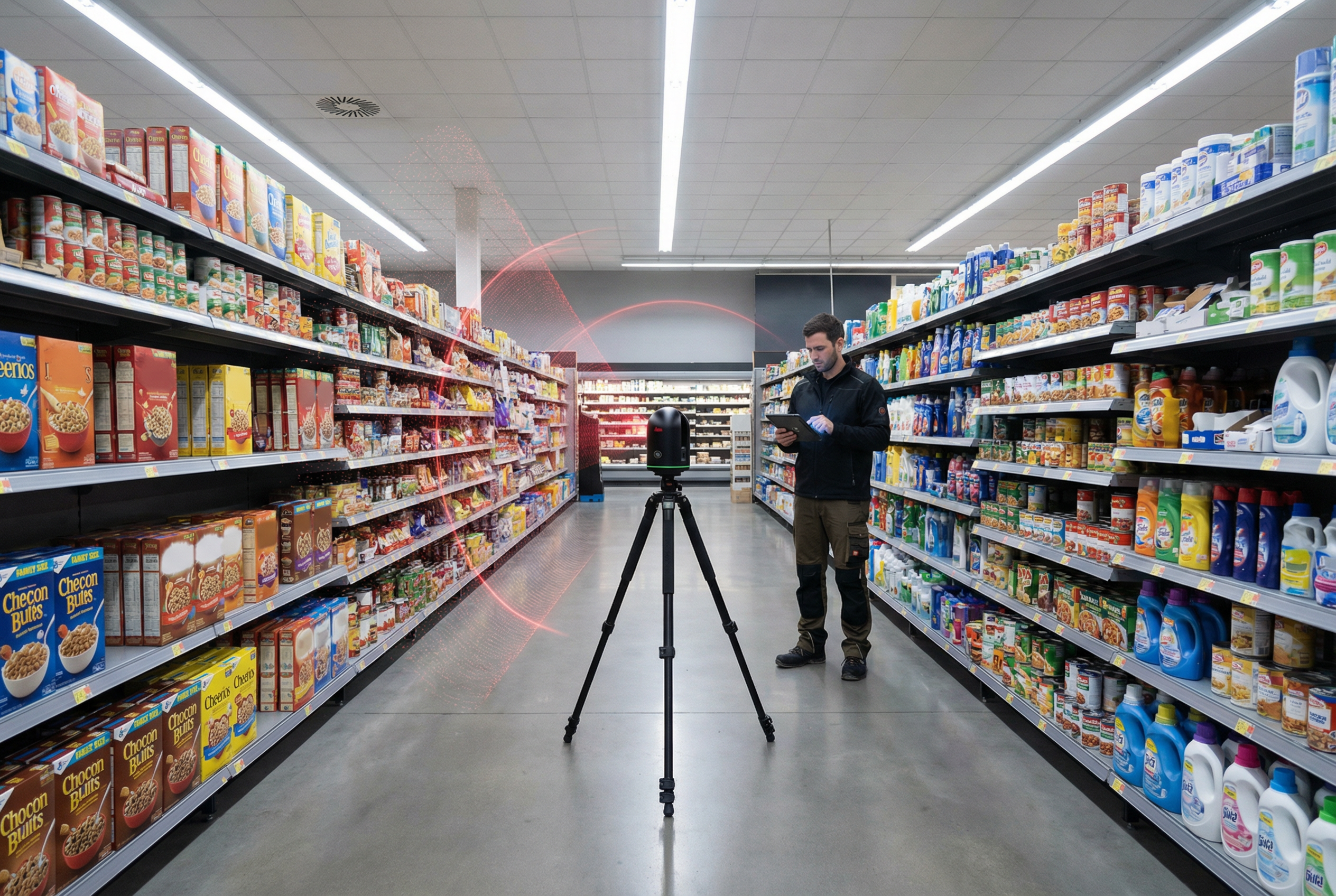
Retail store Laser Scanning services document convenience stores, supermarkets, and big-box retail locations using overnight scheduling — typically 10pm–6am — with a 2–3 night field presence per store. Deliverables include LOD 300 Revit models capturing sales floor layouts, back-of-house areas, and MEP systems, enabling renovation design teams to work from accurate as-built conditions without disrupting daytime store operations.
The operational protocol is built around retail's non-negotiable constraint: the store opens at its normal time the following morning, every morning.
LEICA BLK 360 is the primary instrument for retail store scanning. Its compact form factor — roughly the size of a large water bottle — allows placement between gondola rows without moving merchandise. Each scan position captures the surrounding environment with ±4mm accuracy at ranges up to 60 meters, meaning a standard convenience store layout of 2,400–4,000 square feet typically requires 15–25 scan positions per night, captured in sequence as the scanning technician moves through the sales floor, back-of-house, and stockroom.
For larger big-box formats requiring extended range capture, the LEICA RTC 360 provides broader coverage at 2,000,000 points per second, enabling efficient documentation of large-format stores without extending the overnight capture window.
The store manager coordination protocol is standardized across programs. Robotic Imaging schedules field access with individual store managers 5–7 business days in advance, confirms overnight access with a day-before confirmation call, and completes field capture before store opening — leaving no evidence of the scanning crew's presence. Merchandise stays in place. Security systems remain active. The store opens normally.
For portfolio programs involving hundreds of simultaneous locations, field crews are deployed in coordinated geographic clusters — completing adjacent stores in sequence to minimize mobilization costs and maintain program velocity.
Retail Store Documentation Scope
LOD 300 Revit models for retail stores capture conditions across three primary documentation zones.
Sales Floor and Fixture Layout
Sales floor documentation captures existing conditions at the architectural and fixture level: ceiling heights, column locations, wall configurations, floor-to-floor dimensions, storefront geometry, and existing fixture grid layouts. For brand refresh programs, this data defines the renovation baseline — enabling design teams to model new fixture configurations, signage systems, and customer flow changes against verified as-built geometry.
Point cloud accuracy of ±2–4mm eliminates the measurement discrepancies that generate construction change orders when renovation drawings don't match field conditions. Design teams working from Robotic Imaging's Revit models routinely eliminate site verification trips entirely during design development.
Back-of-House and Stockroom Conditions
Back-of-house documentation captures receiving areas, stockroom layouts, office spaces, employee break rooms, and restroom configurations. For retailers standardizing store operations across their portfolio, back-of-house BIM data supports equipment placement planning, code compliance verification, and operational efficiency studies.
Deliverables include accurate dimensional data for loading dock configurations, dock leveler locations, and stockroom racking footprints — critical for logistics and supply chain teams coordinating store replenishment programs.
MEP Systems Documentation
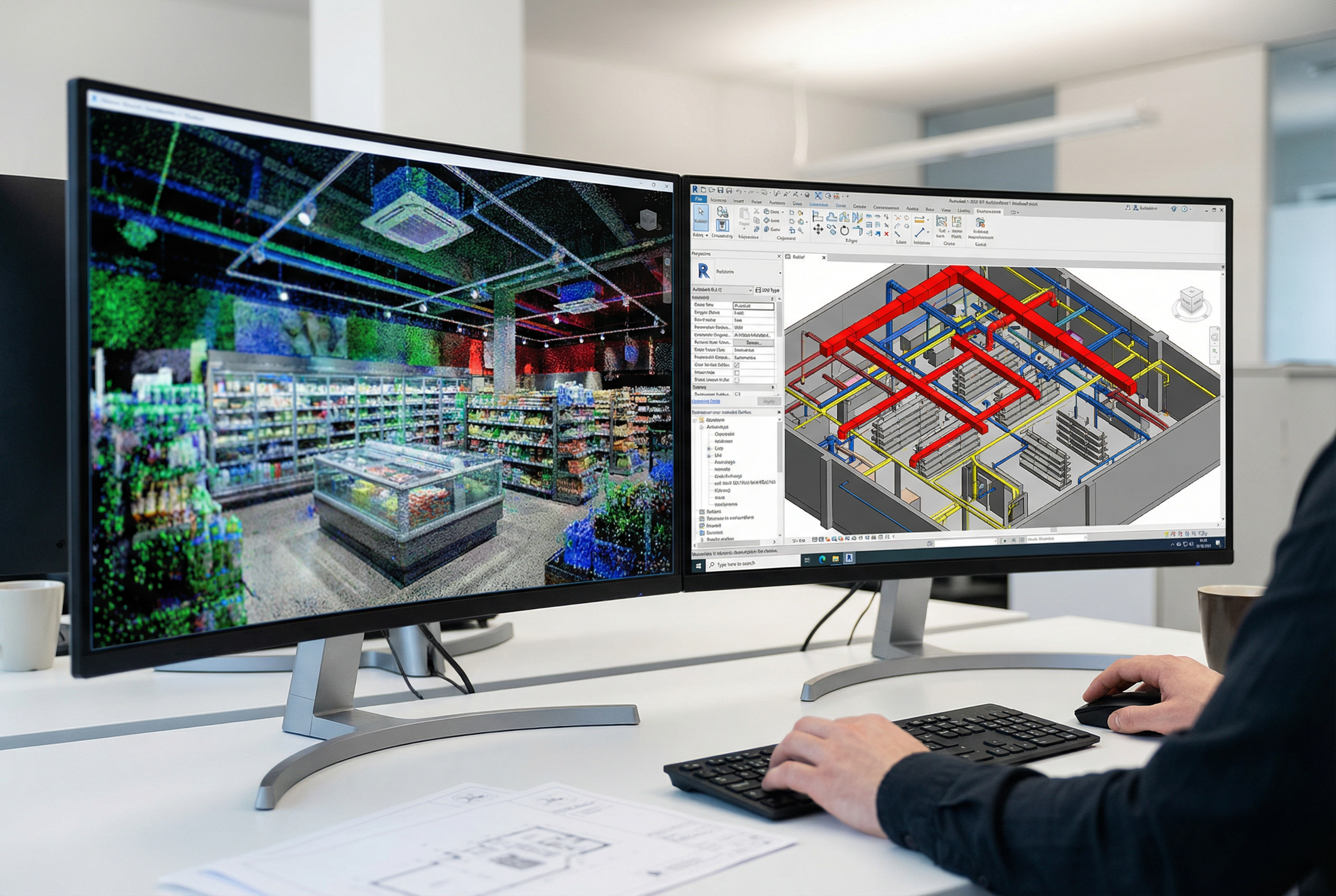
Retail MEP documentation is the technically complex layer that separates specialized retail scan-to-BIM providers from general commercial documentation services. Robotic Imaging captures mechanical, electrical, and plumbing systems in sufficient detail to support renovation design coordination — including HVAC unit locations, electrical panel schedules, plumbing chase locations, and lighting fixture grids.
For grocery and convenience store formats, MEP documentation extends to refrigeration infrastructure: walk-in cooler and freezer dimensions, refrigeration rack locations, condenser unit positions, and refrigerant type identification for EPA compliance tracking. Refrigerant data is captured and documented in the BIM model in formats compatible with environmental compliance reporting requirements — an operational requirement that general commercial scanning firms are not equipped to address.
Output formats are compatible with standard design firm workflows: RCS, RCP, E57, and LAS point cloud formats alongside native Revit (.rvt) deliverables.
Store Format Applications
Robotic Imaging's retail documentation methodology is validated across every major retail store format.
Convenience Stores: The 7-Eleven program — 2,400+ stores documented across multiple program phases — established the operational standard for high-volume convenience store documentation. Typical convenience store footprints of 2,500–5,000 square feet are captured in 2 nights, with LOD 300 Revit models delivered within 10-14 business days. AutoZone, Speedway, and Walgreens retail formats follow comparable documentation protocols, with format-specific Revit templates applied across each brand's store portfolio.
Supermarkets: Kroger's 1,800+ location program represents the largest validated supermarket documentation program in the market. Supermarket documentation adds complexity at the MEP layer — refrigeration racks spanning the full perimeter, walk-in cooler clusters, and HVAC systems serving large open-plan sales floors require more scan positions and more detailed MEP modeling than smaller formats. The LEICA RTC 360 is deployed for large-format grocery stores, providing the extended range coverage that supermarket footprints require. Dollar General and similar value grocery formats follow compressed documentation timelines appropriate to their smaller footprints.
Big-Box and Specialty Retail: Ross, Burlington, Guitar Center, Macy's, and Nordstrom programs demonstrate Robotic Imaging's capability across apparel, home goods, and department store formats. Big-box documentation emphasizes ceiling system geometry, structural column grids, and mechanical unit locations — data sets that drive renovation planning for remodel programs, new fixture installations, and tenant improvement work.
Shopping Centers and Multi-Tenant Retail: Common area documentation, individual tenant space capture, and landlord base-building BIM deliverables support property management teams coordinating renovations across multi-tenant retail environments.
Multi-Location Program Management
Enterprise retail documentation programs require a level of coordination infrastructure that field scanning alone cannot provide. Robotic Imaging's proprietary web dashboard delivers real-time program visibility — accessible via desktop browser and native iOS/Android mobile apps — giving corporate facilities teams a live view of every store's documentation status across simultaneous deployments.
Program dashboards display field capture completion by store, point cloud processing status, BIM modeling progress, and final deliverable availability — organized by geographic region, store format, or custom program groupings that match the client's internal portfolio structure. For a 300-store rollout, facilities managers can view which stores are in field capture, which are in BIM modeling, and which have final Revit models available for design team access — without making a single phone call.
Standardized LOD 300 Revit templates are applied uniformly across every store in a program. Regardless of store age, original construction quality, or regional variation in as-built conditions, every deliverable conforms to the same modeling standards, layer conventions, and file organization — eliminating the format inconsistency that complicates renovation design coordination across aging portfolios.
Phased rollout methodology allows enterprise programs to sequence store documentation by renovation priority, geographic cluster, or construction schedule — aligning documentation delivery to design team capacity and construction start dates.
Schedule a program consultation to discuss your portfolio size, store format mix, and timeline requirements. Robotic Imaging coordinates nationwide US coverage from a single vendor relationship — eliminating the 20+ regional vendor management burden that alternative approaches require.
Ready to Document Your Retail Portfolio?
For retail facilities managers evaluating Scan-to-BIM vendors for portfolio-scale programs, the proof points are specific and verifiable: 2,400+ 7-Eleven stores and 1,800+ Kroger locations documented with overnight scheduling, LOD 300 Revit deliverables, and zero store-hour disruption.
No competitor offers named Fortune 500 retail client proof at this scale. No competitor describes overnight retail scanning logistics with this operational specificity. No competitor addresses retail MEP documentation — refrigeration racks, walk-in coolers, EPA refrigerant compliance — as a standard deliverable scope.
Robotic Imaging's retail scan-to-BIM services are built for the operational realities of multi-location retail: overnight access, store manager coordination, standardized BIM templates, and corporate-level dashboard visibility across simultaneous deployments.
Request a Retail Program Quote — Provide your store count, format types, and target program timeline. Enterprise volume pricing applies to programs of 25+ locations.
See Store Documentation Samples — Request sample LOD 300 Revit models and point cloud outputs for convenience store, supermarket, and big-box formats before committing to a program engagement.
Frequently Asked Questions
How long does it take to scan a retail store? Field capture requires 2–3 nights per store (10pm–6am) using the LEICA BLK 360. The complete LOD 300 Revit model is delivered within 10-14 business days from field capture completion. Store operations are not affected — the store opens normally each morning.
Does laser scanning disrupt store operations? No. Overnight scheduling (10pm–6am) means field crews complete all work before store opening. The LEICA BLK 360's compact form factor allows scanning between gondola rows without moving merchandise, display fixtures, or signage. Store managers confirm a day-before access window; no customer-facing disruption occurs at any point during field capture.