Construction PM Scan-to-BIM: Pre-Con & As-Built
Robotic ImagingMarch 11, 2026
Construction Project Manager Scan-to-BIM: Pre-Construction Verification & As-Built Documentation
For construction project managers managing healthcare renovations, undocumented field conditions discovered after bidding represent one of the most destructive forces on project budgets and schedules. A single HVAC conflict found during rough-in — rather than during pre-construction verification — can trigger a change order exceeding $80,000 while compressing the schedule by weeks. Robotic Imaging provides pre-construction Laser Scanning and Scan-to-BIM services that verify existing conditions before bidding and deliver LOD 300 as-built BIM models at project closeout — in 10-14 business days.
Construction project manager scan-to-BIM supports three distinct project phases: pre-construction verification before GMP or bid package issuance, construction milestone documentation to capture installed conditions, and closeout as-built deliverables for facility management handoff. Whether you're managing a $5M surgical suite renovation or a $40M patient tower addition, the same principle applies — contractors bid on verified data or they bid on assumptions, and assumptions generate change orders.
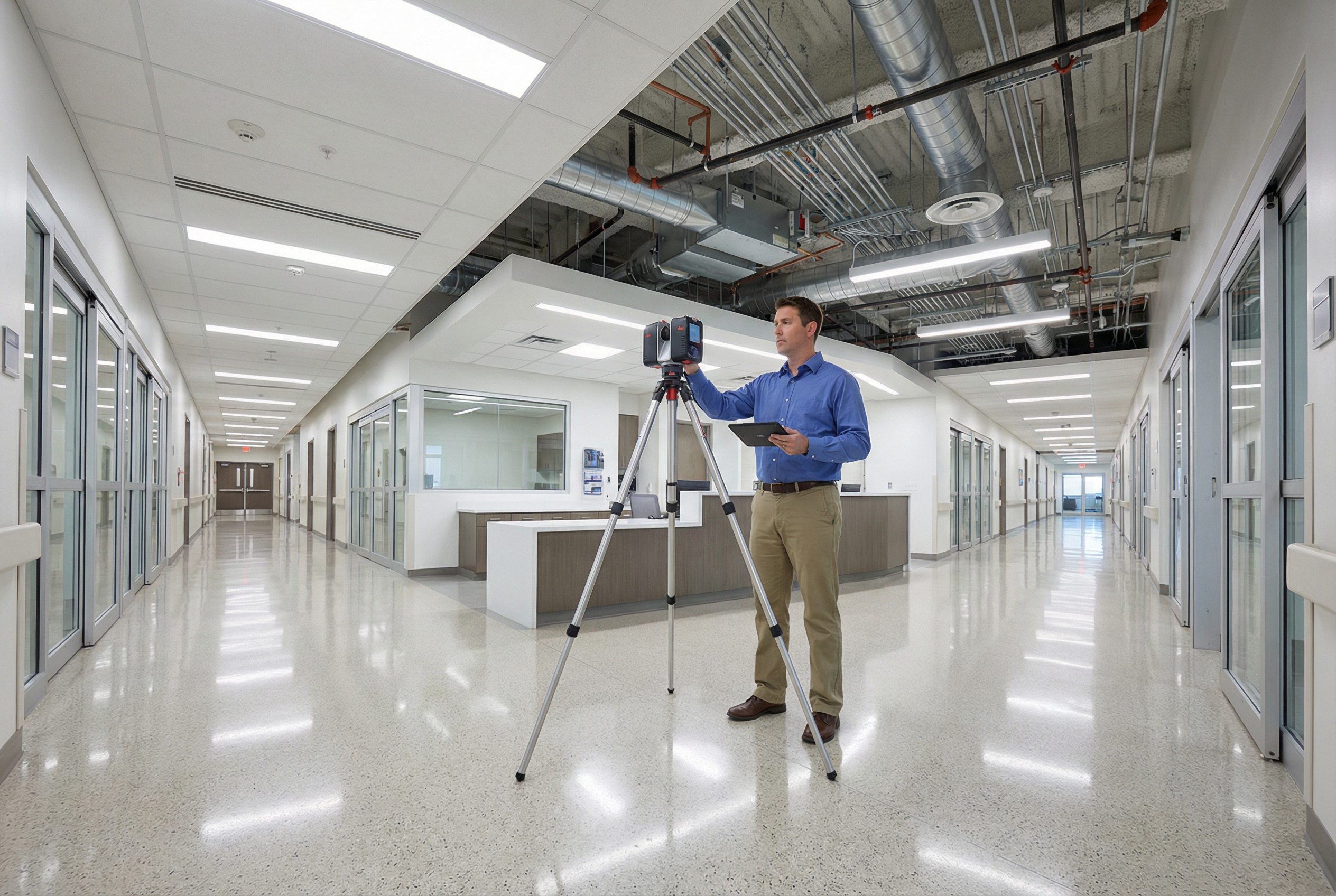
The Construction PM Documentation Problem
Change orders caused by undocumented field conditions aren't bad luck — they're a predictable outcome of relying on drawings that were never updated after the last renovation. In healthcare facilities, where mechanical and electrical systems have been modified, rerouted, and layered over decades, the gap between what the drawings show and what actually exists in the ceiling plenum can be substantial.
The traditional response — send a field superintendent with a tape measure and a clipboard — produces documentation that's incomplete, inconsistent across areas, and immediately challenged the moment a contractor disputes a change order. Manual red-lining captures what the crew noticed, not a comprehensive record of existing conditions. At project closeout, those same red-lines become the as-built record handed to the owner: a collection of handwritten dimensions and pencil marks that facilities management will struggle to use for the next renovation cycle.
Project manager BIM services exist to break this cycle. Pre-construction Laser Scanning establishes verified existing conditions before a single bid is submitted. Milestone scans capture installed conditions at key project phases. A final LOD 300 as-built BIM model gives the owner a facility management asset — not just a closeout formality.
The three-phase approach maps directly to the construction PM's existing workflow. No new process to manage, no technology learning curve for the project team. Pre-con scan before bid package, milestone scans at defined intervals, final scan at substantial completion. Robotic Imaging delivers each phase within the schedule windows construction projects actually operate in.
Ready to protect your project budget before bidding begins? Request a Construction Documentation Quote from Robotic Imaging.
Pre-Construction Verification Before Bidding
Preconstruction laser scanning is the highest-leverage scan-to-BIM investment a construction PM can make. Every dollar spent verifying existing conditions before bid package issuance eliminates a disproportionate risk of change order costs during construction — where the same conflict costs five to ten times more to resolve.
How pre-construction scanning fits the pre-bid window:
A representative example illustrates the stakes: In a hospital MEP renovation, a project team issues bid documents based on 15-year-old record drawings showing a clear pathway for new mechanical distribution through a third-floor ceiling plenum. Three contractors bid accordingly. Two weeks after award, the mechanical subcontractor opens the ceiling and finds an undocumented 24-inch conduit bundle occupying the intended route. Re-routing costs $80,000 (representative example, not an attributed client case), the schedule slips three weeks, and the PM is managing a scope dispute with the owner before the project has hit 20% completion.
A pre-construction scan of that floor plate would have identified the conflict before any contractor sharpened a pencil. The LEICA RTC 360, capturing 2,000,000 points per second at ±1/16 inch accuracy, documents every pipe, duct, conduit, and structural element within 130 meters — producing a point cloud that becomes the verified baseline for MEP coordination drawings.
Preconstruction documentation services workflow:
1. Access coordination — Robotic Imaging's 24/7 scheduling system confirms access windows and notifies field teams. Pre-con scans for occupied healthcare facilities are typically scheduled after hours or during low-census periods. 2. 2-3 day field capture — LEICA RTC 360 scans large floor plates; LEICA BLK 360 accesses tight MEP chases and clinical areas with minimal disruption. Multiple simultaneous scan positions reduce total field time. 3. Point cloud processing and model development — Registered point cloud delivered in RCS, RCP, E57, and LAS formats. LOD 300 Revit model developed from verified scan data. 4. 10-14 business day total delivery — Complete deliverable package returned before GMP or bid package issuance, fitting standard pre-construction schedule windows without impacting critical path.
Change order reduction begins the moment contractors receive bid documents based on scan-verified existing conditions rather than record drawings. Mechanical subcontractors can price accurately. Structural trades know what's actually there. Electrical teams can route based on verified conditions. The GMP becomes defensible because the bid baseline reflects reality.
For construction PMs managing phased hospital renovations, preconstruction documentation services also establish the baseline against which subsequent phases are measured — eliminating the cumulative drift that makes multi-phase projects increasingly difficult to control.
Construction Phase Milestone Documentation
Pre-construction scanning establishes the verified baseline. Construction phase scanning maintains it.
Milestone scanning serves two primary functions during active construction: verifying that installed conditions match design intent before the next trade moves in, and capturing the as-built record of concealed elements before they're enclosed. Both functions address a consistent failure point in traditional construction documentation — the gap between what was installed and what the drawings say was installed grows with every missed opportunity to capture it.
Key milestone scanning applications for healthcare construction:
Rough-in verification before drywall closure. MEP rough-in is the highest-consequence documentation opportunity on most healthcare renovation projects. Once walls and ceilings close, the exact location, elevation, and routing of installed systems is inaccessible without destructive investigation. A scan at rough-in completion produces a verified record — deviation from design drawings is identified before the design team approves closure, not during a future renovation or compliance inspection.
Structural and concrete work. Embed locations, anchor bolt patterns, and concrete slab elevations documented by scan provide contractor coordination data with ±2-4mm accuracy — significantly more reliable than field measurements for fabrication and coordination.
Progress verification for owner reporting. Healthcare owners managing active clinical operations need accurate progress reporting. Milestone scan data provides quantitative progress documentation — square footage completed, percentage of MEP rough-in verified — rather than subjective field reports.
As-built change capture. RFIs and field modifications during construction produce as-built conditions that diverge from issued-for-construction drawings. Capturing those changes at milestone intervals keeps the closeout as-built model current throughout the project, rather than requiring a comprehensive survey at substantial completion to reconstruct months of undocumented changes.
Robotic Imaging coordinates milestone scan scheduling through its project management platform, allowing construction PMs to confirm field access without separate follow-up calls. Scan data is accessible in the project dashboard as soon as processing is complete — reviewable by the PM, design team, and owner without file transfer logistics.
Project Closeout As-Built Deliverables
The construction as-built documentation delivered at project closeout is simultaneously the final deliverable on the current project and the first working document for the next renovation. Healthcare facilities operations teams depend on accurate as-built records for maintenance planning, regulatory compliance documentation, and future construction coordination. The quality of the closeout deliverable directly determines how much value the owner extracts from it.
LOD 300 Revit as-built deliverable — what's included:
A LOD 300 as-built BIM model produced by Robotic Imaging from final construction scans includes:
- Architectural elements — walls, floors, ceilings, doors, windows, and openings at verified installed dimensions and elevations
- Structural documentation — columns, beams, slabs, and structural framing at as-built locations
- MEP systems — mechanical distribution, electrical conduit and panel locations, plumbing rough-in and fixture locations, medical gas systems (where accessible)
- Point cloud deliverables — registered point cloud in RCS, RCP, E57, and LAS formats, retained for reference and future as-built verification
The .rvt deliverable is compatible with the design team's Revit environment without conversion, import issues, or version conflicts. Point cloud formats are compatible with contractor coordination platforms including Navisworks, AutoCAD, and BIM 360.
Facility management handoff value. An LOD 300 as-built BIM model is a working facility management asset. Maintenance staff can query room dimensions, MEP locations, and system routing without field investigation. Future renovation teams have a verified baseline that eliminates the pre-construction scanning cost on subsequent phases — or reduces it substantially if years of modifications require re-verification.
Warranty and compliance support. For healthcare facilities, as-built documentation supports Joint Commission surveys, infection control compliance documentation, and equipment warranty records. An accurate, accessible BIM model reduces the administrative burden on facilities teams and provides defensible documentation in warranty disputes.
As-built verification at closeout, compared against the pre-construction scan baseline, also provides the owner with a complete change documentation record — every deviation from original design that occurred during construction, documented in a format that supports change order reconciliation and owner acceptance.

Healthcare Facility Scanning Coordination
Occupied hospital scanning requires a different operational posture than a vacant commercial building. Patient care cannot be disrupted, sterile environments cannot be compromised, and clinical staff cannot be asked to navigate around survey equipment during peak operating hours. These aren't edge-case considerations — they're standard operating requirements for any vendor scanning in an active healthcare facility.
Infection control and access protocols. Robotic Imaging's field teams operate under hospital-specific infection control requirements, including equipment cleaning protocols, PPE standards appropriate to the clinical environment, and coordination with infection control practitioners before accessing sensitive areas. The LEICA BLK 360 is particularly suited to active clinical areas — its compact form factor, quiet operation, and rapid deployment minimize disruption to clinical workflows in corridors, patient rooms, and procedure areas.
After-hours and overnight scheduling. ICUs, ORs, and active patient care floors typically cannot accommodate scanning during normal operating hours. A representative workflow: a hospital renovation project team coordinates overnight scanning of a third-floor ICU renovation zone, with the Robotic Imaging field crew completing the floor plate capture between 11 PM and 5 AM — entirely outside patient care hours, with the space returned to clinical readiness before the morning shift. Robotic Imaging's 24/7 scheduling capability makes this coordination operationally practical rather than an exception requiring special arrangement.
Phased documentation for active renovation zones. Healthcare construction frequently involves multiple simultaneous renovation phases in different building zones, each with distinct access restrictions and schedule windows. Robotic Imaging has documented multi-location programs for enterprise clients including JLL and Colliers Engineering — the systematic, repeatable process that makes 100+ million square feet of documentation feasible translates directly to phased hospital renovation programs where documentation needs to keep pace with construction.
Minimizing critical path impact. The objection every construction PM raises: "Will adding a scan delay my schedule?" With 2-3 day field capture and 10-14 business day total delivery, pre-construction scanning fits within a standard 2-3 week pre-bid window without touching the critical path. Milestone scans are scheduled around construction phase transitions — before drywall closure, before ceiling grid, before substantial completion — adding documentation without modifying the construction sequence.
Contractor Coordination & RFI Reduction
Scan data delivered before bid package issuance doesn't just protect the owner — it makes every contractor on the project more efficient. When mechanical, electrical, plumbing, and structural subcontractors receive bid documents supported by verified existing conditions, the coordination process begins from a shared, accurate baseline rather than a collection of conflicting assumptions.
RFI reduction through pre-verified conditions. A significant proportion of construction RFIs originate from field conditions that don't match the drawings — conditions that pre-construction scanning would have identified and resolved at the design phase. When contractors trust the existing conditions documentation, fewer RFIs are generated, fewer design responses are required, and the construction schedule absorbs fewer coordination delays.
Clash detection effectiveness. Clash detection in Navisworks or BIM 360 is only as effective as the accuracy of the existing conditions model it runs against. A LOD 300 BIM model developed from ±1/16 inch LEICA RTC 360 point cloud data produces clash detection results that are actionable — identified clashes represent real field conflicts, not modeling artifacts from inaccurate background geometry. Design teams can coordinate MEP systems against a verified model rather than a best-guess interpretation of record drawings.
Fabrication coordination. For mechanical and structural fabrication, dimensional accuracy matters at a different scale than conceptual design. Ductwork, pipe spools, and structural connections fabricated to verified as-built dimensions fit on first installation — reducing field labor costs, material waste, and the schedule impact of fabrication corrections.
Point cloud data sharing. Robotic Imaging delivers point cloud files in RCS, RCP, E57, and LAS formats — compatible with the full range of contractor coordination platforms without conversion. Design team Revit, contractor Navisworks, owner BIM 360 — the same point cloud data serves all stakeholders from a single verified source.
Getting Started: Pre-Construction Assessment to Closeout Delivery
The construction project manager scan-to-BIM workflow is straightforward: pre-con scan before bid package, milestone scans at defined phase transitions, final scan at substantial completion for LOD 300 as-built delivery. Robotic Imaging manages scheduling, field coordination, processing, and deliverable production — the PM's role is access coordination and deliverable review, not scan project management.
Coverage for healthcare construction projects nationwide. Robotic Imaging provides construction documentation services across the United States, with 24/7 scheduling availability for projects requiring after-hours or overnight healthcare facility access. Enterprise clients including JLL and Colliers Engineering have relied on this infrastructure for multi-site programs — the same operational capability supports single-building hospital renovations and multi-phase campus construction programs alike.
Fit within your schedule window. For projects currently in pre-construction — before GMP or bid package issuance — a pre-construction scan assessment can be scheduled, completed, and delivered within the standard pre-bid window. 2-3 day field capture. 10-14 business day total delivery.
Frequently Asked Questions
When should a construction project manager order a pre-construction scan? Before the GMP or bid package is issued to contractors — ideally 3-4 weeks before bid documents are finalized. This allows scan data to be incorporated into coordination drawings and gives contractors verified existing conditions to bid against, reducing change order risk from the outset.
How long does scan-to-BIM take for construction projects? Robotic Imaging completes field capture in 2-3 days for typical hospital floor plates. Total delivery — including point cloud processing and LOD 300 BIM model development — is 10-14 business days from field capture completion. This fits within standard pre-bid schedule windows without impacting critical path.
Can laser scanning be done in an occupied hospital? Yes. Robotic Imaging coordinates after-hours and overnight access for occupied clinical areas, operates under hospital infection control protocols, and uses the LEICA BLK 360 for compact, low-disruption access in active patient care environments. 24/7 scheduling availability supports access window coordination for any shift structure.
What does an as-built BIM model include at construction closeout? A Robotic Imaging LOD 300 as-built BIM model includes architectural elements (walls, floors, ceilings, openings), structural framing, and MEP systems at verified installed dimensions and locations, delivered as a .rvt Revit file compatible with design team and owner platforms. Point cloud deliverables in RCS, RCP, E57, and LAS formats are included for contractor and facilities management use.
How does scan-to-BIM reduce construction change orders? Pre-construction scanning documents existing field conditions before bid package issuance. Contractors receive verified existing conditions documentation rather than record drawings that may not reflect field reality — eliminating the most common source of conflict-based change orders. Identified field conflicts are resolved at the design phase, where cost and schedule impact is minimal, rather than during construction, where the same conflict generates a change order.
Facing change order risk on an upcoming healthcare renovation? Get a customized quote for construction documentation services tailored to your pre-con schedule and healthcare access requirements. Request a PM Quote or Schedule a Pre-Con Assessment with Robotic Imaging today.