Design-Build Scan-to-BIM for IPD Projects
Robotic ImagingApril 9, 2026
Design-Build Scan-to-BIM for IPD Projects
For construction project managers leading design-build hotel renovations or Integrated Project Delivery projects, late existing conditions documentation creates compounding risk: assumption-based GMP commitments, contractor input arriving after design locks, and change order exposure from undocumented MEP systems and structural conditions. Robotic Imaging's design-build Scan-to-BIM services deliver LOD 300 BIM models in 10-14 business days — preconstruction phase documentation that enables design-build teams to begin collaborative design from a verified baseline before GMP commitment.
Design-build Scan-to-BIM provides preconstruction phase existing conditions documentation delivered as LOD 300 BIM models in 10-14 business days. Deployed before design begins, it enables design-build teams to conduct collaborative design sessions from a verified baseline, supports accurate GMP development from scan-verified quantities, and reduces unknown conditions contingency by 5-10% on hotel renovation projects.
Design-Build Documentation: Why Timing Changes Everything
The central risk in any design-build hotel renovation isn't the renovation itself — it's committing to a Guaranteed Maximum Price before anyone has verified what they're actually building into. Traditional documentation approaches create a dangerous sequence: design advances on assumed conditions, contractor estimating follows design, and unknown conditions surface during construction when corrections carry maximum cost impact.
Design-build projects don't have that buffer. The integrated timeline that makes design-build delivery faster also concentrates the cost of documentation failures. When the architect, contractor, and owner operate from separate or unverified existing conditions data, every downstream decision inherits that uncertainty. Quantity takeoffs built on assumption-level accuracy require contingency reserves to compensate — contingency that could otherwise reduce the GMP or fund project scope.
The timing solution is precise: commission existing conditions scanning during the preconstruction phase, before schematic design begins. A LOD 300 BIM model delivered within 10-14 business days of field capture gives your full design-build team a shared, verified baseline before a single design decision locks. For fast-track hotel renovation projects operating under compressed preconstruction schedules, this timing is achievable — not theoretical.
Ready to confirm delivery fits your preconstruction timeline? Request Design-Build Documentation from Robotic Imaging.
Early Contractor Involvement: The Design-Build Advantage
The defining advantage of design-build delivery is early contractor involvement — the general contractor participates in design decisions rather than inheriting them. But that advantage only materializes when the contractor has verified conditions data to work from. Without accurate existing conditions documentation, early contractor involvement defaults to experienced estimation, not constructability analysis from known facts.
Robotic Imaging's preconstruction scanning gives contractor input real teeth. When your contractor reviews constructability during schematic design rather than during design development or construction documents, they're operating from ±2-4mm verified point cloud data that captures every structural element, MEP routing condition, and dimensional constraint in the building. The result is proactive value engineering grounded in actual field conditions — not reactive change orders from conditions discovered during demo.
The workflow integrates directly into design-build preconstruction:
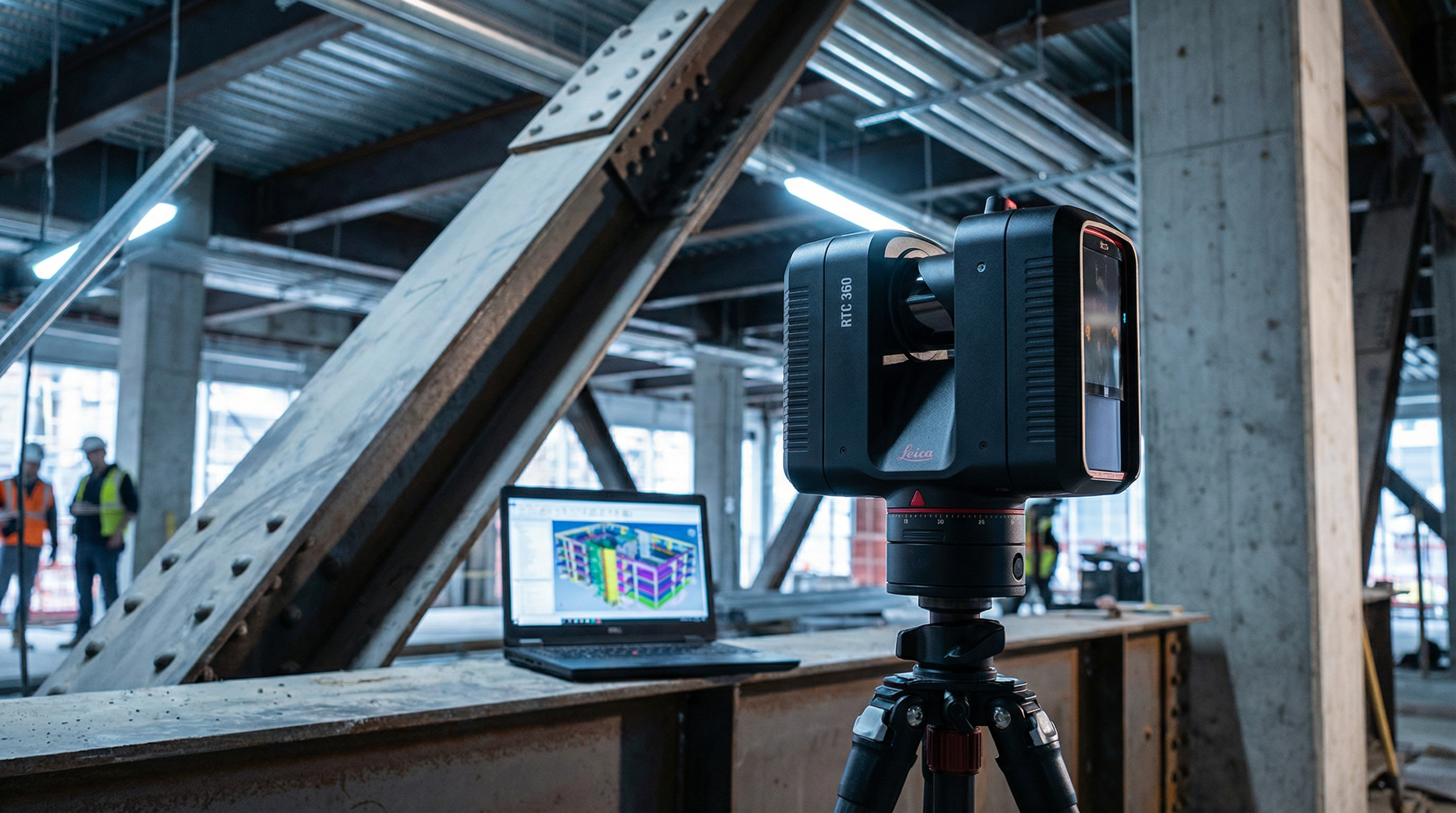
1. Field Capture (2-3 days): LEICA RTC 360 scanning of the project area, including all hotel floors, mechanical rooms, back-of-house, and any areas affecting renovation scope — scheduled during overnight hours to avoid guest disruption 2. Point Cloud Processing (3-5 days): Registration, cleanup, and quality verification of raw scan data to produce a navigable, accurate point cloud 3. BIM Modeling (7-10 days): LOD 300 Revit (.rvt) model produced from verified point cloud data, structured for immediate use in collaborative design sessions
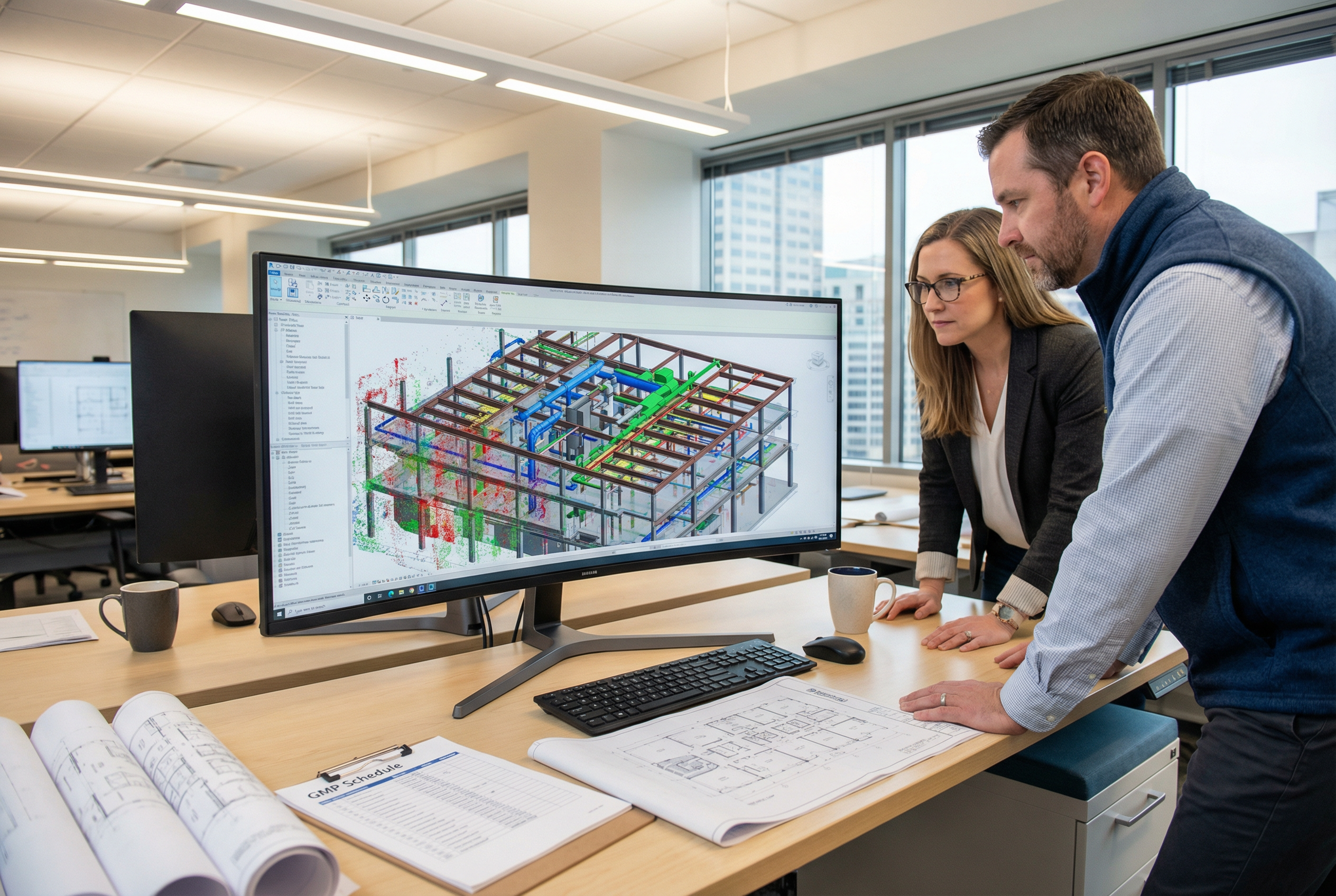
The deliverable is a Revit (.rvt) model that your architect, contractor, and owner can open simultaneously in collaborative BIM services workflows. Shared access to a single verified model eliminates the parallel-measurement problem that plagues multi-party design-build teams — where architect field measurements differ from contractor field measurements and reconciliation consumes schedule.
For design-build teams new to integrating scanning into preconstruction, this sequence is straightforward: scanning precedes schematic design, the model enters your existing Revit collaborative environment, and the team proceeds from verified conditions rather than assumed ones. The process doesn't require new software, new workflows, or new vendor relationships beyond the documentation provider.
GMP Development and Cost Certainty from Verified Conditions
The GMP commitment is where design-build documentation investment pays its clearest return. A GMP built on scan-verified quantities carries fundamentally different risk characteristics than one built on manual measurements or assumed conditions.
LOD 300 provides sufficient detail for contractor quantity verification and GMP development. At this Level of Development, the model includes accurate location, size, and configuration of structural systems, MEP components, and architectural elements — everything a contractor needs for accurate quantity takeoffs without field verification trips. When your contractor's estimating team builds labor and material quantities from a scan-verified Revit model rather than sketched field notes, unknown conditions contingency can typically decrease by 5-10% on hotel renovation projects.
On a $10 million hotel renovation GMP, a 5% contingency reduction represents $500,000 — project budget that can fund additional scope, return to the owner, or strengthen the shared savings pool in an IPD agreement. The documentation investment required to achieve that outcome is a project cost line item that justifies itself in the first contingency conversation.
Transparent scope is the second benefit. When all parties reference the same LOD 300 model, scope boundaries are visually clear. The MEP systems within the renovation boundary are documented. The structural elements requiring work are identified. The areas outside scope are equally defined. Scope ambiguity — one of the leading drivers of design-build change orders — diminishes when the existing conditions are no longer a matter of interpretation.
Robotic Imaging documents conditions with ±2-4mm point cloud accuracy using the LEICA RTC 360, which captures 2,000,000 points per second across a 130-meter range. Every hotel MEP system detail, structural connection, and dimensional condition is captured in the point cloud. The BIM model derived from that data reflects verified reality, not approximated conditions.
How Scan-to-BIM Supports IPD Methodology
Integrated Project Delivery contracts introduce a requirement that traditional design-bid-build projects don't face: a shared, objective existing conditions baseline that all parties — owner, architect, and contractor — agree reflects actual building conditions before shared risk and reward calculations begin. Assumption-based scope under a shared risk/reward structure creates disputes, not collaboration.
Scan-to-BIM for design-build and IPD projects addresses this requirement directly. The LOD 300 model produced from ±2-4mm point cloud data becomes the objective baseline for target value design exercises. When the integrated project team sits down to align scope with target cost, they're analyzing verified conditions — not debating whose field measurements are more accurate.
Integrated project delivery scanning supports three specific IPD process requirements:
Target Value Design: Design decisions and scope trade-offs during target value design sessions can be evaluated against verified existing conditions. Value engineering options are analyzed against real building data — potential MEP rerouting options, structural reuse opportunities, and phasing alternatives are grounded in documented reality.
Transparent Cost Tracking: IPD shared risk/reward structures require transparent scope and cost tracking through design. When quantity takeoffs derive from a scan-verified BIM model, cost tracking through design phases reflects accurate scope evolution rather than accumulated measurement uncertainty.
Collaborative Decision-Making: Robotic Imaging's project dashboard provides owner, architect, and contractor simultaneous access to point cloud data and model progress. Rather than passing deliverables sequentially, all IPD partners can review the same verified data at the same time — supporting the concurrent design decisions that distinguish IPD from sequential delivery.
For IPD documentation, the shared access model is as important as the model itself. When every party works from the same verified dataset, the information asymmetries that generate disputes in risk/reward contracts are systematically reduced.
Hospitality Project Applications: Scanning Operational Hotels
Hotel renovation projects present operational constraints that eliminate many traditional documentation approaches entirely. Guests occupy floors during renovation planning. Lobbies and food and beverage spaces cannot close for survey crews during operating hours. Mechanical rooms supporting active hotel systems require access coordination. And renovation timelines align with occupancy calendars — not survey crew availability.
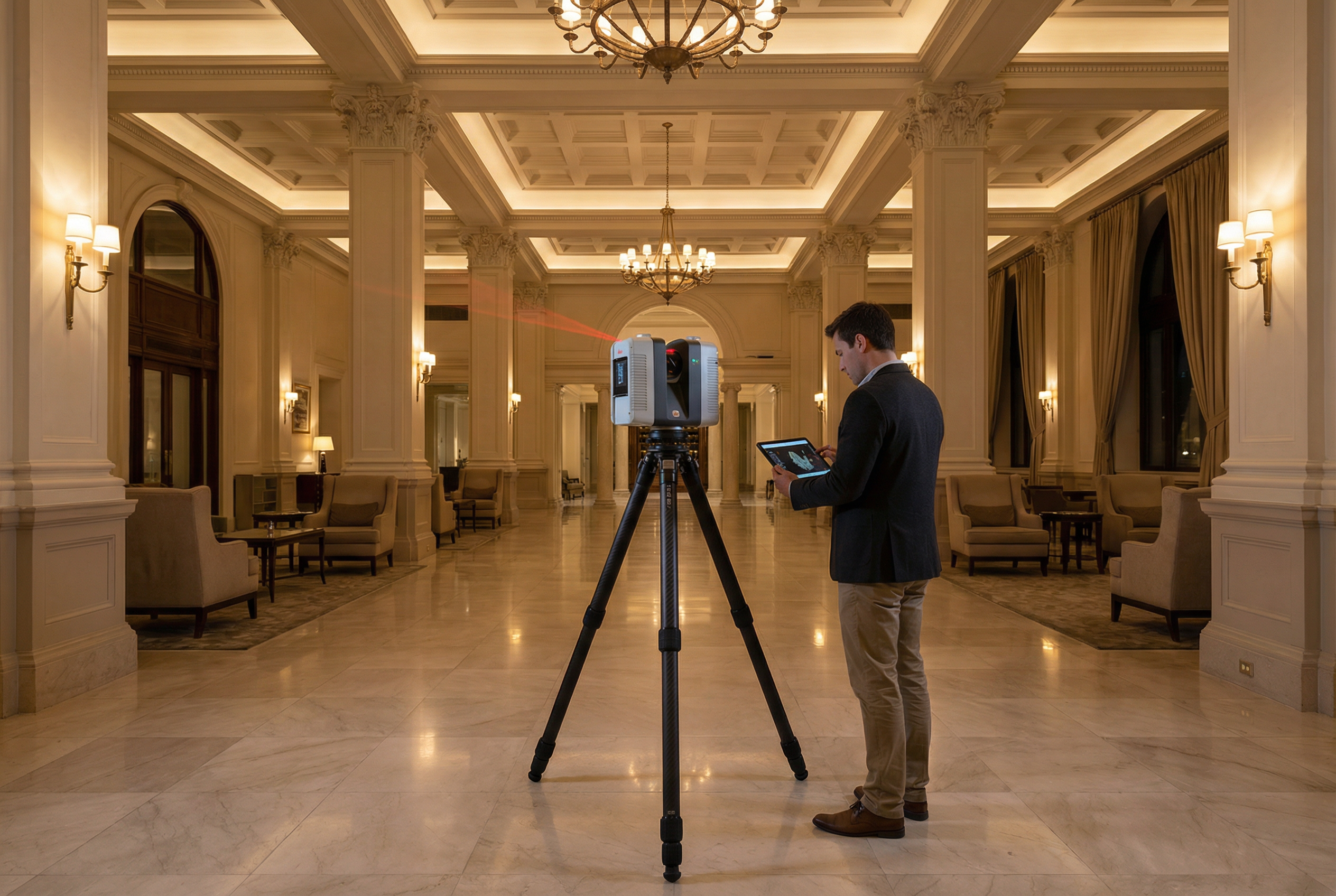
Robotic Imaging's 24/7 scheduling system resolves these constraints directly. Field capture for hotel projects can be scheduled during overnight windows — after lobby close and before breakfast service — when guest traffic is minimal and operational impact is essentially zero. The LEICA RTC 360's speed advantage (2,000,000 points per second) means a full hotel floor plate can be captured in a single overnight session, with scan positions covering corridor systems, guestroom corridors, back-of-house areas, and mechanical spaces before the morning shift begins.
For projects with phased renovation scopes, scanning can be deployed in phases aligned with the hotel's seasonal occupancy patterns — full documentation of Phase 1 areas during a low-occupancy window, with Phase 2 areas captured before that design phase begins. This phased approach matches the scan delivery schedule to the design-build team's actual information needs rather than front-loading cost for documentation of areas not yet in active design.
Hospitality-specific MEP complexity adds a technical requirement that scanning addresses precisely. Hotel HVAC distribution, fire suppression systems, in-wall electrical and data cabling, and plumbing stacks in occupied guestroom wings represent conditions that manual surveys cannot reliably document at the accuracy level required for contractor quantity verification. The LEICA BLK 360 handles tighter operational spaces — corridors, mechanical rooms, and constrained back-of-house areas — with documentation precision sufficient for MEP coordination modeling.
The combined equipment deployment (LEICA RTC 360 for large floor plates and public spaces, LEICA BLK 360 for constrained operational areas) captures a complete existing conditions picture — the same picture your contractor needs before GMP commitment and your architect needs before schematic design.
Constructability and Prefabrication Planning
Design-build delivery increasingly incorporates prefabrication and modular construction components — particularly in hotel renovation where bathroom pod replacement, MEP prefabrication, and modular casework represent schedule and cost advantages when dimensionally coordinated. Prefabrication planning has a hard dependency: the prefabricated components must match the verified dimensions of the receiving space, not the assumed dimensions.
A LOD 300 scan-derived BIM model provides the dimensional accuracy foundation for prefabrication coordination. When the structural bay dimensions, rough opening sizes, and MEP rough-in conditions derive from ±2-4mm verified point cloud data, prefabricated components can be manufactured to fit actual field conditions. The tolerance stack-up that creates prefab installation failures — where components manufactured to drawing dimensions don't fit actual building conditions — is eliminated when the BIM model reflects the building as it actually exists.
Constructability reviews during schematic design benefit from the same verified baseline. Access routing for material delivery through an occupied hotel, swing space requirements during phased renovation, and sequencing constraints from existing structural systems are all visible in the verified model before design locks. Robotic Imaging has documented more than 100 million square feet of commercial and operational facilities, including multi-site programs for Fortune 500 clients such as JLL and TravelCenters of America — operational facilities requiring the same non-disruptive scheduling and precision documentation that hotel renovations demand.
Start Your Design-Build Project with Verified Conditions
Design-build hotel renovations and IPD projects share a documentation requirement that assumption-based approaches cannot satisfy: a verified, shared existing conditions baseline that all parties trust before GMP commitment, collaborative design sessions, and shared risk/reward structures begin.
The preconstruction scan workflow is straightforward: 2-3 day overnight field capture → 3-5 day point cloud processing → 7-10 day BIM modeling = LOD 300 Revit (.rvt) model delivered in 10-14 business days, ready for your collaborative design environment before your GMP deadline.
Frequently Asked Questions
When should design-build teams commission Scan-to-BIM? Commission during the preconstruction phase, before schematic design begins. This timing enables contractor input from project start, supports target value design from verified conditions, and ensures the LOD 300 model is available before GMP commitment.
How does Scan-to-BIM improve GMP accuracy? Scan-verified quantities give contractor estimating teams documented field conditions rather than assumed ones. Verified conditions typically reduce unknown conditions contingency by 5-10%, directly improving GMP cost certainty.
Can laser scanning occur in an occupied hotel without disrupting guests? Yes. Robotic Imaging's 24/7 scheduling system supports overnight and off-season field capture. The LEICA RTC 360 captures complete hotel floor plates during overnight windows with minimal operational impact — no guest disruption, no operational shutdown required.
What LOD is required for design-build contractor estimating and GMP development? LOD 300 provides sufficient detail for contractor quantity verification and GMP development, including accurate location, size, and configuration of structural, MEP, and architectural elements.
Facing GMP risk from undocumented hotel conditions? Get a customized quote for design-build documentation tailored to your preconstruction schedule.
Request a Design-Build Documentation Quote — Tell us your GMP deadline and we'll confirm 10-14 business day delivery fits your preconstruction phase.
Schedule an IPD Team Consultation — Discuss how Scan-to-BIM integrates into your specific design-build or IPD workflow with Robotic Imaging's project team.
Download the Design-Build Scan-to-BIM Guide — Preconstruction documentation workflow, LOD specification guide, and GMP risk reduction framework for design-build project managers.