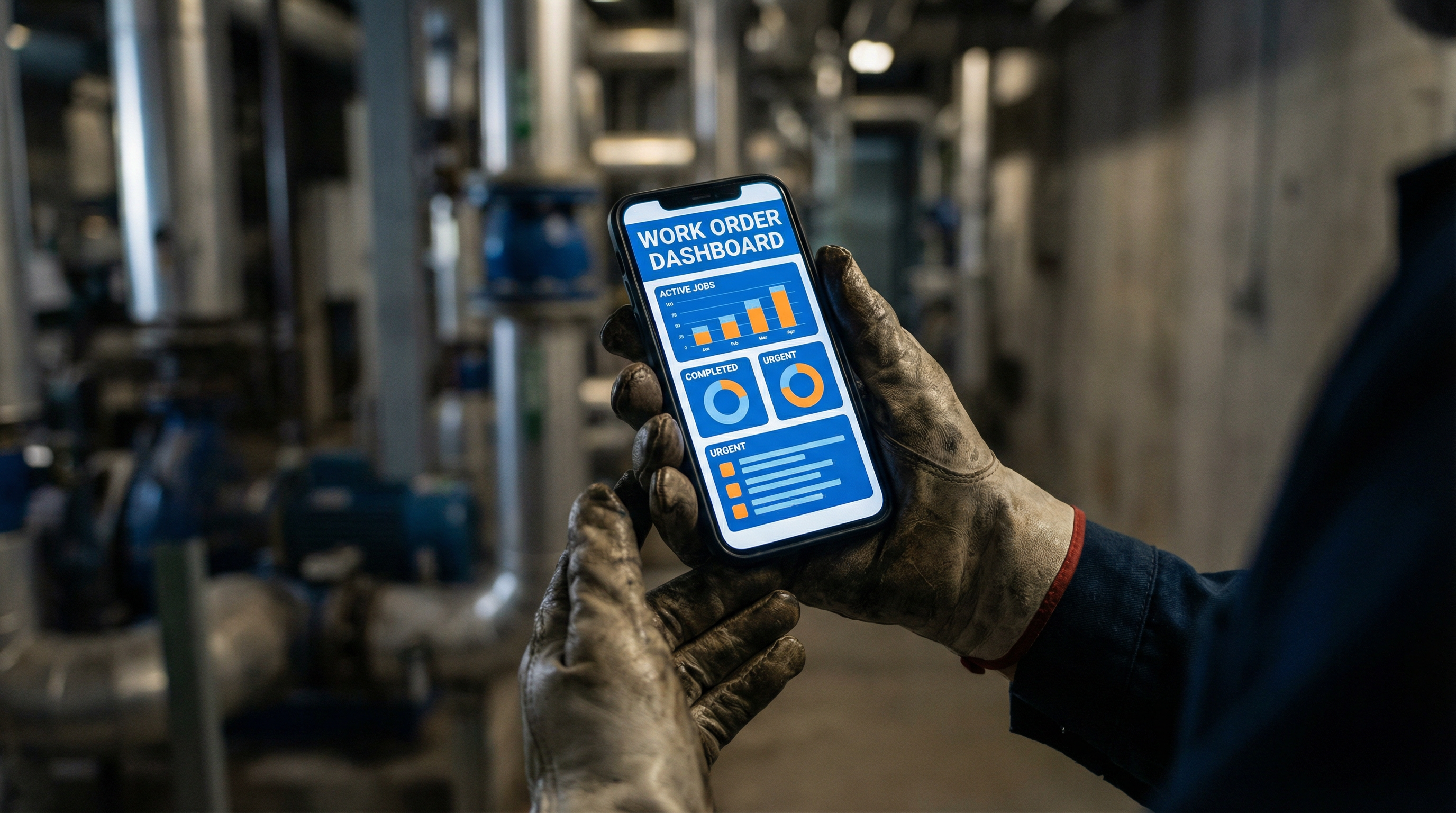
Mobile Work Order Platform for Maintenance Managers
Robotic ImagingApril 16, 2026
Maintenance Manager Mobile Work Order Platform
For maintenance managers coordinating service technicians across 50–500 retail locations, desktop-bound work order systems create compounding inefficiency: technicians receive assignments by phone, arrive on-site without equipment specifications, complete service without field documentation capability, and return to office hours later to enter work order data from memory. Robotic Imaging's mobile work order platform delivers work orders directly to technician smartphones with equipment details pre-populated from AI-extracted asset records, enables QR code equipment access in field, and captures service documentation immediately — delivering 20–30% technician productivity gains by eliminating office data entry overhead entirely.
A maintenance manager mobile work order platform delivers work orders to technician smartphones via push notifications with store location, equipment specifications, and issue description; enables equipment information access via QR code scanning in field; provides mobile service logging documenting work performed, parts used, and photos immediately; offers real-time technician status tracking; and guides preventive maintenance with mobile checklists — typically achieving 20–30% technician productivity gains.
Ready to eliminate phone dispatch and office data entry from your maintenance operations? Request a Maintenance Platform Demo to see the full coordination workflow for retail technician teams.
The Multi-Location Maintenance Coordination Problem
Retail maintenance managers running distributed technician teams face a structural inefficiency that desktop CMMS platforms don't solve: the coordination loop breaks at the field level. Work orders get created in a desktop system, assigned by phone call or email, and acknowledged whenever the technician checks their inbox. Equipment context lives in the office. Service documentation waits until the technician drives back to headquarters.
For a portfolio of 50 stores, this friction compounds daily. A technician dispatched to service a rooftop HVAC unit at Store 147 calls the office to confirm the equipment model and refrigerant type before ordering parts. A coordinator spends 45 minutes at end-of-day entering service notes from six paper work orders into the CMMS. A maintenance manager trying to confirm which technician is on-site at which location phones three people before getting an answer.
The root cause isn't technician capability or coordinator effort — it's architecture. Desktop CMMS platforms were built for schedulers sitting at workstations, not field technicians working across rooftops, basements, and equipment rooms with inconsistent WiFi. Mobile apps added to desktop platforms inherit the same data model: office-created, office-resolved, with field execution as an afterthought.
Robotic Imaging's mobile maintenance management platform was built from a different architecture: native iOS and Android apps designed for field-first workflows, where equipment records are populated by AI extraction before technicians arrive, work orders travel with full asset context, and documentation happens in the field at completion — not hours later from fading memory.
Mobile Work Order Assignment and Push Notification Dispatch
The most immediate productivity loss in phone-and-email dispatch isn't the time spent on the call — it's the lag, miscommunication, and context loss that follows. A technician who receives a work order by phone has a model number scribbled on a notepad, a store address, and a vague description of the complaint. A technician who receives a push notification has everything.
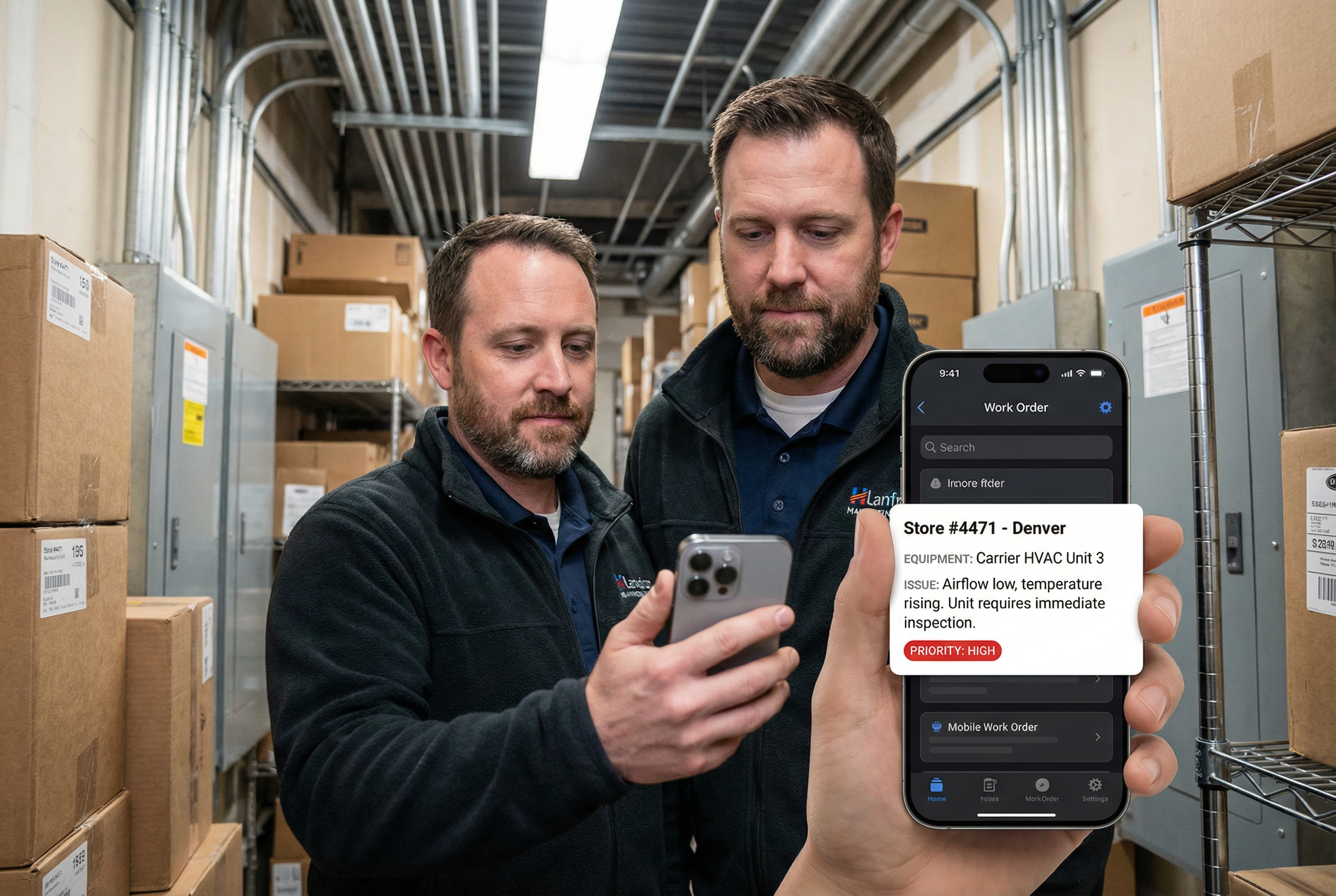
Robotic Imaging's mobile work order platform delivers work orders as push notifications to technician smartphones the moment a manager creates and assigns them. Each notification carries the complete work order payload: store name and address, equipment identifier, reported issue description, priority level, and any manager notes. The technician taps the notification and the full work order opens in the native iOS or Android app — no login screen, no web browser redirect, no loading delay.
The assignment workflow for maintenance managers is equally direct. From the manager dashboard, an open request at Store 312 gets assigned to the nearest available technician in two taps. The platform confirms assignment delivery, and the technician's acceptance updates work order status in real time. The phone-tag dispatch loop — call technician, confirm availability, describe the job, repeat if unavailable — is replaced by a documented, tracked push notification with automatic status feedback.
For retail portfolios where reactive maintenance volume runs high — refrigeration complaints, HVAC failures, lighting issues — the difference between phone dispatch and push notification delivery at scale is measurable. Technicians accept assignments faster, arrive with context, and maintenance managers maintain assignment visibility without active coordination effort.
The technician mobile platform supports iOS and Android with <2-second load times and 60fps performance — consumer app responsiveness in an enterprise field service context. Technicians who are skeptical of new technology because they've experienced slow, browser-based CMMS mobile experiences encounter something fundamentally different. One QR scan, one tap — the friction point that kills adoption with web-based tools doesn't exist in a native app architecture.
Equipment Information Access in the Field via QR Code
The diagnostic time wasted when a technician arrives on-site without equipment context is invisible in most CMMS reporting — but maintenance managers who track labor hours per work order recognize it immediately. A technician who spends 15 minutes locating the equipment nameplate, photographing the serial number, calling the office to cross-reference the service history, and confirming the correct refrigerant type before beginning work has lost 15 billable minutes on every reactive call where that context wasn't pre-loaded.
Robotic Imaging's platform eliminates this friction through QR code equipment access. Each asset in the platform carries a unique QR code that can be affixed to the equipment. When a technician scans the code with their smartphone camera, the native app opens the complete equipment record instantly: manufacturer, model number, serial number, installation date, service history, maintenance notes, and AI-extracted specifications from the original documentation capture.
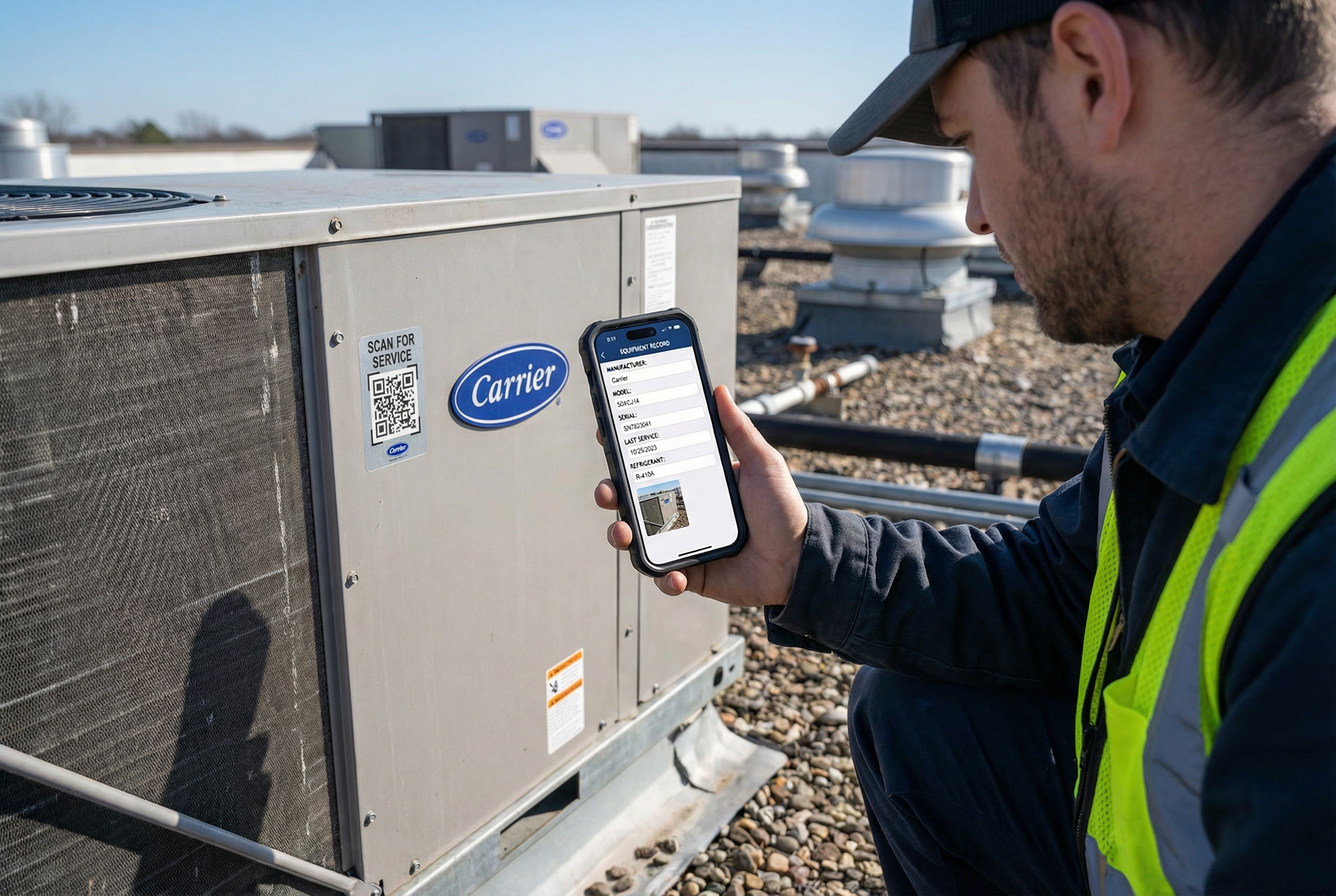
The asset records themselves are built from Robotic Imaging's AI extraction engine, which processes smartphone photos of equipment nameplates with 85–90% automated accuracy — extracting manufacturer, model, and serial number in 5–10 seconds versus the 3–5 minutes required for manual entry. When store managers photograph new equipment using the platform's self-service documentation workflow, AI populates the asset record before a technician ever touches the equipment. The work order asset integration means technicians arrive informed, not investigative.
This matters most in retail environments where connectivity is unreliable. Basement compressor rooms, rooftop HVAC units, and rural store locations with weak cellular signal are exactly where technicians need equipment context most — and exactly where web-based CMMS mobile apps fail. Robotic Imaging's offline capability caches 1,000+ equipment records locally on the device. The QR scan, equipment record retrieval, and service history review all function without WiFi or cellular connection. When connectivity returns, the platform syncs automatically.
For maintenance management asset software evaluation, this combination — AI-populated equipment records accessible via QR scan with full offline capability — represents the field decision-support layer that separates mobile-first architecture from desktop CMMS platforms with added mobile apps. Competitors offer work order delivery; Robotic Imaging delivers work order delivery with the equipment intelligence attached.
Mobile Service Documentation and Field Logging
Service documentation quality degrades with time. A technician who logs work performed, parts used, and observations immediately after completing service captures accurate information. A technician who returns to the office at 5pm to enter the day's six work orders from memory produces approximations — and those approximations accumulate as billing inaccuracies, inventory discrepancies, and incomplete service histories that degrade asset record quality over months.
Robotic Imaging's platform captures service documentation in the field, at completion, through the same native app that delivered the work order. The service logging workflow is structured for technician speed: work performed description, labor time, parts used with quantity, photo capture of completed work, and any follow-up notes. The entire workflow completes in under three minutes from a smartphone screen.
The photo capture function is particularly valuable for retail maintenance contexts where warranty claims, landlord documentation, and compliance records require visual evidence. A technician completing a refrigeration repair photographs the completed installation before leaving the equipment room. That photo attaches to the work order record immediately, visible to the maintenance manager's dashboard in real time, and archived against the equipment's service history automatically.
Parts documentation at field logging directly supports billing accuracy. When a technician records parts used against the work order at completion, the platform deducts from inventory and associates parts cost with the service event. This eliminates the reconciliation gap between parts pulled from the van and parts billed to the work order — a gap that generates both undercharging and overcharging when parts tracking relies on end-of-day manual entry.
The mobile maintenance management workflow also supports work order completion evidence for multi-vendor environments. When internal technicians and contracted service providers both operate against the same asset base, field-logged documentation with photos and timestamps provides the maintenance manager with consistent completion verification regardless of who performed the work.
Real-Time Technician Status and Mobile Work Order Tracking
For a maintenance manager responsible for a 200-store retail portfolio, the operational question isn't whether work orders are being completed — it's whether the right work order is being completed at the right location right now. Phone-based status checks answer this question one technician at a time. Robotic Imaging's platform answers it for the entire team simultaneously.
The manager dashboard provides real-time technician status across the full portfolio: technician location, assigned work order, current status (en route, on-site, work in progress, completed), and time elapsed since assignment. When a technician updates work order status from their mobile app — accepted, arrived, parts ordered, completed — the manager dashboard reflects the change instantly without requiring any manager action.
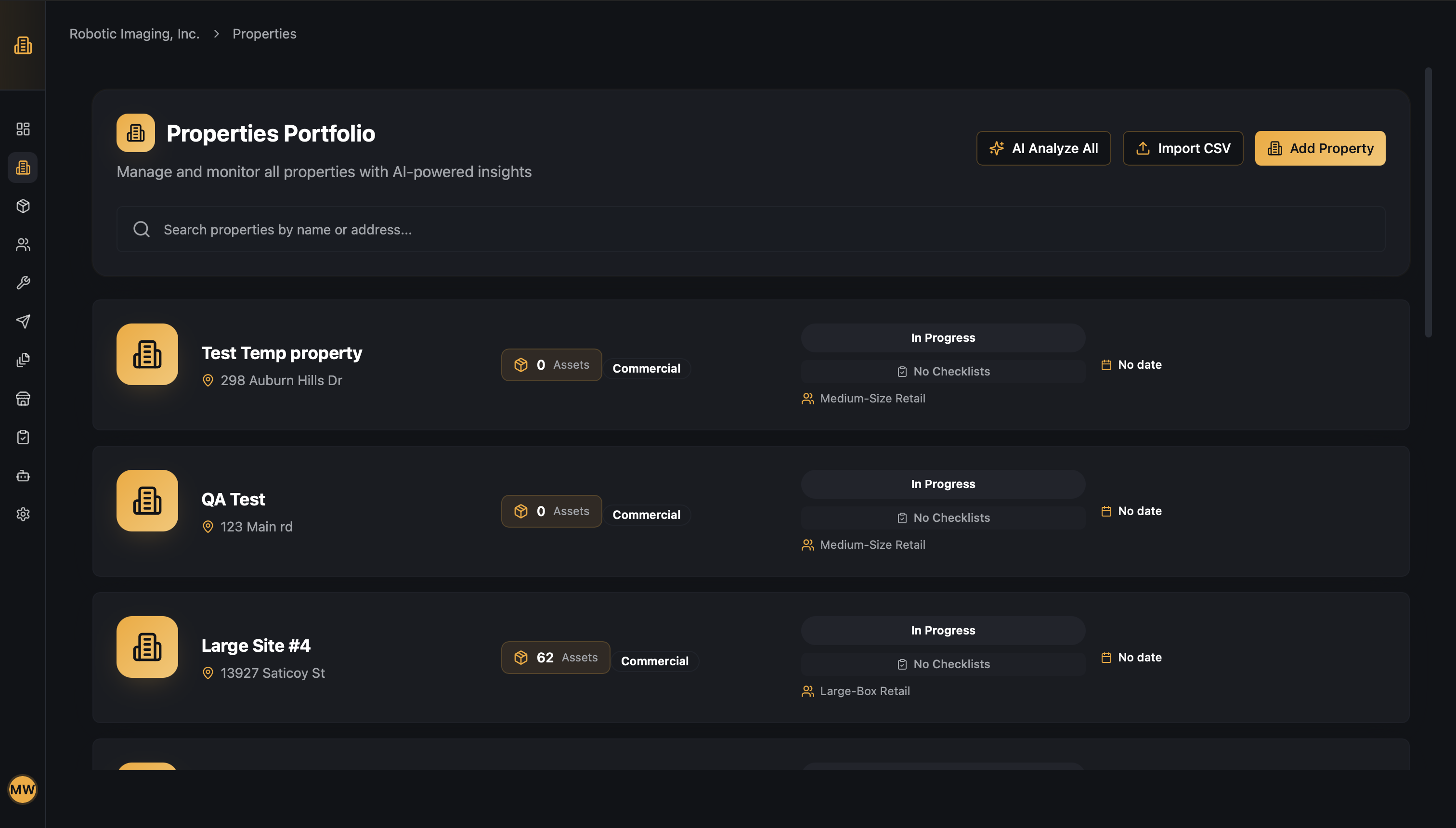
This mobile work order tracking capability supports maintenance coordination across multiple simultaneous service events. On a Monday morning with reactive calls open at seven locations and three technicians in the field, the manager sees exactly which stores are covered, which work orders are progressing, and which have been waiting beyond acceptable response time — all from a single dashboard view rather than seven phone calls.
The escalation workflow operates from the same platform. Work orders that exceed time thresholds trigger manager notifications, enabling proactive reassignment or escalation before a store reports a delayed response. For retail contexts where refrigeration failures have time-sensitive food safety implications and HVAC failures affect store operations and customer experience, real-time status visibility directly reduces the window between problem identification and resolution confirmation.
Field service mobile app deployments at enterprise retail scale validate this capability. Robotic Imaging's platform is deployed across 7-Eleven's 1,000+ store network, coordinating asset documentation and maintenance visibility across a portfolio where multi-technician coordination and real-time status tracking are operational requirements, not convenience features.
Parts Inventory Mobile Tracking
Parts tracking accuracy in mobile maintenance management determines whether billing is defensible, inventory is reliable, and reorder timing is proactive. When parts documentation happens at field completion through the platform rather than from memory at end-of-day, the accuracy difference is material.
Robotic Imaging's parts inventory mobile tracking integrates with work order completion. When a technician logs a service event, parts used are recorded against specific inventory items: part number, description, quantity consumed, and unit cost. The platform updates inventory counts in real time, giving maintenance managers visibility into van inventory levels without requiring technicians to submit separate parts reports.
For retail maintenance portfolios where technicians carry consistent van stock — capacitors, contactors, thermostats, refrigeration fittings — real-time parts depletion tracking enables proactive reorder before a technician runs short on a high-frequency part mid-week. The parts documentation at work order completion also provides the line-item detail required for accurate customer billing, internal cost allocation, and vendor reconciliation.
The billing support function is particularly valuable when maintenance operations bill back to individual store locations or business units. Field-logged parts documentation with timestamps and work order association creates an audit-ready record of every part consumed per location per service event — eliminating the manual reconciliation effort that consumes coordinator time when parts tracking relies on paper records or delayed data entry.
Preventive Maintenance Mobile Execution and Checklist Consistency
Preventive maintenance quality consistency across a distributed technician team is one of the maintenance manager's hardest operational challenges. Senior technicians execute PM protocols from experience; newer technicians may skip steps, abbreviate documentation, or apply inconsistent standards — and the quality difference isn't visible until equipment fails early or an inspection reveals incomplete service records.
Robotic Imaging's preventive maintenance software capability delivers scheduled PM work orders to technician smartphones with associated mobile checklists. Each checklist item requires technician confirmation before the work order can be marked complete, enforcing consistent execution regardless of technician experience level. The checklist structure also provides documentation that specific PM tasks were completed on specific dates — the service history record that supports warranty claims and regulatory compliance.
The scheduled maintenance workflow operates from the same work order platform as reactive calls. Maintenance managers configure PM schedules by equipment type and frequency; the platform generates and assigns PM work orders automatically on schedule, delivers them to technician smartphones with the appropriate checklist, and captures completed checklist responses as part of the service record. Preventive maintenance scheduling and execution exist in the same data environment as reactive work orders — eliminating the split between a separate PM scheduling tool and the work order tracking system.
For retail portfolios where equipment manufacturers require documented PM compliance to maintain warranty coverage, the mobile checklist execution and automatic service record creation provide the documentation trail without additional administrative overhead.
Maintenance Manager Mobile Oversight Across the Portfolio
The full value of a mobile work order platform for maintenance managers is realized at the portfolio level — where individual technician productivity gains aggregate into operational performance improvement across 50, 200, or 500 retail locations. Robotic Imaging's platform provides the oversight layer that connects field execution to manager visibility.
The team performance dashboard surfaces work order completion rates, average response times, and open work order aging across the entire technician team. Maintenance managers identify performance patterns — which locations generate disproportionate reactive volume (indicating deferred PM needs), which technicians are completing more work orders per day (indicating efficiency benchmarks), and which equipment types are generating repeat calls (indicating replacement evaluation triggers) — from aggregated field data rather than CMMS reports manually compiled from delayed data entry.
The equipment maintenance platform also supports the transition from reactive-dominant to preventive-dominant maintenance programs. As AI-populated asset records accumulate service history from field-logged work orders, maintenance managers gain the data foundation to shift PM scheduling from calendar-based to condition-based — extending equipment life and reducing reactive call volume across the portfolio.
Dollar General's planned deployment across 4,000 locations reflects the enterprise retail scale at which this portfolio oversight capability operates — where the maintenance manager's need to coordinate field execution, maintain asset intelligence, and demonstrate portfolio-level performance justifies the mobile maintenance platform investment.
Platform Value for Retail Maintenance Operations
The compounding efficiency gain from eliminating phone dispatch, office data entry, and technician on-site research translates directly to measurable productivity improvement. At 20–30% technician productivity gain across a team of 10 field technicians, the recoverable capacity is equivalent to 2–3 additional technicians without headcount addition — or existing technicians completing 2–3 additional work orders per day.
Beyond technician productivity, the asset documentation capability eliminates the $5K–$15K professional audit fees typically required to build equipment asset records for a new CMMS deployment. Store managers photograph equipment with the self-service app; AI extraction at 85–90% accuracy populates manufacturer, model, and serial number automatically; the maintenance manager gains a current, field-verified equipment asset base without audit engagement or coordinator data entry effort.
For maintenance managers evaluating mobile work order platforms against existing CMMS investments: Robotic Imaging positions as the mobile execution layer and asset intelligence layer that augments existing systems rather than replacing them. Work order integration capability means field-logged service data flows back to the CMMS of record while technicians interact with a native mobile experience designed for field execution.
Ready to eliminate office data entry overhead and give your technicians the field tools that drive 20–30% productivity gains?
- Request a Maintenance Platform Demo — See push notification dispatch, QR equipment access, and real-time tracking for your retail portfolio
- Schedule a Maintenance Operations Briefing — Customized assessment for your technician team size and store count
- Download the Maintenance Manager Platform Guide — Feature-by-feature evaluation framework for mobile CMMS selection
Written by
Robotic Imaging